






GS Group announced executive appointments for 16 affiliates on November 26. Unlike last year, GS Retail conducted minor personnel changes this year. Park Tae-hyun, Head of Convenience Store Support Division, and Bae Jae-seong, Head of Video Production Division, were promoted to Executive Director, while Executive Director Jang Jun-soo moved to GS Networks. Last year saw major personnel changes with Vice President Hur Suh-hong being appointed CEO and vice president promotions in home shopping and supermarket divisions.
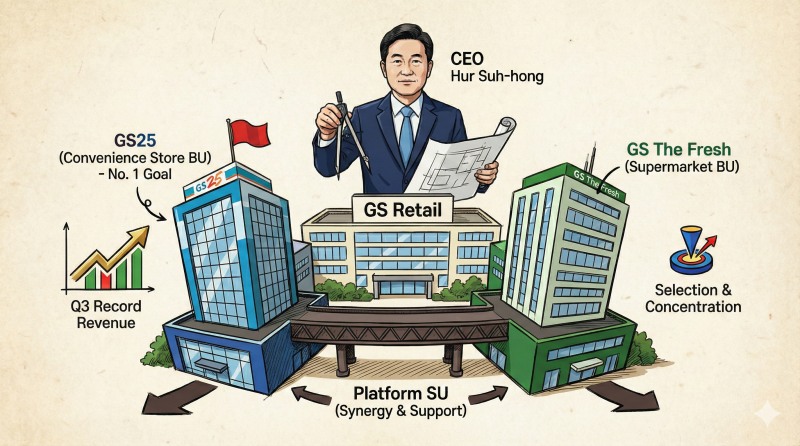
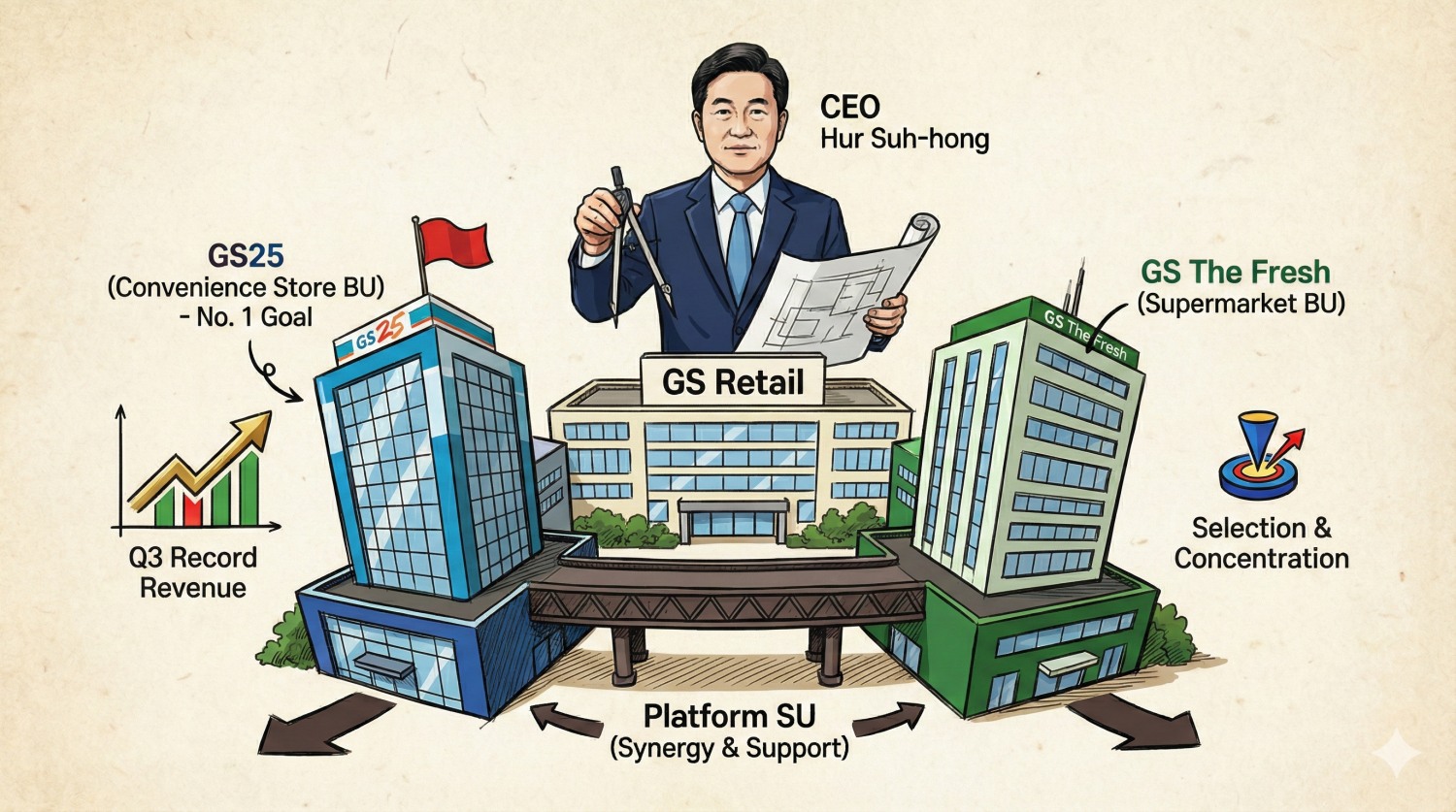
This year's notable point is organizational restructuring. GS Retail reorganized its existing platform and home shopping-centered system into a three Business Unit (BU) system—convenience store, supermarket, and home shopping—plus one Support Unit (SU) system. The key is separating and elevating the convenience store (GS25) and supermarket (GS The Fresh), which had been bundled under one organization, into independent BUs.
Additionally, a Platform SU (Support Unit) was newly established to oversee support functions for convenience stores and supermarkets, including MD, marketing, and store support. Under Platform SU are MD Headquarters, Marketing Division, and O4O Division. GS Retail explained, "(Platform SU) strengthens synergy between convenience store and supermarket businesses and enhances MD expertise." Home Shopping BU also established an 'Integrated Sales Division' to enhance synergy between TV and mobile and strengthen partner product sourcing capabilities.
Hur's system experienced somewhat shaken performance momentum due to poor market conditions in the first half of this year. Particularly in Q2, tension heightened in core businesses as competitor BGF Retail's convenience store CU overtook in sales.
However, the atmosphere reversed from Q3. This is because the 'selection and concentration' strategy pursued since early this year showed visible results. Since taking office, CEO Hur has focused on substance-centered management, including store efficiency and cleanup of struggling subsidiaries (About Pet, Firsf, etc.). By concentrating on successful businesses and boldly eliminating unsuccessful ones, profitability was significantly improved.
As a result, GS Retail recorded its largest quarterly revenue ever in Q3 2025. Consolidated revenue was KRW 3.2054 trillion, up 5.3% year-over-year, and operating profit increased 31.6% to KRW 111.1 billion. Net profit turned to black at KRW 90.3 billion. At the center of this 'surprise performance' was the convenience store, and GS25 recovered its 'revenue number one' position in just one quarter.
Given that CEO Hur went through a turbulent year, some interpret this organizational restructuring as an effort to solidify the convenience store 'number one' position in the core business. The will to establish a complete number one system by narrowing not only revenue but also operating profit gaps is evident.
Currently in the convenience store industry, GS25 is number one in revenue, while CU leads in operating profit and store count. This year's quarterly operating profit gaps narrowed to ▲Q1 KRW 6 billion (GS25 KRW 17.2 billion, CU KRW 23.2 billion) ▲Q2 KRW 1.2 billion (GS25 KRW 59 billion, CU KRW 60.2 billion) but widened again to ▲Q3 KRW 12.6 billion (GS25 KRW 85.1 billion, CU KRW 97.7 billion). This is why next year's strategy becomes even more important.
GS The Fresh's competitiveness is also expected to strengthen through the separated organizational structure. GS Retail, number one in store count, is performing well amid competitor stagnation. It has also raised quick commerce competitiveness through aggressive store openings and entry into three delivery apps. The goal is to open 1,000 stores by 2027.
A GS Retail official said, "This organizational restructuring focused on strengthening business competitiveness in line with changing business environments, including consumption changes due to high prices and exchange rates, intensifying competition among retail formats, and accelerating artificial intelligence (AI) technology development," adding, "Particularly, the BU system conversion centered on core businesses is expected to maximize management efficiency through agile and efficient decision-making."
Park seulgi (seulgi@fntimes.com)











![[THE COMPASS] 한미사이언스 경영권 분쟁, 신동국이 주도하는 ‘종식’ 게임](https://cfnimage.commutil.kr/phpwas/restmb_setimgmake.php?pp=006&w=69&h=45&m=5&simg=20261008122108000710a837df649412411124362.jpg&nmt=18)
![영업익 53% 뛴다는데…대웅제약 몸값 누르는 두 가지 변수 [5대 제약사 3Q 실적 ④]](https://cfnimage.commutil.kr/phpwas/restmb_setimgmake.php?pp=006&w=69&h=45&m=5&simg=202610081106100618007fd637f543112168227135.jpg&nmt=18)


![[그래픽 뉴스] ‘순대’가 경제용어라고? 순(純)대외자산, 한국의 진짜 해외자산은 얼마일까?](https://cfnimage.commutil.kr/phpwas/restmb_setimgmake.php?pp=006&w=298&h=298&m=1&simg=202609021356075202de68fcbb3512411124362_0.jpg&nmt=18)
![[그래픽 뉴스] ISA 대개편! 나에게 유리한 계좌는?](https://cfnimage.commutil.kr/phpwas/restmb_setimgmake.php?pp=006&w=298&h=298&m=1&simg=202608041713155615de68fcbb3512411124362_0.jpg&nmt=18)
![[그래픽 뉴스] 미국 증시 새로운 키워드 'MANGOS'](https://cfnimage.commutil.kr/phpwas/restmb_setimgmake.php?pp=006&w=298&h=298&m=1&simg=202607291740382069de68fcbb3512411124362_0.jpg&nmt=18)

![[그래픽 뉴스] 은퇴후 30년 부모님 세대의 생존전략](https://cfnimage.commutil.kr/phpwas/restmb_setimgmake.php?pp=006&w=298&h=298&m=1&simg=202606301704439153de68fcbb3512411124362_0.jpg&nmt=18)
![[신간]은퇴연옥…김경록의 은퇴 후 삶의 나침반](https://cfnimage.commutil.kr/phpwas/restmb_setimgmake.php?pp=006&w=81&h=123&m=5&simg=20260414140833047280f8caa4a5ce12411124362.jpg&nmt=18)
![[신간] 물처럼 흐르고 원칙으로 서다…김용환의 통찰을 담다](https://cfnimage.commutil.kr/phpwas/restmb_setimgmake.php?pp=006&w=81&h=123&m=5&simg=20260409114249027860f8caa4a5ce12411124362.jpg&nmt=18)
![[안현정 서평] 플랫폼의 영지에서 ‘미학적 주권’을 선포하라...'K가 죽어야 K가 산다' 장준환 著](https://cfnimage.commutil.kr/phpwas/restmb_setimgmake.php?pp=006&w=81&h=123&m=5&simg=20260527121426063220c1c16452b012411124362.jpg&nmt=18)
![[서평] 추세 매매의 대가들...추세추종 투자전략의 대가 14인 인터뷰](https://cfnimage.commutil.kr/phpwas/restmb_setimgmake.php?pp=006&w=81&h=123&m=5&simg=2023102410444004986c1c16452b0175114235199.jpg&nmt=18)


![[머니무브 2026] “지금 사도 될까?” 답이 안 보인다면…하반기 투자, 4명의 전문가에게 물어보세요](https://cfnimage.commutil.kr/phpwas/restmb_setimgmake.php?pp=006&w=89&h=45&m=1&simg=202609151044050355302a735e27af12411124362.jpg&nmt=18)
![[AD] ‘PBV 라인업 확장’ 기아, 9월 독일서 ‘PV7’ 첫 공개](https://cfnimage.commutil.kr/phpwas/restmb_setimgmake.php?pp=006&w=89&h=45&m=1&simg=2026083111010602815074925877361231180222.jpg&nmt=18)
![[AD] 제네시스, 럭셔리 경험 더한 ‘2027 GV70’‧‘GV70 그래파이트’ 출시](https://cfnimage.commutil.kr/phpwas/restmb_setimgmake.php?pp=006&w=89&h=45&m=1&simg=20260702143546085600749258773622211122717.jpg&nmt=18)