






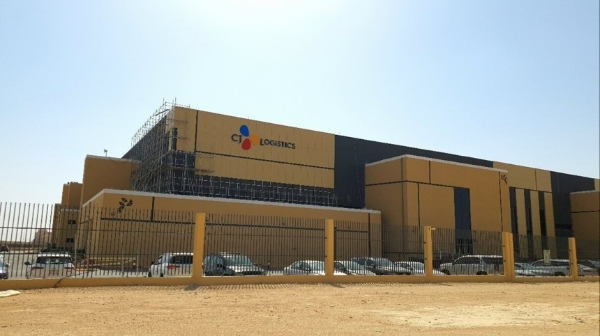
Front view of CJ Logistics' Saudi GDC (GDC·Global Distribution Center) / Photo = CJ Logistics
According to industry sources on the 7th, CJ Logistics recently expanded its 7-day delivery service, “O-NE(Parcel),” to 40 cities and counties and 134 towns and townships nationwide. Previously, in January, the company introduced 7-day delivery in major metropolitan areas and the Seoul Capital Area. The latest expansion includes many towns in Gyeonggi Province—such as Paju, Gimpo, Yeoju, and Icheon—along with residential and agricultural areas like Miryang in Gyeongnam and Iksan in Jeonbuk.
The driving force behind this nationwide expansion is CJ Logistics’ competition with Coupang. Coupang, with 14 million paid members and 21 million users, is Korea’s largest e-commerce company. Having started with direct-purchase “Rocket Delivery” (same-day delivery), Coupang has expanded into the third-party logistics (3PL) market, showing rapid growth. Last year, Coupang’s logistics subsidiary, Coupang Logistics Service (CLS), recorded sales of 3.8349 trillion KRW, a 46.3% increase from the previous year (2.6217 trillion KRW).
During the same period, CJ Logistics’ parcel business revenue remained nearly flat at 3.7289 trillion KRW, compared to the previous year’s 3.7227 trillion KRW, causing it to be overtaken by Coupang in the parcel sector for the first time. According to last year’s business report, CJ Logistics’ domestic parcel market share shrank from 50.1% in 2020 to 43.9% in 2024, dealing a blow to its pride as the country’s top logistics company.
CJ Logistics’ 7-day delivery stems from this sense of urgency. Coupang, with its own delivery network and expansion into the parcel market, is encroaching on even small and medium-sized clients of traditional courier companies. Coupang already offers delivery nationwide 365 days a year, including weekends and holidays. Without a 7-day delivery service, CJ Logistics risks losing clients. However, issues such as overwork and workload imbalance among delivery drivers remain challenges to address. Some drivers have reported concerns about excessive workloads.
CJ Logistics stated, “We are implementing a 5-day workweek for drivers alongside the 7-day delivery, and have reached agreements with agency owners after thorough discussions. The nationwide expansion of 7-day delivery was also introduced after sufficient consultation and preparation since April.”

The photo shows CJ Logistics constructing a logistics center equipped with cold chain capabilities in Gainesville, Georgia, USA. /Photo courtesy of CJ Logistics
As Korea’s largest logistics company, CJ Logistics boasts overwhelming infrastructure: 662 domestic logistics centers, 20,000 delivery drivers, and over 2,000 client companies. Internationally, it operates 279 logistics centers and 462 sites in 47 countries and 289 cities. This global logistics network underpins its push for “cross-border parcel” services.
CJ Logistics now operates GDCs in both Incheon and Riyadh. The company previously partnered with US e-commerce firm iHerb in 2019 to build GDCs. When iHerb ships products from the US, CJ Logistics’ GDC handles logistics for neighboring countries. The Incheon GDC covers Japan and Singapore, while the Saudi GDC manages the Middle East.
The Middle Eastern e-commerce market is expected to grow by double digits annually. Saudi Arabia, with a youthful population—half under 30—has widespread credit card use and rising mobile and internet penetration. The Riyadh GDC spans 18,000 square meters (about 5,500 pyeong) and can process 15,000 parcels per day, also servicing the UAE, Qatar, Kuwait, and other Middle Eastern countries.
CJ Logistics, which has declared a focus on cross-border parcels, is also planning a “North America Project” with the Korea Ocean Business Corporation (KOBC). The plan involves investing about 600 billion KRW to build three large logistics centers in New Jersey and Chicago, targeting completion by 2027. Unlike the Incheon and Riyadh GDCs, these US centers will serve logistics operations throughout the United States. Additionally, CJ Logistics is partnering with global video platform TikTok to help K-brands enter Southeast Asian markets, leveraging over 60 sites in Singapore, Malaysia, and Thailand to provide customized logistics services.
To support these ambitions, CJ Logistics recently appointed Jonathan Song, formerly of US logistics giant Expeditors International, as head of its Global Business Division. The company aims to leverage synergies in the Middle East, US, and India to become a “Top 10” global logistics firm.
CJ Logistics commented, “The Riyadh GDC is now complete and in trial operation, with full-scale operations expected in the second half of this year. We have also established partnerships with major logistics companies in the US, Japan, and Southeast Asia to ensure stable overseas delivery of Korean products to various countries.”
Son Wontae (tellme@fntimes.com)











![교통비 아끼는 '모두의카드'…각양각색 카드사별 혜택은 [알뜰 카드생활]](https://cfnimage.commutil.kr/phpwas/restmb_setimgmake.php?pp=006&w=69&h=45&m=5&simg=202609231950200279409efc5ce4ae12115497227.jpg&nmt=18)


![[그래픽 뉴스] ‘순대’가 경제용어라고? 순(純)대외자산, 한국의 진짜 해외자산은 얼마일까?](https://cfnimage.commutil.kr/phpwas/restmb_setimgmake.php?pp=006&w=298&h=298&m=1&simg=202609021356075202de68fcbb3512411124362_0.jpg&nmt=18)
![[그래픽 뉴스] ISA 대개편! 나에게 유리한 계좌는?](https://cfnimage.commutil.kr/phpwas/restmb_setimgmake.php?pp=006&w=298&h=298&m=1&simg=202608041713155615de68fcbb3512411124362_0.jpg&nmt=18)
![[그래픽 뉴스] 미국 증시 새로운 키워드 'MANGOS'](https://cfnimage.commutil.kr/phpwas/restmb_setimgmake.php?pp=006&w=298&h=298&m=1&simg=202607291740382069de68fcbb3512411124362_0.jpg&nmt=18)

![[그래픽 뉴스] 은퇴후 30년 부모님 세대의 생존전략](https://cfnimage.commutil.kr/phpwas/restmb_setimgmake.php?pp=006&w=298&h=298&m=1&simg=202606301704439153de68fcbb3512411124362_0.jpg&nmt=18)
![[신간]은퇴연옥…김경록의 은퇴 후 삶의 나침반](https://cfnimage.commutil.kr/phpwas/restmb_setimgmake.php?pp=006&w=81&h=123&m=5&simg=20260414140833047280f8caa4a5ce12411124362.jpg&nmt=18)
![[신간] 물처럼 흐르고 원칙으로 서다…김용환의 통찰을 담다](https://cfnimage.commutil.kr/phpwas/restmb_setimgmake.php?pp=006&w=81&h=123&m=5&simg=20260409114249027860f8caa4a5ce12411124362.jpg&nmt=18)
![[안현정 서평] 플랫폼의 영지에서 ‘미학적 주권’을 선포하라...'K가 죽어야 K가 산다' 장준환 著](https://cfnimage.commutil.kr/phpwas/restmb_setimgmake.php?pp=006&w=81&h=123&m=5&simg=20260527121426063220c1c16452b012411124362.jpg&nmt=18)
![[서평] 추세 매매의 대가들...추세추종 투자전략의 대가 14인 인터뷰](https://cfnimage.commutil.kr/phpwas/restmb_setimgmake.php?pp=006&w=81&h=123&m=5&simg=2023102410444004986c1c16452b0175114235199.jpg&nmt=18)


![[머니무브 2026] “지금 사도 될까?” 답이 안 보인다면…하반기 투자, 4명의 전문가에게 물어보세요](https://cfnimage.commutil.kr/phpwas/restmb_setimgmake.php?pp=006&w=89&h=45&m=1&simg=202609151044050355302a735e27af12411124362.jpg&nmt=18)
![[AD] ‘PBV 라인업 확장’ 기아, 9월 독일서 ‘PV7’ 첫 공개](https://cfnimage.commutil.kr/phpwas/restmb_setimgmake.php?pp=006&w=89&h=45&m=1&simg=2026083111010602815074925877361231180222.jpg&nmt=18)
![[AD] 제네시스, 럭셔리 경험 더한 ‘2027 GV70’‧‘GV70 그래파이트’ 출시](https://cfnimage.commutil.kr/phpwas/restmb_setimgmake.php?pp=006&w=89&h=45&m=1&simg=20260702143546085600749258773622211122717.jpg&nmt=18)
![[AD] 개소세 혜택 종료…현대차, ‘썸머 페스타’로 고객 부담 완화](https://cfnimage.commutil.kr/phpwas/restmb_setimgmake.php?pp=006&w=89&h=45&m=1&simg=20260702142355004830749258773622211122717.jpg&nmt=18)