






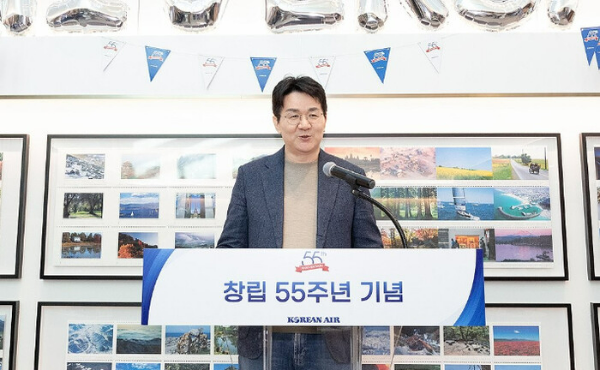
Cho Won-tae, Korean Air Chairman / Photo=Korean Air
According to Korean Air on the 4th, Cho addressed Asiana Airlines employees last month, stating, “The integration of our airlines is not about one company absorbing another. Rather, it will be a natural process of blending into one another. I do not want to see Asiana’s unique culture and assets disappear.”
He further introduced himself as "Asiana Airlines Chairman Cho Won-tae" and outlined the vision for the unified airline in two years. “Being referred to as the chairman of Asiana Airlines is merely a title, but the weight of responsibility feels heavier than anything else,” he said.
Cho also reassured employees about fair opportunities post-merger, stating, “Everyone will be fairly compensated based on their ability and effort throughout the integration process and beyond. No hardworking employee will be left behind.”
This marked the first time Cho directly addressed Asiana employees, emphasizing unity and inclusivity. His leadership approach appears aimed at easing concerns among employees unsettled by the structural changes within the company.
At the beginning of his message, Cho underscored the importance of integration, stating, “As the chairman of both Korean Air and Asiana Airlines, I see all employees from both companies as one family.”
Korean Air initiated the acquisition of Asiana Airlines in November 2020, undergoing a rigorous four-year antitrust review by 14 regulatory bodies, including Turkey, Taiwan, Thailand, the Philippines, Malaysia, Vietnam, South Korea, Singapore, Australia, China, the UK, Japan, the EU, and the US. In December 2024, Korean Air acquired 131.57 million newly issued shares of Asiana Airlines, securing a 63.88% stake. The acquisition cost totaled approximately KRW 1.5 trillion, with Korean Air planning to use these funds to reduce Asiana’s debt burden, which stood at a staggering 1,847% debt-to-equity ratio as of Q3 2024.
After completing the physical merger of Korean Air and Asiana Airlines, Cho is in a hurry to complete the chemical fusion. His first step was to board an Asiana Airlines flight just after the New Year. On January 10, he flew from Incheon International Airport to Los Angeles on an Asiana aircraft, a move interpreted as a gesture to personally experience the airline’s in-flight services following the merger. It was his first time flying on an Asiana plane.
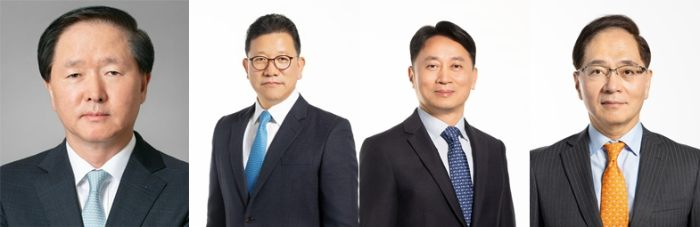
Hanjin Group's regular executive changes. From left, Korean Air Vice Chairman Woo Kee-hong, Asiana Airlines Vice President Song Bo-young, Air Busan CEO Jung Byung-sub, and Air Seoul CEO Kim Joong-ho. /Photo=Hanjin Group
이미지 확대보기
Cho has since made regular executive changes at Asiana, led by a shakeup of the airline's management team. In the first post-merger shakeup, Korean Air revived its vice chairman position after a six-year absence, while Asiana and its low-cost carrier (LCC) subsidiary, Air Busan and Air Seoul, underwent significant leadership changes.
First, Korean Air’s President Woo Kee-hong, who played a pivotal role in securing the merger, was promoted to vice chairman. Woo, born in 1962, graduated from Seoul National University’s business school and joined Korean Air’s planning and management division in 1987. He has held Korean Air’s key positions, including head of North America operations, head of passenger business, and head of corporate strategy. In 2017, he was appointed CEO of Korean Air by the late former chairman Cho Yang-ho. Woo is credited with successfully restructuring Korean Air’s operations during the COVID-19 pandemic and leading the Asiana merger process.
Leadership changes also took place at Asiana Airlines and its LCC subsidiaries. Korean Air’s Executive Director Song Bo-young was appointed CEO of Asiana Airlines, replacing Won Yoo-seok, who had led the airline for the past two years. Song, born in 1965, is a graduate of Korea University with a degree in business administration and joined Korean Air in 1988. He has served as head of Southeast Asia operations, North America operations, and passenger business before being promoted to CEO.
Air Busan’s new CEO is Jung Byung-sub, a former Managing Director at Korean Air’s passenger sales division. Jung, born in 1967, graduated from Korea University with a degree in business administration and joined Korean Air in 1991. He has held key roles in passenger route sales, Washington and East Coast operations, and scheduling management. Similarly, Air Seoul’s new CEO is Kim Joong-ho, a former senior general manager at Korean Air. Kim, born in 1966, graduated from Yonsei University with a degree in economics and joined Korean Air in 1991. At Korean Air, he held positions in the Passenger Marketing Department, Passenger Route Sales Department, Fukuoka Branch Manager, Osaka Branch Manager, and Jeju Branch Manager.
Chairman Cho Won-tae promoted 18 executives in this restructuring, including Vice Chairman Woo Kee-hong. It is a commitment to raise Korean Air's profile in time for the launch of the integrated airline in October 2026, and to instill Korean Air DNA in its subsidiary Asiana Airlines and grandchild Air Busan-Air Seoul. Furthermore, last month, we also provided merger incentives to employees of Korean Air and Asiana Airlines. It was a 50% bonus, split equally between the two companies.
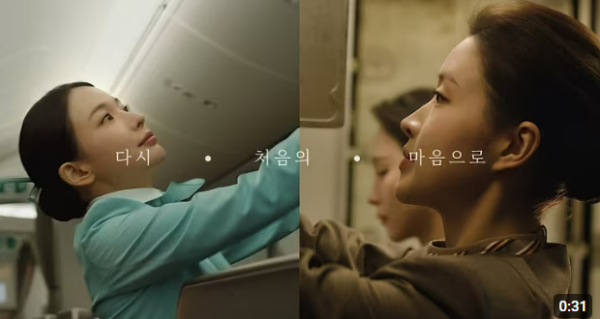
Korean Air's new ad campaign / Photo captured from Korean Air YouTube
A new advertising campaign is also in the works. With the phrase, "Back to the Beginning", the campaign promotes the corporate union between Korean Air and Asiana Airlines. The exchange will start with cabin crew exchanges between the two companies and expand to include management and maintenance positions. Within two years, the merged airline will be rebranded under the singular name "Korean Air."
In 2023, Korean Air reported annual revenue of KRW 16.1 trillion, while Asiana Airlines recorded KRW 7.6 trillion. Their LCC subsidiaries—Jin Air, Air Busan, and Air Seoul—posted revenues of KRW 1.2772 trillion, KRW 890.4 billion, and KRW 310.9 billion, respectively. The combined total revenue exceeds KRW 25 trillion. In 2024, cumulative revenue through the 3rd quarter is KRW 13.369 trillion for Korean Air, KRW 6.2015 trillion for Asiana Airlines, KRW 1.103 trillion for Jin Air, KRW 757.8 billion for Air Busan, and about KRW 250 billion for Air Seoul. Projections for 2024 indicate a potential annual revenue of KRW 27-28 trillion.
As of late 2024, the newly merged airline operates 306 aircraft, including 165 from Korean Air (142 passenger planes and 23 cargo planes), 83 from Asiana Airlines (70 passenger planes and 13 cargo planes), 31 from Jin Air, 21 from Air Busan, and 6 from Air Seoul, solidifying its position as a top-10 global "mega carrier."
However, recent incidents pose challenges for the integration. On January 29, an Air Busan aircraft caught fire while preparing for takeoff at Gimhae Airport. Air Busan flight BX391, bound for Hong Kong with 176 passengers and crew onboard, experienced an internal fire near the tail section. Fortunately, all passengers evacuated safely via emergency slides, but the incident raised concerns about LCC safety, particularly in the wake of a tragic Jeju Air accident in late 2024 that claimed 179 lives. Korean Air has since dispatched safety and maintenance executives to investigate the cause of the incident and deployed emergency replacement flights for affected routes.
Another challenge is the conflict with the Busan city government, which holds a 16% stake in Air Busan. Air Busan was founded in 2007 as a joint venture between Asiana Airlines, the city of Busan, and Busan businesses. The city fears losing its regional airline identity if Air Busan is absorbed into the unified LCC. In response, Busan officials are pushing for a separate sale of Air Busan. Korean Air is currently preparing to launch an integrated LCC of Air Busan and Air Seoul, centered on Jin Air.
Son Wontae (tellme@fntimes.com)











![[머니무브 2026]“무엇을 살까”보다 “무엇을 볼까”…4인의 전문가가 짚은 하반기 투자 키워드](https://cfnimage.commutil.kr/phpwas/restmb_setimgmake.php?pp=006&w=69&h=45&m=5&simg=20260911155001002480c1c16452b012411124362.jpg&nmt=18)

![[DCM] 대한전선, 실적 개선에도 CAPEX 發 재무부담 과제](https://cfnimage.commutil.kr/phpwas/restmb_setimgmake.php?pp=006&w=69&h=45&m=5&simg=20260911110319021460141825007d12411124362.jpg&nmt=18)

![송파구 '극동' 46평, 10.7억 떨어진 12.8억원에 거래 [일일 하락가]](https://cfnimage.commutil.kr/phpwas/restmb_setimgmake.php?pp=006&w=69&h=45&m=5&simg=20260727083903035290b372994c951245313551.jpg&nmt=18)


![[그래픽 뉴스] ‘순대’가 경제용어라고? 순(純)대외자산, 한국의 진짜 해외자산은 얼마일까?](https://cfnimage.commutil.kr/phpwas/restmb_setimgmake.php?pp=006&w=298&h=298&m=1&simg=202609021356075202de68fcbb3512411124362_0.jpg&nmt=18)
![[그래픽 뉴스] ISA 대개편! 나에게 유리한 계좌는?](https://cfnimage.commutil.kr/phpwas/restmb_setimgmake.php?pp=006&w=298&h=298&m=1&simg=202608041713155615de68fcbb3512411124362_0.jpg&nmt=18)
![[그래픽 뉴스] 미국 증시 새로운 키워드 'MANGOS'](https://cfnimage.commutil.kr/phpwas/restmb_setimgmake.php?pp=006&w=298&h=298&m=1&simg=202607291740382069de68fcbb3512411124362_0.jpg&nmt=18)

![[그래픽 뉴스] 은퇴후 30년 부모님 세대의 생존전략](https://cfnimage.commutil.kr/phpwas/restmb_setimgmake.php?pp=006&w=298&h=298&m=1&simg=202606301704439153de68fcbb3512411124362_0.jpg&nmt=18)
![[신간]은퇴연옥…김경록의 은퇴 후 삶의 나침반](https://cfnimage.commutil.kr/phpwas/restmb_setimgmake.php?pp=006&w=81&h=123&m=5&simg=20260414140833047280f8caa4a5ce12411124362.jpg&nmt=18)
![[신간] 물처럼 흐르고 원칙으로 서다…김용환의 통찰을 담다](https://cfnimage.commutil.kr/phpwas/restmb_setimgmake.php?pp=006&w=81&h=123&m=5&simg=20260409114249027860f8caa4a5ce12411124362.jpg&nmt=18)
![[안현정 서평] 플랫폼의 영지에서 ‘미학적 주권’을 선포하라...'K가 죽어야 K가 산다' 장준환 著](https://cfnimage.commutil.kr/phpwas/restmb_setimgmake.php?pp=006&w=81&h=123&m=5&simg=20260527121426063220c1c16452b012411124362.jpg&nmt=18)
![[서평] 추세 매매의 대가들...추세추종 투자전략의 대가 14인 인터뷰](https://cfnimage.commutil.kr/phpwas/restmb_setimgmake.php?pp=006&w=81&h=123&m=5&simg=2023102410444004986c1c16452b0175114235199.jpg&nmt=18)


![[AD] ‘PBV 라인업 확장’ 기아, 9월 독일서 ‘PV7’ 첫 공개](https://cfnimage.commutil.kr/phpwas/restmb_setimgmake.php?pp=006&w=89&h=45&m=1&simg=2026083111010602815074925877361231180222.jpg&nmt=18)
![[AD] 제네시스, 럭셔리 경험 더한 ‘2027 GV70’‧‘GV70 그래파이트’ 출시](https://cfnimage.commutil.kr/phpwas/restmb_setimgmake.php?pp=006&w=89&h=45&m=1&simg=20260702143546085600749258773622211122717.jpg&nmt=18)
![[AD] 개소세 혜택 종료…현대차, ‘썸머 페스타’로 고객 부담 완화](https://cfnimage.commutil.kr/phpwas/restmb_setimgmake.php?pp=006&w=89&h=45&m=1&simg=20260702142355004830749258773622211122717.jpg&nmt=18)
![[AD] 기아 ‘디 올 뉴 셀토스’, 인도 타임스 드라이브 어워즈서 ‘올해의 SUV’ 선정](https://cfnimage.commutil.kr/phpwas/restmb_setimgmake.php?pp=006&w=89&h=45&m=1&simg=202605071156400590007492587736124111243152.jpg&nmt=18)
![[AD]‘그랜저 잡자’ 기아, 상품성 더한 ‘The 2027 K8’ 출시](https://cfnimage.commutil.kr/phpwas/restmb_setimgmake.php?pp=006&w=89&h=45&m=1&simg=2026042110193702730074925877361211627527.jpg&nmt=18)