





Chunmoo moves from truck to container, and out to sea
Hanwha Aerospace and its U.S. subsidiary Hanwha Defense USA (HDUSA) said on Nov. 10 that they will conduct two Chunmoo guided missile firing tests from a vessel off the southern coast of the United States this month.Chunmoo is a surface-to-surface weapon system, fired from the ground at ground targets. The tests are an attempt to broaden its use so that it can also be operated from ships at sea.
The key is the container. The launcher is built in the form of a cargo container and placed on the deck of a vessel. At last month’s Association of the United States Army (AUSA) exhibition, HDUSA unveiled a 20-foot container-type Chunmoo. It uses the same missiles and launching mechanism as the vehicle-mounted version. A container-type vertical launching system, the K-VLS, was also displayed at the show.
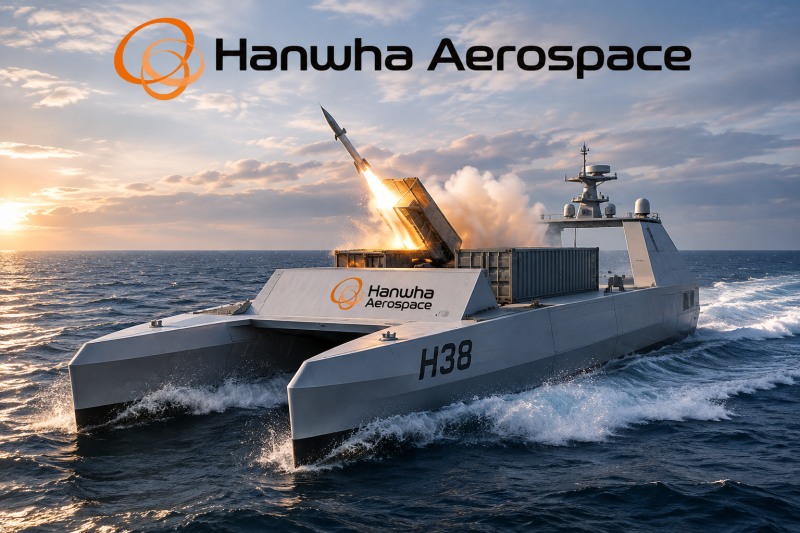
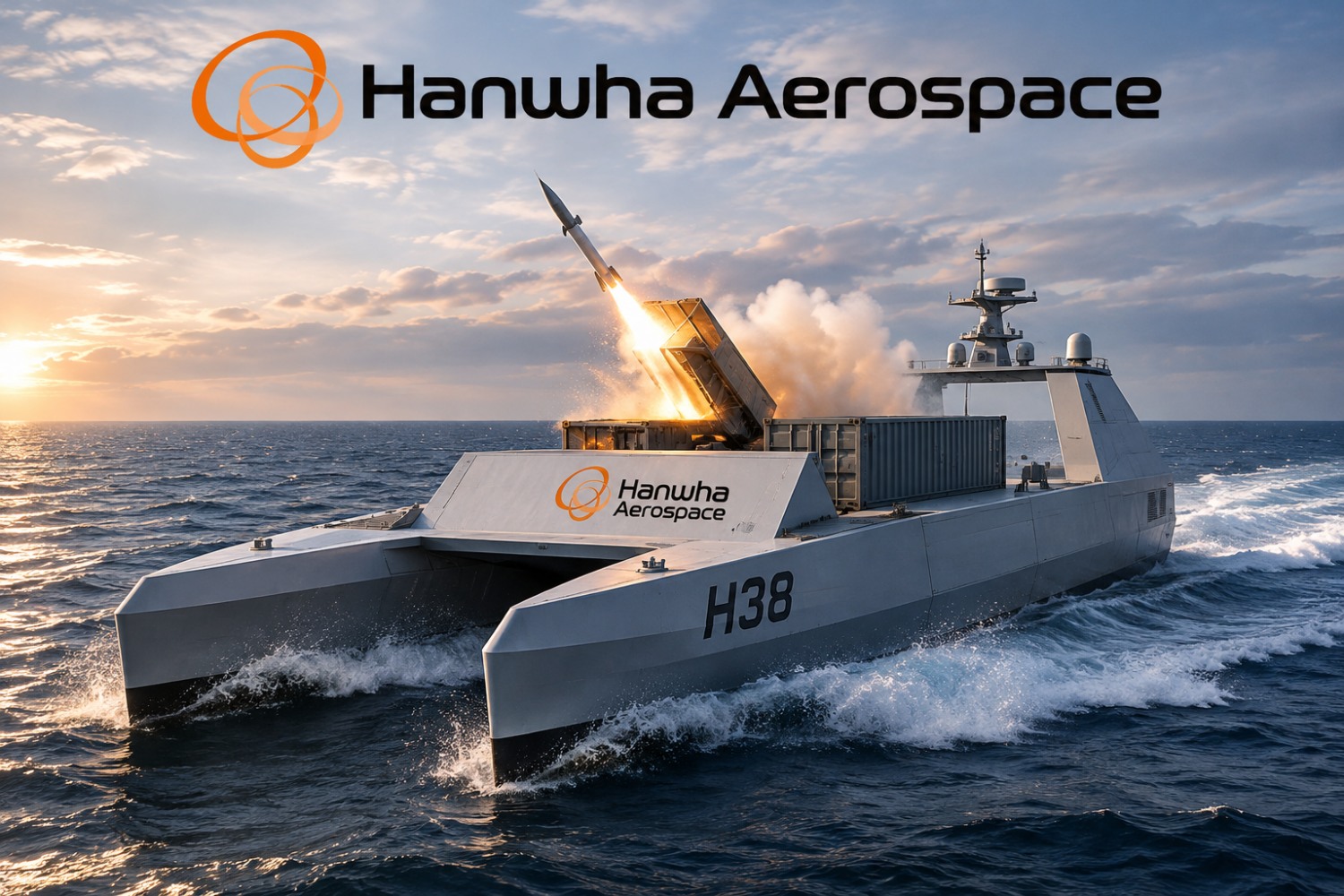
A model that places the container-type Chunmoo on an unmanned vessel had already been shown at a European exhibition. In June, at the Eurosatory defense exhibition, Hanwha Aerospace unveiled a model carrying the container-type Chunmoo on the Striker-S, a 35-meter, 250-ton unmanned vessel.
Unlike on land, ships rock with the waves, so securing launch stability that accounts for wave action and vessel movement is critical in maritime firing. That is why sea-based firing tests are necessary.
The vessel on which Hanwha wants to mount Chunmoo is a medium unmanned surface vessel (MUSV). In April, HDUSA signed a memorandum of understanding (MOU) with U.S. MUSV maker Magnet Defense to jointly develop the 38-meter H38. The H38 is being developed on the basis of Magnet Defense’s flagship M48 model, and Hanwha is pushing to apply a container-mounted Chunmoo launcher to it.
In 2024, the M48 completed a round trip of 32,000 nautical miles (about 59,000 km) on autonomous navigation, departing from Miami, U.S., and passing through the Panama Canal. Under the arrangement, Magnet Defense handles navigation technology, while Hanwha is responsible for manufacturing capabilities and the missile system. According to Magnet Defense, the H38 can sail 17,000 nautical miles, and its flat deck allows it to carry a variety of equipment.
Hanwha’s Three Defense Units Split Roles After Reshuffle: Localization, Space·AI and North AmericaHanwha Aerospace's New Playbook: Pairing Weapons Deals with Energy SupplyHanwha Aerospace Secures KRW 3 Trillion Operating Profit, Targets 25% Annual Growth Through 2030Hanwha Systems Raises KRW 3.4 Trillion as It Winds Down ‘Bridge’ Role in Hanwha Ocean DealHanwha Aerospace Stock Surges 3,500% in Six Years on 'Extraordinary Strength' [KFT Topic]
Rapidly growing U.S. Navy demand… a $6.2 billion market opens
Hanwha is investing in unmanned vessels because demand from the U.S. Navy is growing.In March, the U.S. Navy introduced the “MUSV Marketplace” to quickly purchase ready-to-use unmanned surface vessels. The amount to be spent on MUSVs over the coming defense planning period is about $6.2 billion. The initial purchase target was put at about 30 vessels.
However, it is still too early to say that Hanwha has fully entered this market. Neither Hanwha nor Magnet Defense was among the seven companies the U.S. Navy picked in May for its first at-sea demonstration. The H38 has also yet to secure a U.S. Navy mass-production contract.
That makes it important to show the system actually firing. The H38 is being developed so that its payload can be swapped according to missions such as electronic warfare, communications and strike. The Chunmoo firing test relates to the strike mission among them.
After Philly, Austal… widening the places to build ships
Along with weapons, Hanwha is adding shipyards.Last month, HDUSA was selected as the first builder for the U.S. Navy and Marine Corps’ Landing Ship Medium (LSM) program, and signed a contract with Tote Services, which manages the program, to build one vessel. The contract is worth $269 million. The LSM is a warship that carries Marine Corps troops, equipment and supplies.
The win came two years after Hanwha acquired Philly Shipyard in the United States in 2024, and is HDUSA’s first U.S. Navy ship construction contract. The vessel will be built at Philly Shipyard, and the contract includes an option to order three additional ships. Tote Services cited price competitiveness and acceptance of contract terms as reasons for the selection. The U.S. Navy and Marine Corps plan to build a fleet of 35 LSMs. HDUSA is also moving to acquire a 60% stake in Philly Shipyard through a joint venture established with Hanwha Future Proof.
The next target is Austal USA, which has a shipyard in Mobile, Alabama. It is the U.S. arm of Australian shipbuilder and defense contractor Austal, and builds U.S. Navy vessels and modules for nuclear-powered submarines. In August, HDUSA made a non-binding offer valuing the company at $1.05 billion to $1.2 billion. The offer covers Austal’s entire U.S. business, excluding its operations in Australia, the Philippines and Vietnam.
Austal USA has about 3,500 employees and an order backlog of $10 billion. It has delivered 34 vessels to the U.S. Navy to date. If the acquisition succeeds, Hanwha’s U.S. shipbuilding bases will increase to two, adding to Philly Shipyard, which has mainly operated around commercial vessels.
Hurdles remain, however. In a disclosure last month, Austal said the main issues in due diligence had been settled, but it extended the due diligence period because additional lower-priority information requests remain. Negotiations with Hanwha on the terms of the deal have begun.
Austal USA posted an operating loss of A$202.8 million for the fiscal year ended June 2026, swinging to a loss from a profit of A$97.7 million a year earlier. The main cause was non-cash provisions built up on U.S. naval vessel contracts. Because it builds U.S. Navy vessels, a deal would also need to clear a U.S. government national security review.
A Hanwha Aerospace official said, “As confirmed in Austal’s disclosure in Australia, the main due diligence has been completed and we are negotiating the key terms of the contract.” The official added, “We will respond actively to U.S. defense demand and build an integrated solution that covers not only manned-unmanned vessel packages but also ground defense such as self-propelled howitzers and ammunition.”
Jung Jina (urzinnie@fntimes.com)