






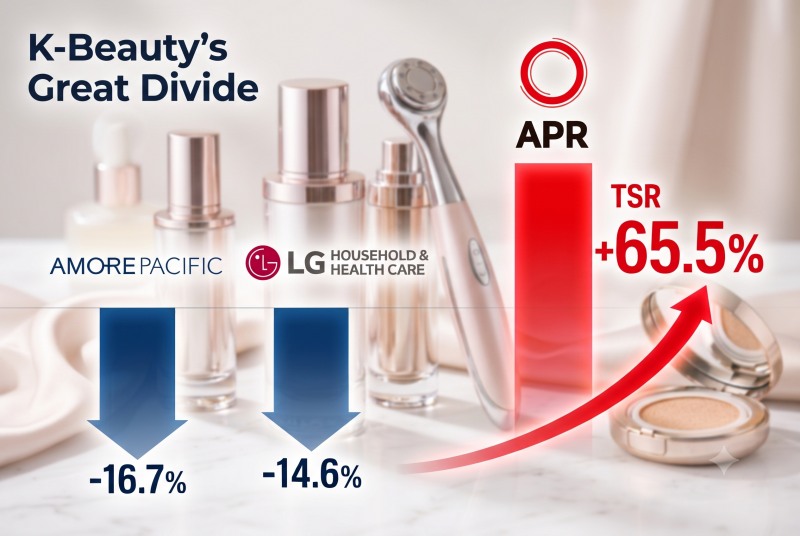
This infographic, originally published by Korea Financial Times, has been reconstructed using generative AI.
이미지 확대보기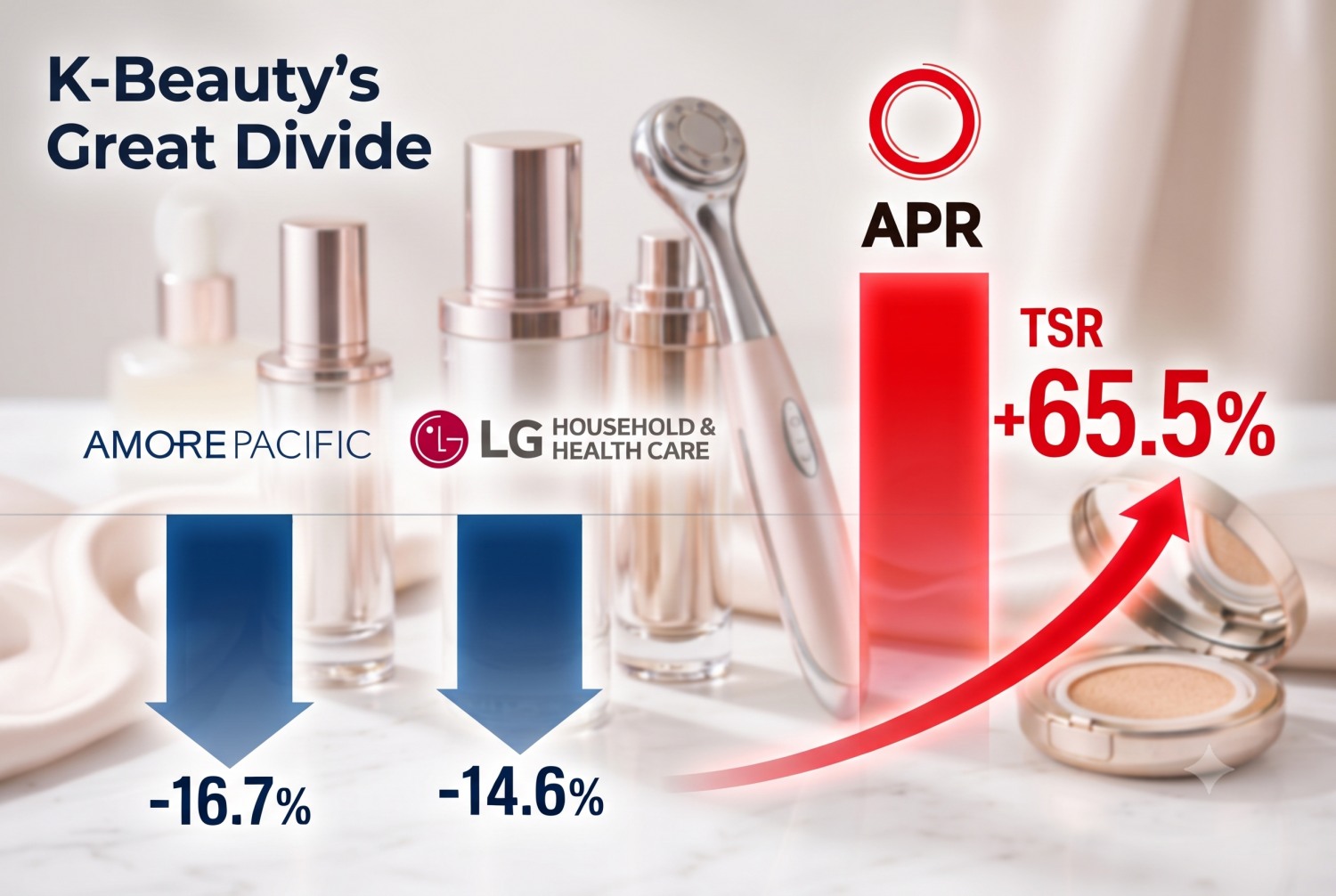
Unlike the traditional cosmetics makers, which struggled to win back market confidence despite improved earnings, APR pulled ahead in the shareholder-value race as steep growth combined with expectations for overseas expansion.
According to a disclosure by the Financial Supervisory Service on the 30th, APR's TSR for the first half of this year came to 65.5%. Over the same period, Amorepacific posted -16.7% and LG H&H posted -14.6%.
While major beauty companies generally showed improved earnings in the second quarter, shareholder outcomes — combining share price performance and dividends — diverged sharply. TSR is a metric that combines share price changes and dividends to show the total return shareholders earned over a given period.
APR's Solo Run at 65.5% — Growth Potential Drives the Share Price
APR's disclosed TSR for the period from January 2 to June 30 this year was 65.5%. In other words, someone who invested KRW 10 million in APR at the start of the year would have seen that investment's value grow to KRW 16.55 million by the end of June. The rise in share price was the main driver — APR's stock jumped 65.5% this year, from KRW 233,000 (closing price) on January 2 to KRW 385,500 on June 30.APR's high TSR is interpreted as reflecting not just current earnings but market expectations for future growth, now priced into the stock.
APR's revenue for the first half of this year came to KRW 1.3609 trillion, up 129% from the same period last year. Operating profit also rose 150% to KRW 342.8 billion. The cosmetics and beauty division sustained high growth by expanding across regions, distribution channels and product lines, while the beauty device division also supported strong results on the back of steady demand worldwide.
The market is focused on APR's ability to expand the success formula it has proven in North America into other regions, including Europe. In the second quarter this year, APR's overseas revenue reached KRW 767.5 billion, up 134.2% year-on-year, and the share of overseas sales in total revenue expanded from 77% to 92%. Analysts note that with Europe still in the early stages of market entry and the company also expanding into the Middle East and Latin America, there is significant room for further growth.
Han Yu-jeong, an analyst at Hanwha Investment & Securities, said, "Rather than focusing on the near-term burden of rising costs, attention should be paid to the fact that the company's expansion into new countries is proceeding more smoothly and rapidly than expected." She added, "Hit products and operating methods proven in the U.S. are quickly being transferred to Europe, and since Europe is still in the early stage of expansion centered on five major countries, there remains considerable room for further growth."
Kim Myung-ju, an analyst at Korea Investment & Securities, said, "APR, which is building brand awareness faster than any other Korean brand globally, not just in the U.S., currently has the cheapest valuation among Korean brand companies."
LG H&H and Amorepacific Fail to Meet Growth Expectations — Both Post Negative TSR
Both Amorepacific and LG H&H posted negative TSR for the first half of this year. Operating profit rose at both companies during the period, but that was not enough to prevent their share prices from falling. This is interpreted as a result of the two companies failing to meet the market's expectations for future growth, even as earnings recovered.According to the disclosures, Amorepacific's first-half TSR was -16.7%, while LG H&H's was -14.6%. Assuming an investment of KRW 10 million in each company on January 2 this year, the combined value of share price and dividends by the end of June would have shrunk to about KRW 8.33 million for Amorepacific and KRW 8.54 million for LG H&H.
Amorepacific's consolidated revenue for the first half of this year came to KRW 2.3117 trillion, up 11.5% from the same period last year. Operating profit also rose 27.5% to KRW 244 billion, with both top-line and profitability improving.
Even so, the earnings recovery alone was not enough to lift the share price. While its businesses in the Americas and EMEA (Europe, the Middle East and Africa) grew, first-quarter revenue in Greater China fell 13.5% year-on-year, and investment to expand its brand and product lineup in Western markets weighed on profits. Analysts say a clear rebound at Cosrx and further proof of performance from next-generation global brands such as Aestura still need to be confirmed.
NH Investment & Securities noted in June that despite stable earnings, Amorepacific's 12-month forward price-to-earnings ratio (PER) had fallen to 16.6 times, adding that a meaningful share price rebound would depend on the performance of new growth brands in Western e-commerce channels.
Amorepacific's share price fell 16.7% this year, from KRW 126,900 on January 2 to KRW 105,700 on June 30.
LG H&H's first-half TSR of -14.6% was 2.1 percentage points higher than Amorepacific's. This appears to reflect the year-end dividend paid in April, which partially offset the share price decline, along with the relative defensive strength of its household goods and beverage businesses. However, given the narrow gap between the two companies' TSR figures, it is difficult to say LG H&H was clearly assessed more favorably by the market.
LG H&H's revenue for the first half of this year came to KRW 3.234 trillion, down 2.1% from the same period last year, while operating profit rose 6.8% to KRW 210.6 billion, an improvement in profitability. In the first quarter, revenue and operating profit fell 7.1% and 24.3% respectively amid the restructuring of domestic distribution channels and weakness in China and Japan, but North American revenue rose 35%, driven by growth at key brands such as Dr. Groot.
Market observers point to lowered earnings expectations and the potential for recovery following business restructuring — rather than high growth expectations — as the reason LG H&H's share price decline was relatively limited. With 2025 operating profit down 62.8% from the previous year, growth in the North American business and the possibility of normalization in the cosmetics division are seen as having limited further downside.
Indeed, Kwon Woo-jung, an analyst at Kyobo Securities, lowered LG H&H's target price from KRW 370,000 to KRW 280,000 in February and gave a "neutral" investment rating, citing the significant time needed for earnings to improve even as intensive restructuring centered on the cosmetics business continues.
However, second-quarter results showed clear growth momentum in the North American business. LG H&H's overseas revenue in the second quarter this year came to KRW 584.5 billion, up 12.6% year-on-year, of which North American revenue rose 47.3% to KRW 205.8 billion. The company recently sold its U.S. cosmetics subsidiary, The Avon Company, and shifted the focus of its North American business toward K-beauty and wellness brands built on retail and digital channels. Since the second-quarter results and the Avon sale were disclosed after the period used to calculate first-half TSR, they are expected to be new variables shaping future market assessment.
LG H&H's share price fell 15% this year, from KRW 270,000 on January 2 to KRW 229,500 on June 30.
An industry official said, "Amorepacific maintains an edge within the sector on profitability metrics, but its growth rate is falling short of market expectations. To achieve a share price re-rating, it needs to show growth momentum in line with the industry average, centered on its overseas business." The official added, "For LG H&H as well, how quickly top-line growth recovers after the business restructuring — rather than current profitability — will be the key factor in market assessment."
Park seulgi (seulgi@fntimes.com)












![[현장] ‘1만원 에어프라이어’ 실화?…다이소 잡으러 나선 이마트 ‘와우샵’](https://cfnimage.commutil.kr/phpwas/restmb_setimgmake.php?pp=006&w=69&h=45&m=5&simg=20261022144754079030b5b890e35c211234199164.jpg&nmt=18)
![서초구 '래미안원베일리' 41평, 14.5억 오른 120억원에 거래 [일일 신고가]](https://cfnimage.commutil.kr/phpwas/restmb_setimgmake.php?pp=006&w=69&h=45&m=5&simg=20260624115142011110dd55077bc212411124362.jpg&nmt=18)

![[DQN] 이호성號 하나은행, 적립금 증가율 18.24%···5대 은행 '최고' [2026 3분기 퇴직연금랭킹]](https://cfnimage.commutil.kr/phpwas/restmb_setimgmake.php?pp=006&w=69&h=45&m=5&simg=20261022050626071200b4a7c6999c121131189150.jpg&nmt=18)


![[그래픽 뉴스] ‘순대’가 경제용어라고? 순(純)대외자산, 한국의 진짜 해외자산은 얼마일까?](https://cfnimage.commutil.kr/phpwas/restmb_setimgmake.php?pp=006&w=298&h=298&m=1&simg=202609021356075202de68fcbb3512411124362_0.jpg&nmt=18)
![[그래픽 뉴스] ISA 대개편! 나에게 유리한 계좌는?](https://cfnimage.commutil.kr/phpwas/restmb_setimgmake.php?pp=006&w=298&h=298&m=1&simg=202608041713155615de68fcbb3512411124362_0.jpg&nmt=18)
![[그래픽 뉴스] 미국 증시 새로운 키워드 'MANGOS'](https://cfnimage.commutil.kr/phpwas/restmb_setimgmake.php?pp=006&w=298&h=298&m=1&simg=202607291740382069de68fcbb3512411124362_0.jpg&nmt=18)

![[그래픽 뉴스] 은퇴후 30년 부모님 세대의 생존전략](https://cfnimage.commutil.kr/phpwas/restmb_setimgmake.php?pp=006&w=298&h=298&m=1&simg=202606301704439153de68fcbb3512411124362_0.jpg&nmt=18)
![[신간]은퇴연옥…김경록의 은퇴 후 삶의 나침반](https://cfnimage.commutil.kr/phpwas/restmb_setimgmake.php?pp=006&w=81&h=123&m=5&simg=20260414140833047280f8caa4a5ce12411124362.jpg&nmt=18)
![[신간] 물처럼 흐르고 원칙으로 서다…김용환의 통찰을 담다](https://cfnimage.commutil.kr/phpwas/restmb_setimgmake.php?pp=006&w=81&h=123&m=5&simg=20260409114249027860f8caa4a5ce12411124362.jpg&nmt=18)
![[안현정 서평] 플랫폼의 영지에서 ‘미학적 주권’을 선포하라...'K가 죽어야 K가 산다' 장준환 著](https://cfnimage.commutil.kr/phpwas/restmb_setimgmake.php?pp=006&w=81&h=123&m=5&simg=20260527121426063220c1c16452b012411124362.jpg&nmt=18)
![[서평] 추세 매매의 대가들...추세추종 투자전략의 대가 14인 인터뷰](https://cfnimage.commutil.kr/phpwas/restmb_setimgmake.php?pp=006&w=81&h=123&m=5&simg=2023102410444004986c1c16452b0175114235199.jpg&nmt=18)


![[머니무브 2026] “지금 사도 될까?” 답이 안 보인다면…하반기 투자, 4명의 전문가에게 물어보세요](https://cfnimage.commutil.kr/phpwas/restmb_setimgmake.php?pp=006&w=89&h=45&m=1&simg=202609151044050355302a735e27af12411124362.jpg&nmt=18)
![[AD] ‘PBV 라인업 확장’ 기아, 9월 독일서 ‘PV7’ 첫 공개](https://cfnimage.commutil.kr/phpwas/restmb_setimgmake.php?pp=006&w=89&h=45&m=1&simg=2026083111010602815074925877361231180222.jpg&nmt=18)
![[AD] 제네시스, 럭셔리 경험 더한 ‘2027 GV70’‧‘GV70 그래파이트’ 출시](https://cfnimage.commutil.kr/phpwas/restmb_setimgmake.php?pp=006&w=89&h=45&m=1&simg=20260702143546085600749258773622211122717.jpg&nmt=18)