





This infographic, originally published by Korea Financial Times, has been reconstructed using generative AI (Gemini).
이미지 확대보기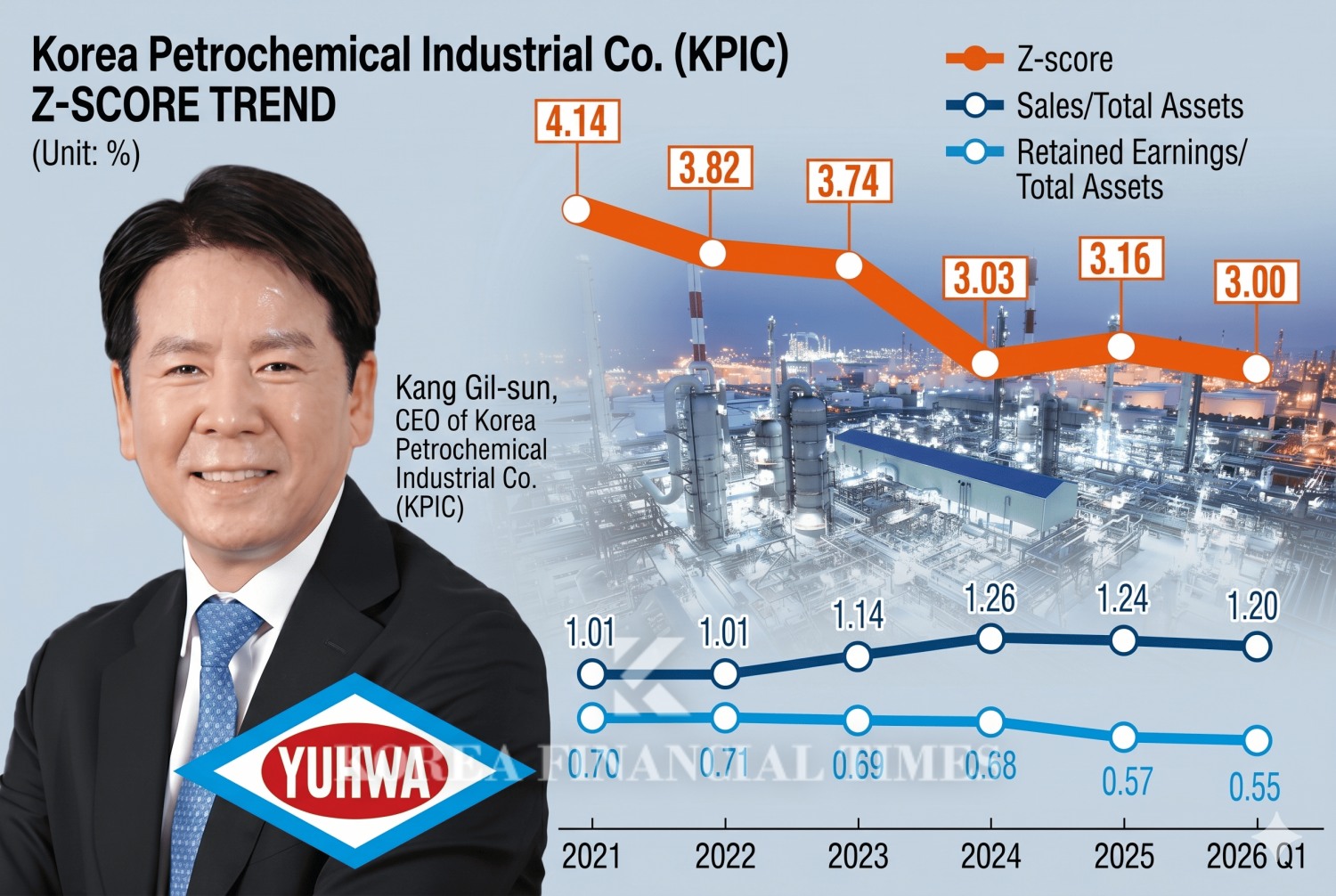
The government and the country's naphtha cracking center (NCC) operators have been pushing for restructuring of the domestic petrochemical industry since the second half of last year. Among Korea's three major petrochemical complexes — Daesan, Yeosu, and Ulsan — Ulsan has seen the slowest progress. This is because the three companies based there — SK Geo Centric, Korea Petrochemical, and S-Oil — have divergent interests.
SK Geo Centric is in the camp that agrees on the need to reduce NCC capacity. Its facilities are relatively aged, and the company holds that a mid-to-long-term structural overhaul is needed in tandem with a rebalancing of its group portfolio. S-Oil, by contrast, is reluctant to cut NCC capacity. This is because it judges that the new facilities of its "Shaheen Project," which will begin full-scale operation early next year, have sufficient price competitiveness even compared with Chinese players.
Korea Petrochemical's situation is somewhat more complex. While it faces no immediate crisis, it must grapple with the need to devise a long-term survival strategy within a petrochemical industry ecosystem that has entered a structural downturn.
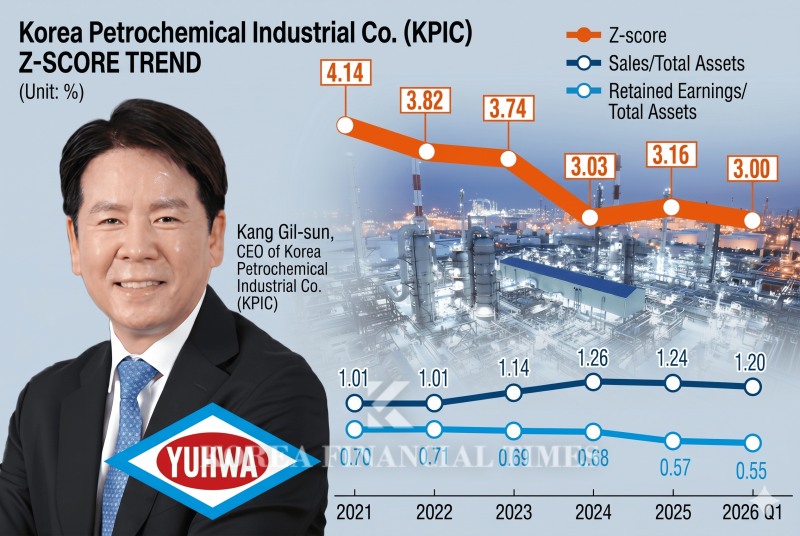
The company has among the strongest financial soundness of Korea's major NCC operators. According to "THE COMPASS," the artificial intelligence (AI) data platform developed in-house by the Korea Financial Times, Korea Petrochemical's Altman Z-Score stood at 3.0 as of the first quarter of this year. The Z-Score is a financial-soundness indicator that predicts the risk of corporate bankruptcy; a reading of 3.0 or higher is assessed as the "safe" zone, indicating a very healthy financial condition.
Compared with other domestic NCC operators such as Lotte Chemical (1.07) and LG Chem (0.98) — which have been struggling amid the oversupply originating from China since 2022 and have already entered the "distress" zone below 1.18 — it is immediately clear just how strong Korea Petrochemical's financial soundness is.
This is thanks to Korea Petrochemical's distinctive defensive management. Lotte Chemical and LG Chem each made trillion-won-scale investments in overseas facility expansion and in business transitions such as secondary batteries, respectively. Korea Petrochemical, by contrast, has made almost no notable investments since 2020. Its capital expenditure over the past three years has also averaged roughly KRW 84 billion per year, an extremely conservative level.
An item that illustrates this well is X5 (sales / total assets). This quarter, that value was 1.2, accounting for 40% of the total. This means Korea Petrochemical generated sales efficiently despite holding NCC facilities more than 30 years old.
[Petrochemicals: A Shifting Landscape] Korea's Petrochemical Restructuring Accelerates as Middle East Crisis BitesLotte-HD Hyundai Daesan Merger Signals Full-Scale Petrochemical Restructuring in KoreaLotte Chemical Swung to Profit in Q1 — So Why Won't the Stock Move?Lotte Chemical Snaps 10-Quarter Deficit Streak... How Long Will War-Driven Windfall Last?Kumho Petrochemical's Treasury Shares Face Governance Test After 20 Years [Treasury Share Report]
That said, Korea Petrochemical too has seen its financial soundness gradually deteriorate, posting losses for three consecutive years from 2023 to 2025. Its annual Z-Score fell from 4.14 in 2021 to 3.0 in the first quarter of this year. In particular, the X2 (retained earnings / total assets) and X3 (operating profit / total assets) items, which reflect profitability, dropped sharply.
The adage may be "earn in the boom, endure the bust," but the company can no longer prepare for the future with such a strategy. That is because, with the oversupply from China shifting the petrochemical industry's paradigm, analysts say this downturn is not a temporary cycle but a structural slump. The later the timing of investment, the greater the risk of falling into a vicious cycle in which the capacity to invest in a transition to new businesses is depleted.
The risk of a key feedstock supplier turning into a competitor is also materializing. Korea Petrochemical sources naphtha, a petrochemical raw material, mainly from nearby S-Oil. If S-Oil expands its own petrochemical business through the operation of "Shaheen," the contractual relationship between the two companies could change. For Korea Petrochemical, it is a moment to consider reorganizing its supply chain.
It is not as though Korea Petrochemical has given no thought to restructuring its business. Hanju, an industrial gas and water supply company in which it had held an equity stake since the mid-2010s, was incorporated as a subsidiary last year through an additional increase in its stake. As a result, the company lowered the share of petrochemicals in its revenue from a previous level of 99% to around 80% currently. Given its high dependence on downstream industries, this is hard to view as a fundamental transformation of its business profile, but it amounts to a first step toward portfolio diversification.
One petrochemical industry official said, "Considering Korea Petrochemical's weight class, there are limits to an independent business transition," adding, "In the end, there will likely be no realistic card to play other than joining a restructuring in which government support can be expected."
Gwak Horyung (horr@fntimes.com)











![[THE COMPASS] 한미사이언스 경영권 분쟁, 신동국이 주도하는 ‘종식’ 게임](https://cfnimage.commutil.kr/phpwas/restmb_setimgmake.php?pp=006&w=69&h=45&m=5&simg=20261008122108000710a837df649412411124362.jpg&nmt=18)

![영업익 53% 뛴다는데…대웅제약 몸값 누르는 두 가지 변수 [5대 제약사 3Q 실적 ④]](https://cfnimage.commutil.kr/phpwas/restmb_setimgmake.php?pp=006&w=69&h=45&m=5&simg=202610081106100618007fd637f543112168227135.jpg&nmt=18)

![[기고] 앞으로 10년 뒤, 당신의 예금 통장은 과연 안전할까](https://cfnimage.commutil.kr/phpwas/restmb_setimgmake.php?pp=006&w=69&h=45&m=5&simg=20261008135710064190c1c16452b012411124362.jpg&nmt=18)


![[그래픽 뉴스] ‘순대’가 경제용어라고? 순(純)대외자산, 한국의 진짜 해외자산은 얼마일까?](https://cfnimage.commutil.kr/phpwas/restmb_setimgmake.php?pp=006&w=298&h=298&m=1&simg=202609021356075202de68fcbb3512411124362_0.jpg&nmt=18)
![[그래픽 뉴스] ISA 대개편! 나에게 유리한 계좌는?](https://cfnimage.commutil.kr/phpwas/restmb_setimgmake.php?pp=006&w=298&h=298&m=1&simg=202608041713155615de68fcbb3512411124362_0.jpg&nmt=18)
![[그래픽 뉴스] 미국 증시 새로운 키워드 'MANGOS'](https://cfnimage.commutil.kr/phpwas/restmb_setimgmake.php?pp=006&w=298&h=298&m=1&simg=202607291740382069de68fcbb3512411124362_0.jpg&nmt=18)

![[그래픽 뉴스] 은퇴후 30년 부모님 세대의 생존전략](https://cfnimage.commutil.kr/phpwas/restmb_setimgmake.php?pp=006&w=298&h=298&m=1&simg=202606301704439153de68fcbb3512411124362_0.jpg&nmt=18)
![[신간]은퇴연옥…김경록의 은퇴 후 삶의 나침반](https://cfnimage.commutil.kr/phpwas/restmb_setimgmake.php?pp=006&w=81&h=123&m=5&simg=20260414140833047280f8caa4a5ce12411124362.jpg&nmt=18)
![[신간] 물처럼 흐르고 원칙으로 서다…김용환의 통찰을 담다](https://cfnimage.commutil.kr/phpwas/restmb_setimgmake.php?pp=006&w=81&h=123&m=5&simg=20260409114249027860f8caa4a5ce12411124362.jpg&nmt=18)
![[안현정 서평] 플랫폼의 영지에서 ‘미학적 주권’을 선포하라...'K가 죽어야 K가 산다' 장준환 著](https://cfnimage.commutil.kr/phpwas/restmb_setimgmake.php?pp=006&w=81&h=123&m=5&simg=20260527121426063220c1c16452b012411124362.jpg&nmt=18)
![[서평] 추세 매매의 대가들...추세추종 투자전략의 대가 14인 인터뷰](https://cfnimage.commutil.kr/phpwas/restmb_setimgmake.php?pp=006&w=81&h=123&m=5&simg=2023102410444004986c1c16452b0175114235199.jpg&nmt=18)


![[머니무브 2026] “지금 사도 될까?” 답이 안 보인다면…하반기 투자, 4명의 전문가에게 물어보세요](https://cfnimage.commutil.kr/phpwas/restmb_setimgmake.php?pp=006&w=89&h=45&m=1&simg=202609151044050355302a735e27af12411124362.jpg&nmt=18)
![[AD] ‘PBV 라인업 확장’ 기아, 9월 독일서 ‘PV7’ 첫 공개](https://cfnimage.commutil.kr/phpwas/restmb_setimgmake.php?pp=006&w=89&h=45&m=1&simg=2026083111010602815074925877361231180222.jpg&nmt=18)
![[AD] 제네시스, 럭셔리 경험 더한 ‘2027 GV70’‧‘GV70 그래파이트’ 출시](https://cfnimage.commutil.kr/phpwas/restmb_setimgmake.php?pp=006&w=89&h=45&m=1&simg=20260702143546085600749258773622211122717.jpg&nmt=18)