






With the recent commercial law revision issue, attention is focused on whether the large-scale treasury stocks held for years could become a "trump card" for enhancing shareholder value.
SK Inc. declared its transformation into an "investment-oriented holding company" in 2017, followed by an announcement in 2021 to evolve into an "investment company."
The intention was not to remain a traditional holding company managing the group's business portfolio, but to actively invest in promising companies in growth sectors and realize profits.
It's a model similar to Warren Buffett's Berkshire Hathaway, which invests equity stakes in various companies to increase corporate value. The market praised it, saying "SK Inc. has presented an advanced holding company model."
However, the returns for investors fell short of expectations. SK Inc.'s stock price has risen only 3-4% over approximately nine years since 2017.
Investment activities were actually vigorous. According to SK Inc., the company generated 4.1 trillion won in gains through 32 listings or sales of portfolio companies from 2020 to June this year.
However, there are considerable regrets about exit methods and timing. Since 2023, it has supported "rebalancing (business restructuring)" to resolve affiliates' financial crises.
In this process, SK Inc. merged SK E&S, its largest cash generator, with SK Innovation and contributed 400 billion won to a capital increase aimed at eliminating the obligation to list SK On, which had been promised to financial investors (FIs).
SK Materials affiliates, representative semiconductor materials companies discovered by SK Inc., were transferred to SK Ecoplant. While intended to prevent financial risks from spreading throughout the group, it ultimately resulted in distributing core resources to underperforming subsidiaries.
Nevertheless, SK Group's rebalancing efforts are considered largely complete. Interest is now focused on new corporate value enhancement measures.
In October last year, SK Inc. became the first holding company to disclose a "value-up plan," but it was insufficient to boost the stock price. The plan included improving return on equity (ROE) from 3% to 8-10% and returning 1-2% of market capitalization annually to shareholders through treasury stock purchases and cancellations or additional dividends.
The Korea Corporate Governance Forum pointed out that "the easiest value-up method is to cancel all treasury stocks."
What lifted the stock price was the expectation of commercial law revision that emerged with the launch of the Lee Jae-myung administration. The company's stock price surged over 70% from May to October this year. Amid this, a third commercial law amendment centered on "mandatory treasury stock cancellation" is being promoted mainly by the ruling party.
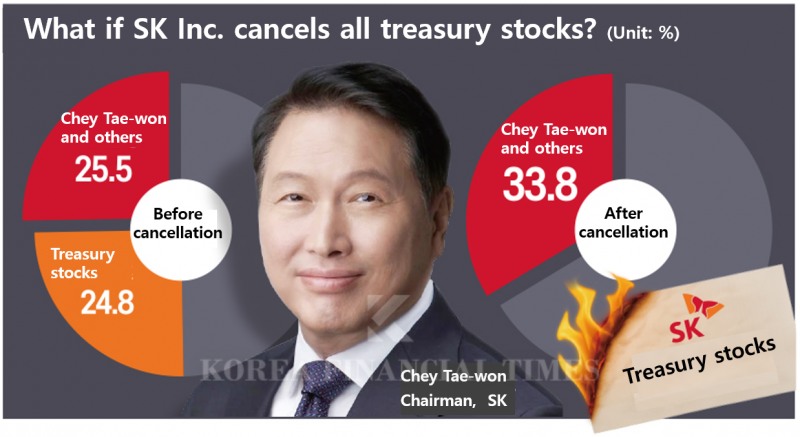
SK Inc.'s treasury stock ratio is 24.8%. This is comparable to the 25.5% stake held by Chairman Chey Tae-won (17.9%) and specially related parties. Treasury stocks have no voting rights, but if sold to third parties, voting rights are revived. This means they can be used for management rights defense purposes.
In 2003, when SK was threatened by foreign hedge fund Sovereign Asset Management, it defended management rights by selling treasury stocks to Hana Bank and Shinhan Bank. Later, in 2015, during the holding company conversion process, it merged with SK C&C (now SK AX) to expand its treasury stock ratio, establishing Chairman Chey Tae-won's stable control.
However, considering recent government policies, there are predictions that it may be difficult to use treasury stocks for management rights defense as in the past.
When Democratic Party Representative Oh Ki-hyung pointed out "Lotte Holdings' high treasury stock ratio (27.5%)" at a recent National Assembly Strategy and Finance Committee audit, Lotte Holdings President Ko Jung-wook responded, "Even if it takes time, I think cancellation is the right direction."
SK, which has the second-highest treasury stock ratio among domestic non-financial large company holding companies after Lotte Holdings, should also be seen as in a situation where it's difficult to ignore cancellation demands.
If SK Inc. cancels all currently held treasury stocks, changes will immediately occur in SK Group's governance structure. As the number of issued shares decreases, the stake of Chairman Chey Tae-won's family will increase from 25.5% to 33.8%.
However, the indirect effect of treasury stocks will also disappear, so the largest shareholder's stake may not actually reach a majority. Shareholder-friendly policies that prioritize the rights and interests of the National Pension Service (10.3% after cancellation) and minority shareholders are essential.
An industry official noted, "Shareholder-friendly policies don't necessarily threaten the owner family's management rights. Rather, we need to recall that the fundamental cause of Sovereign's attack on SK was SK Global's accounting fraud," adding, "Since it wouldn't have happened if checks and monitoring of controlling shareholders had worked properly, shareholder management could help with overall group risk management."
Recently, owner risks that could threaten SK Group's governance structure have effectively reached the final stage. The property division amount is also expected to decrease significantly due to the Supreme Court's remand in the divorce lawsuit appeal. Going forward, SK Inc. is expected to seek corporate value enhancement through investments in promising AI (artificial intelligence) companies as an investment company.
In June last year, SK announced it would invest 80 trillion won in AI and semiconductor sectors by 2026. Chairman Chey Tae-won, who met with big tech companies like Nvidia, said, "These days, there's nothing to talk about except AI."
Gwak Horyung (horr@fntimes.com)










![[기자수첩] 보험사 품는 사모펀드, 대주주 심사 재고해야](https://cfnimage.commutil.kr/phpwas/restmb_setimgmake.php?pp=006&w=69&h=45&m=5&simg=20260913173909069220ed56b8e1f814379898.jpg&nmt=18)
![[Z-스코어 기업가치 바로 보기] 차입이냐 자기자본이냐…LG엔솔 vs 삼성SDI ‘명암ʼ](https://cfnimage.commutil.kr/phpwas/restmb_setimgmake.php?pp=006&w=69&h=45&m=5&simg=20260912004753014480dd55077bc212411124362.jpg&nmt=18)


![[그래픽 뉴스] ‘순대’가 경제용어라고? 순(純)대외자산, 한국의 진짜 해외자산은 얼마일까?](https://cfnimage.commutil.kr/phpwas/restmb_setimgmake.php?pp=006&w=298&h=298&m=1&simg=202609021356075202de68fcbb3512411124362_0.jpg&nmt=18)
![[그래픽 뉴스] ISA 대개편! 나에게 유리한 계좌는?](https://cfnimage.commutil.kr/phpwas/restmb_setimgmake.php?pp=006&w=298&h=298&m=1&simg=202608041713155615de68fcbb3512411124362_0.jpg&nmt=18)
![[그래픽 뉴스] 미국 증시 새로운 키워드 'MANGOS'](https://cfnimage.commutil.kr/phpwas/restmb_setimgmake.php?pp=006&w=298&h=298&m=1&simg=202607291740382069de68fcbb3512411124362_0.jpg&nmt=18)

![[그래픽 뉴스] 은퇴후 30년 부모님 세대의 생존전략](https://cfnimage.commutil.kr/phpwas/restmb_setimgmake.php?pp=006&w=298&h=298&m=1&simg=202606301704439153de68fcbb3512411124362_0.jpg&nmt=18)
![[신간]은퇴연옥…김경록의 은퇴 후 삶의 나침반](https://cfnimage.commutil.kr/phpwas/restmb_setimgmake.php?pp=006&w=81&h=123&m=5&simg=20260414140833047280f8caa4a5ce12411124362.jpg&nmt=18)
![[신간] 물처럼 흐르고 원칙으로 서다…김용환의 통찰을 담다](https://cfnimage.commutil.kr/phpwas/restmb_setimgmake.php?pp=006&w=81&h=123&m=5&simg=20260409114249027860f8caa4a5ce12411124362.jpg&nmt=18)
![[안현정 서평] 플랫폼의 영지에서 ‘미학적 주권’을 선포하라...'K가 죽어야 K가 산다' 장준환 著](https://cfnimage.commutil.kr/phpwas/restmb_setimgmake.php?pp=006&w=81&h=123&m=5&simg=20260527121426063220c1c16452b012411124362.jpg&nmt=18)
![[서평] 추세 매매의 대가들...추세추종 투자전략의 대가 14인 인터뷰](https://cfnimage.commutil.kr/phpwas/restmb_setimgmake.php?pp=006&w=81&h=123&m=5&simg=2023102410444004986c1c16452b0175114235199.jpg&nmt=18)


![[AD] ‘PBV 라인업 확장’ 기아, 9월 독일서 ‘PV7’ 첫 공개](https://cfnimage.commutil.kr/phpwas/restmb_setimgmake.php?pp=006&w=89&h=45&m=1&simg=2026083111010602815074925877361231180222.jpg&nmt=18)
![[AD] 제네시스, 럭셔리 경험 더한 ‘2027 GV70’‧‘GV70 그래파이트’ 출시](https://cfnimage.commutil.kr/phpwas/restmb_setimgmake.php?pp=006&w=89&h=45&m=1&simg=20260702143546085600749258773622211122717.jpg&nmt=18)
![[AD] 개소세 혜택 종료…현대차, ‘썸머 페스타’로 고객 부담 완화](https://cfnimage.commutil.kr/phpwas/restmb_setimgmake.php?pp=006&w=89&h=45&m=1&simg=20260702142355004830749258773622211122717.jpg&nmt=18)
![[AD] 기아 ‘디 올 뉴 셀토스’, 인도 타임스 드라이브 어워즈서 ‘올해의 SUV’ 선정](https://cfnimage.commutil.kr/phpwas/restmb_setimgmake.php?pp=006&w=89&h=45&m=1&simg=202605071156400590007492587736124111243152.jpg&nmt=18)
![[AD]‘그랜저 잡자’ 기아, 상품성 더한 ‘The 2027 K8’ 출시](https://cfnimage.commutil.kr/phpwas/restmb_setimgmake.php?pp=006&w=89&h=45&m=1&simg=2026042110193702730074925877361211627527.jpg&nmt=18)