






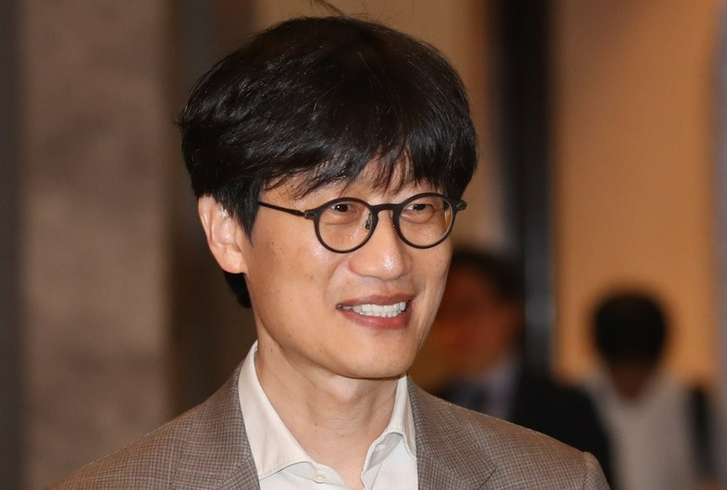

As global big tech companies intensify their competition in AI, his return is seen as a move to ensure Naver does not miss the golden opportunity in AI business. With CEO Choi Soo-yeon’s reappointment highly likely, the company is expected to focus more on its 'Sovereign AI' business and expansion into the Middle East.
According to industry sources on the 5th, Naver will propose GIO Lee Hae-jin’s appointment as an internal director at the upcoming general shareholders’ meeting in March. It has been reported that he will also resume his role as chairman of the board.
Lee stepped back from frontline management in 2017, citing the need to modernize corporate governance, and has since focused solely on overseas business development and investments—leading what some have called a ‘reclusive management’ style. However, with the emergence of China’s new AI service ‘DeepSeek’ and the escalating US-China AI rivalry, his return suggests a strategic push to strengthen Naver’s AI business.
During Lee’s leadership, Naver successfully established itself as the dominant Korean-language search engine, beating out foreign competitors like Google and Yahoo. The company built a user-driven community ecosystem with services like Naver Blog and Knowledge iN, growing into Korea’s largest portal site. Today, South Korea remains one of the few countries where a domestic search engine holds a dominant market share over Google.
Currently, Naver is focusing on its ‘sovereign AI’ strategy to compete with global big tech firms. 'Sovereign AI' refers to AI services that understand and cater to the unique characteristics and cultures of different regions. In April last year, at the ‘AI Seoul Summit,’ Lee Hae-jin emphasized the need for responsible and diverse AI models that respect local cultures and values.
Building on this strategy, Naver has recently achieved notable success in securing partnerships and contracts for 'Sovereign AI' projects in Saudi Arabia and other Arab nations. With CEO Choi Soo-yeon having led Naver’s AI strategy so far and her reappointment seeming likely, Lee’s return is also expected to further strengthen the company’s global Sovereign AI strategy.
Meanwhile, a Naver representative commented on Lee’s potential return as chairman of the board, stating that “it is difficult to provide a definitive answer at this time” regarding the proposals for the upcoming general shareholders’ meeting.

Kim JaeHun (rlqm93@fntimes.com)











![[그래픽 뉴스] ‘순대’가 경제용어라고? 순(純)대외자산, 한국의 진짜 해외자산은 얼마일까?](https://cfnimage.commutil.kr/phpwas/restmb_setimgmake.php?pp=006&w=298&h=298&m=1&simg=202609021356075202de68fcbb3512411124362_0.jpg&nmt=18)
![[그래픽 뉴스] ISA 대개편! 나에게 유리한 계좌는?](https://cfnimage.commutil.kr/phpwas/restmb_setimgmake.php?pp=006&w=298&h=298&m=1&simg=202608041713155615de68fcbb3512411124362_0.jpg&nmt=18)
![[그래픽 뉴스] 미국 증시 새로운 키워드 'MANGOS'](https://cfnimage.commutil.kr/phpwas/restmb_setimgmake.php?pp=006&w=298&h=298&m=1&simg=202607291740382069de68fcbb3512411124362_0.jpg&nmt=18)

![[그래픽 뉴스] 은퇴후 30년 부모님 세대의 생존전략](https://cfnimage.commutil.kr/phpwas/restmb_setimgmake.php?pp=006&w=298&h=298&m=1&simg=202606301704439153de68fcbb3512411124362_0.jpg&nmt=18)
![[신간]은퇴연옥…김경록의 은퇴 후 삶의 나침반](https://cfnimage.commutil.kr/phpwas/restmb_setimgmake.php?pp=006&w=81&h=123&m=5&simg=20260414140833047280f8caa4a5ce12411124362.jpg&nmt=18)
![[신간] 물처럼 흐르고 원칙으로 서다…김용환의 통찰을 담다](https://cfnimage.commutil.kr/phpwas/restmb_setimgmake.php?pp=006&w=81&h=123&m=5&simg=20260409114249027860f8caa4a5ce12411124362.jpg&nmt=18)
![[안현정 서평] 플랫폼의 영지에서 ‘미학적 주권’을 선포하라...'K가 죽어야 K가 산다' 장준환 著](https://cfnimage.commutil.kr/phpwas/restmb_setimgmake.php?pp=006&w=81&h=123&m=5&simg=20260527121426063220c1c16452b012411124362.jpg&nmt=18)
![[서평] 추세 매매의 대가들...추세추종 투자전략의 대가 14인 인터뷰](https://cfnimage.commutil.kr/phpwas/restmb_setimgmake.php?pp=006&w=81&h=123&m=5&simg=2023102410444004986c1c16452b0175114235199.jpg&nmt=18)


![[머니무브 2026] “지금 사도 될까?” 답이 안 보인다면…하반기 투자, 4명의 전문가에게 물어보세요](https://cfnimage.commutil.kr/phpwas/restmb_setimgmake.php?pp=006&w=89&h=45&m=1&simg=202609151044050355302a735e27af12411124362.jpg&nmt=18)
![[AD] ‘PBV 라인업 확장’ 기아, 9월 독일서 ‘PV7’ 첫 공개](https://cfnimage.commutil.kr/phpwas/restmb_setimgmake.php?pp=006&w=89&h=45&m=1&simg=2026083111010602815074925877361231180222.jpg&nmt=18)
![[AD] 제네시스, 럭셔리 경험 더한 ‘2027 GV70’‧‘GV70 그래파이트’ 출시](https://cfnimage.commutil.kr/phpwas/restmb_setimgmake.php?pp=006&w=89&h=45&m=1&simg=20260702143546085600749258773622211122717.jpg&nmt=18)