





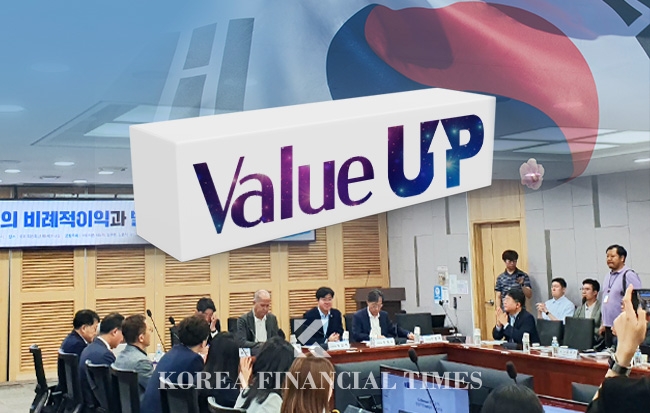
On the 23rd, the 'Shareholders' Proportional Interest and Valuation Debate' was held at the National Assembly in Yeouido.
There were also calls for amendments to the Commercial Code to extend directors' fiduciary duties to shareholders.
The 'Shareholders' Proportional Interest and Valuation Debate' was held at the Yeouido National Assembly on the 23rd, co-hosted by lawmakers from the opposition Democratic Party of Korea, including Park Sang-hyuk, Kang Joon-hyun, Kang Hoon-sik, Kim Nam-geun, Lee Jung-moon, Yoo Dong-soo, Min Byung-duk, and Oh Ki-hyung.
Woojin Kim, a professor of business administration at Seoul National University, spoke on “Analyzing the Causes of the Korean Discount: Return on Equity (ROE) and Cost of Capital for Listed Companies.
Prof. Woojin Kim explained the causes of the Korean discount, saying, “In the situation of ‘ROE < r’ (required rate of return), the company continues to reinvest instead of returning to shareholders, and the situation of PBR < 1 (price-to-earnings ratio) is deepening due to investments with a negative net present value (NPV).
He also cited conflicts of interest between controlling shareholders and common shareholders, resulting in wealth transfers between shareholders and the breakdown of the one-in-N principle.
“Companies need to establish appropriate shareholder return policies by comparing ROE and r, and the government should simultaneously promote policies to protect common shareholders and reform the tax system,” Kim said.
On the same day, Professor Lee Sang-hoon, professor at Kyungpook National University College of Law, presented 'Value Up and Directors' Duty of Loyalty'.
“Profit infringement occurs in the process of transferring corporate value to stock value,” Professor Lee said, adding, ”Currently, Korea's fiduciary duty only recognizes the protection of corporate value, but not the impairment of shareholder and stock value, so the phenomenon of stock price discount is ignored and encouraged.”
For example, M&A (mergers and acquisitions), mergers/divestitures, tender offers, delistings, and mergers that result in an unfair increase in the controlling shareholder's shareholding. He also pointed to cases where the proceeds of a subsidiary listing, such as a spin-off listing, are used to expand management's control rather than returning the proceeds to the parent company's shareholders.
“There is a proposal to amend the Commercial Code to include shareholders in the scope of directors' fiduciary duties,” Prof. Lee said.
The panelists had a variety of opinions on whether the fiduciary duty of directors should be expanded and the implementation of corporate valuation programs.
“Conflicts of interest between controlling shareholders and general shareholders do exist in Korea's corporate governance system, which is based on corporate groups, and I agree with the problem,” said Professor Son Chang-wan of Yonsei University School of Law. ‘However, I am opposed in principle to the introduction of directors’ fiduciary duty to shareholders as a solution, but legislating directors‘ indirect duty to protect shareholders’ interests could be an alternative.”
Dr. Hwang Hyun-young, Capital Market Research Institute, said, “There are various ways to solve the current problem, but one alternative is to prepare a clear regulation on directors‘ duty of loyalty.” “However, the important question is ’how' to make it an effective provision without breaking the entire framework of the current commercial law system,” he said.
In the industry, Park Yoo-kyung, head of EM equities at APG Asset Management, pointed out that “the Korean capital market is still stuck in the 1997 IMF crisis,” and suggested that “I think Korea needs a wake-up program rather than a corporate valuation program.”
From the business community, Kang Seok-gu, head of the research department at the Korea Chamber of Commerce and Industry, said, “I agree with the argument that the cost of capital related to expanding shareholder return for low-ROE companies should be considered, but in reality, the value of profits that are not returned to shareholders will be different from that of a company that reinvests diligently and a company that hoards.” Kang also suggested that there are various side effects of expanding directors' fiduciary duties under the Commercial Code, including increased director liability, shareholder representation lawsuits, and increased penalties for embezzlement.
On the government side, Choi Chi-yeon, head of the Fair Market Division at the Financial Services Commission, said, “We are reviewing various issues to improve governance with related ministries,” and suggested that “we will collect opinions from all sides and try to come up with reasonable alternatives.”
Jeong Suneun (bravebambi@fntimes.com)










![[Z-스코어 기업가치 바로 보기] 차입이냐 자기자본이냐…LG엔솔 vs 삼성SDI ‘명암ʼ](https://cfnimage.commutil.kr/phpwas/restmb_setimgmake.php?pp=006&w=69&h=45&m=5&simg=20260912004753014480dd55077bc212411124362.jpg&nmt=18)
![[기자수첩] 보험사 품는 사모펀드, 대주주 심사 재고해야](https://cfnimage.commutil.kr/phpwas/restmb_setimgmake.php?pp=006&w=69&h=45&m=5&simg=20260913173909069220ed56b8e1f814379898.jpg&nmt=18)


![[그래픽 뉴스] ‘순대’가 경제용어라고? 순(純)대외자산, 한국의 진짜 해외자산은 얼마일까?](https://cfnimage.commutil.kr/phpwas/restmb_setimgmake.php?pp=006&w=298&h=298&m=1&simg=202609021356075202de68fcbb3512411124362_0.jpg&nmt=18)
![[그래픽 뉴스] ISA 대개편! 나에게 유리한 계좌는?](https://cfnimage.commutil.kr/phpwas/restmb_setimgmake.php?pp=006&w=298&h=298&m=1&simg=202608041713155615de68fcbb3512411124362_0.jpg&nmt=18)
![[그래픽 뉴스] 미국 증시 새로운 키워드 'MANGOS'](https://cfnimage.commutil.kr/phpwas/restmb_setimgmake.php?pp=006&w=298&h=298&m=1&simg=202607291740382069de68fcbb3512411124362_0.jpg&nmt=18)

![[그래픽 뉴스] 은퇴후 30년 부모님 세대의 생존전략](https://cfnimage.commutil.kr/phpwas/restmb_setimgmake.php?pp=006&w=298&h=298&m=1&simg=202606301704439153de68fcbb3512411124362_0.jpg&nmt=18)
![[신간]은퇴연옥…김경록의 은퇴 후 삶의 나침반](https://cfnimage.commutil.kr/phpwas/restmb_setimgmake.php?pp=006&w=81&h=123&m=5&simg=20260414140833047280f8caa4a5ce12411124362.jpg&nmt=18)
![[신간] 물처럼 흐르고 원칙으로 서다…김용환의 통찰을 담다](https://cfnimage.commutil.kr/phpwas/restmb_setimgmake.php?pp=006&w=81&h=123&m=5&simg=20260409114249027860f8caa4a5ce12411124362.jpg&nmt=18)
![[안현정 서평] 플랫폼의 영지에서 ‘미학적 주권’을 선포하라...'K가 죽어야 K가 산다' 장준환 著](https://cfnimage.commutil.kr/phpwas/restmb_setimgmake.php?pp=006&w=81&h=123&m=5&simg=20260527121426063220c1c16452b012411124362.jpg&nmt=18)
![[서평] 추세 매매의 대가들...추세추종 투자전략의 대가 14인 인터뷰](https://cfnimage.commutil.kr/phpwas/restmb_setimgmake.php?pp=006&w=81&h=123&m=5&simg=2023102410444004986c1c16452b0175114235199.jpg&nmt=18)


![[AD] ‘PBV 라인업 확장’ 기아, 9월 독일서 ‘PV7’ 첫 공개](https://cfnimage.commutil.kr/phpwas/restmb_setimgmake.php?pp=006&w=89&h=45&m=1&simg=2026083111010602815074925877361231180222.jpg&nmt=18)
![[AD] 제네시스, 럭셔리 경험 더한 ‘2027 GV70’‧‘GV70 그래파이트’ 출시](https://cfnimage.commutil.kr/phpwas/restmb_setimgmake.php?pp=006&w=89&h=45&m=1&simg=20260702143546085600749258773622211122717.jpg&nmt=18)
![[AD] 개소세 혜택 종료…현대차, ‘썸머 페스타’로 고객 부담 완화](https://cfnimage.commutil.kr/phpwas/restmb_setimgmake.php?pp=006&w=89&h=45&m=1&simg=20260702142355004830749258773622211122717.jpg&nmt=18)
![[AD] 기아 ‘디 올 뉴 셀토스’, 인도 타임스 드라이브 어워즈서 ‘올해의 SUV’ 선정](https://cfnimage.commutil.kr/phpwas/restmb_setimgmake.php?pp=006&w=89&h=45&m=1&simg=202605071156400590007492587736124111243152.jpg&nmt=18)
![[AD]‘그랜저 잡자’ 기아, 상품성 더한 ‘The 2027 K8’ 출시](https://cfnimage.commutil.kr/phpwas/restmb_setimgmake.php?pp=006&w=89&h=45&m=1&simg=2026042110193702730074925877361211627527.jpg&nmt=18)