






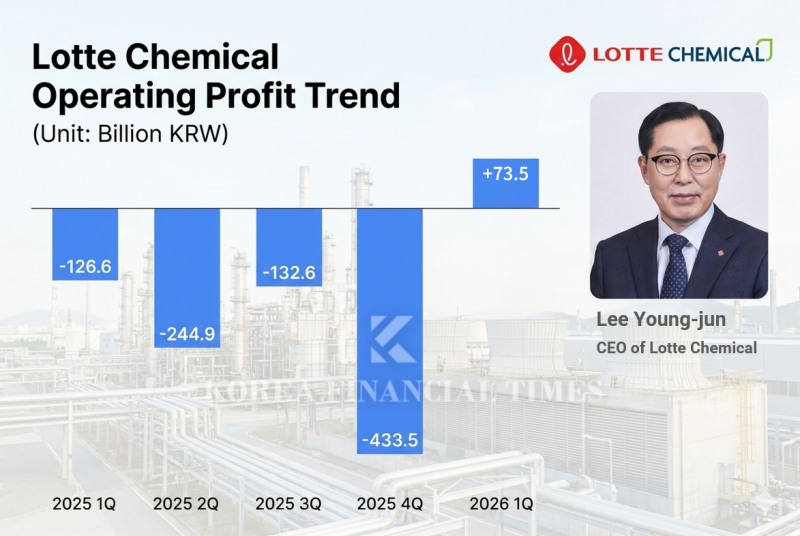
This infographic, originally published by Korea Financial Times, has been reconstructed using generative AI (Gemini).
이미지 확대보기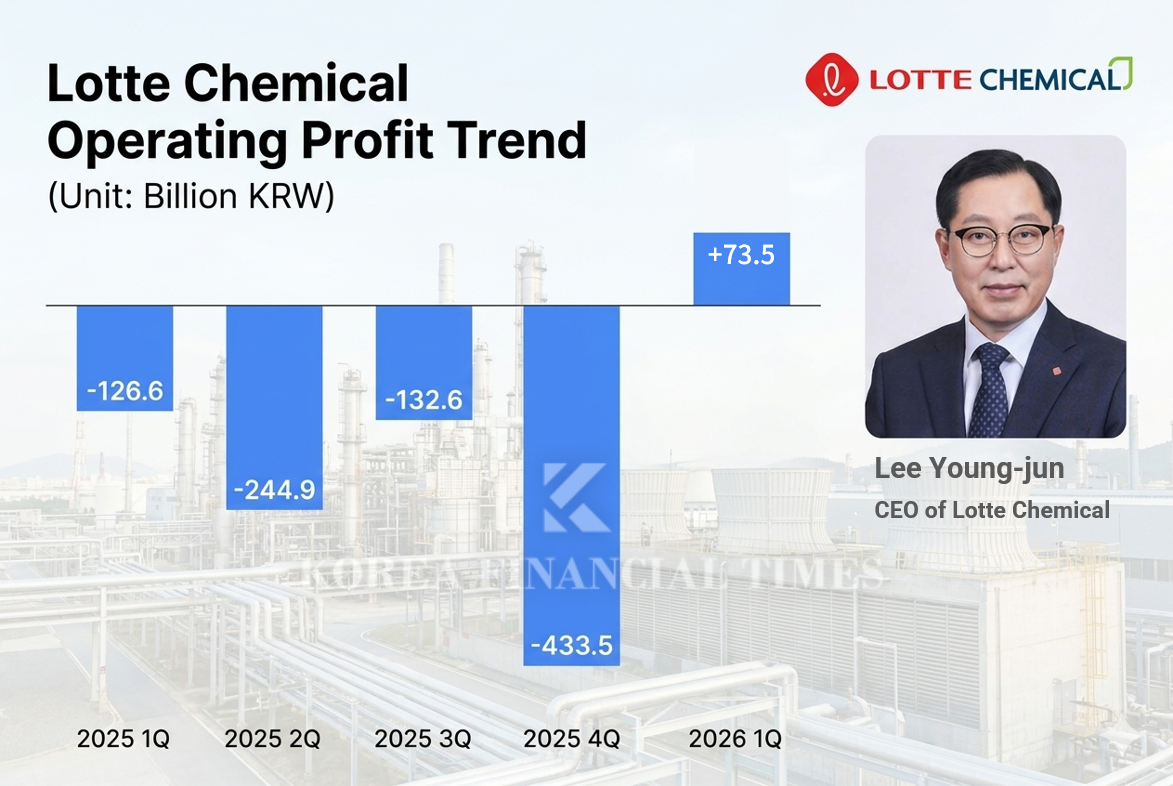
On May 11, Lotte Chemical announced its provisional earnings for the first quarter of 2026, reporting revenue of KRW 4.9905 trillion and an operating profit of KRW 73.5 billion (operating profit margin of 1.5%). Revenue increased by 1.8% compared to the same period last year.
The operating profit exceeded the forecasted deficit (an operating loss of KRW 21.0 billion), marking a successful swing to the black. This is Lotte Chemical's first profit in 10 quarters since the third quarter of 2023.
Regarding this performance, Lotte Chemical evaluated, "Despite the expansion of geopolitical risks in the Middle East, volatility in the global supply chain, and the impact of rising raw material prices, we improved profitability through production operation optimization, such as agile raw material procurement and flexible adjustment of utilization rates."
Specifically, the Basic Chemical division led the earnings rebound by turning a profit, recording KRW 3.4490 trillion in revenue and KRW 45.5 billion in operating profit (operating profit margin of 1.3%). The low-cost raw material inventory accumulated before the outbreak of the war was reflected in the corporate earnings as an "inventory valuation gain." Lotte Chemical explained, "A positive lagging effect of KRW 250 billion occurred based on basic materials."
However, there are strong concerns that if the war ends and international oil prices plummet, the company could swing back to a deficit due to a reverse lagging effect. Regarding this, Lotte Chemical responded that while it is "difficult to predict" global circumstances, "the situation where the spread (the margin between product prices and raw material costs) is improving is positive." The company also forecasted that if international oil prices decline gradually until the end of the year, it would be able to protect its profitability. However, the fact that petrochemical demand has not yet improved was cited as a negative factor.
Business divisions other than Basic Chemical also performed evenly well.
The Advanced Materials division recorded KRW 1.0233 trillion in revenue and KRW 61.5 billion in operating profit (operating profit margin of 6.0%). Although the operating profit decreased by 15.6% compared to the same period last year, it jumped by 218.7% from the previous quarter. The company explained that profitability improved due to the end of year-end inventory adjustments and an expansion in sales volume driven by a recovery in demand from downstream industries.
Lotte Chemical's Losses Mount for 4th Year as Basic Chemical Unit Struggles, Plans Growth Push in Advanced Materials[Petrochemicals: A Shifting Landscape] Korea's Petrochemical Restructuring Accelerates as Middle East Crisis BitesLotte-HD Hyundai Daesan Merger Signals Full-Scale Petrochemical Restructuring in Korea
Lotte Fine Chemical posted KRW 510.7 billion in revenue and KRW 32.7 billion in operating profit (operating profit margin of 6.4%). Profitability improved compared to both the first quarter of last year (operating profit margin of 4.2%) and the fourth quarter (operating profit margin of 4.4%).
The copper foil subsidiary Lotte Energy Materials reported KRW 159.8 billion in revenue and an operating loss of KRW 5.0 billion (operating loss margin of 3.1%), significantly reducing its loss rate, which had reached 20% in the previous quarter. It is analyzed that the company benefited from a positive lagging effect due to soaring copper prices, despite the ongoing EV chasm (demand stagnation). In the second quarter, it plans to increase sales volume through the accelerated transition to North American Energy Storage Systems (ESS) by client companies and the full-scale shipment of high value-added circuit foils for AI.
All-Out Effort for Petrochemical Integration and Financial Stabilization
As of the end of the first quarter, Lotte Chemical's liabilities stood at KRW 13.7760 trillion, up 2.1% from three months prior. The scale of borrowings increased by 7.5% to KRW 10.1082 trillion, and the net borrowing ratio rose by 5.7 percentage points to 43.7%. The interest expense burden from borrowings continues.The company aims to launch an integrated corporate entity combining the Daesan plant and HD Hyundai Oilbank by this coming September, in accordance with the government's petrochemical business reorganization plan. The Yeosu plant is also scheduled to undergo step-by-step reorganization in cooperation with Hanwha Solutions and DL Chemical following the submission of a business reorganization plan in March. After the launch of the integrated entity, the performance and related liabilities of these facilities will be excluded from Lotte Chemical's consolidated financial statements, which is expected to strengthen its book financial soundness.
At the same time, Lotte Chemical is expanding its functional materials and high value-added businesses from a mid- to long-term perspective. Through the completion of Korea's largest single compounding plant scheduled for later this year, it plans to produce 500,000 tons of Engineering Plastics (EP), a high value-added specialty material, annually. In the future, the company plans to expand its production lineup to high-performance product groups such as 'Super EP'.
A Lotte Chemical official stated, "We will continue to closely monitor the external environment and market conditions while focusing on optimizing production operations to stably supply materials." The official added, "Furthermore, we will strengthen the competitiveness of basic chemicals through business reorganization and steadily pursue mid- to long-term future growth strategies by building a balanced portfolio."
Gwak Horyung (horr@fntimes.com)











![[THE COMPASS] 한미사이언스 경영권 분쟁, 신동국이 주도하는 ‘종식’ 게임](https://cfnimage.commutil.kr/phpwas/restmb_setimgmake.php?pp=006&w=69&h=45&m=5&simg=20261008122108000710a837df649412411124362.jpg&nmt=18)

![영업익 53% 뛴다는데…대웅제약 몸값 누르는 두 가지 변수 [5대 제약사 3Q 실적 ④]](https://cfnimage.commutil.kr/phpwas/restmb_setimgmake.php?pp=006&w=69&h=45&m=5&simg=202610081106100618007fd637f543112168227135.jpg&nmt=18)

![[기고] 앞으로 10년 뒤, 당신의 예금 통장은 과연 안전할까](https://cfnimage.commutil.kr/phpwas/restmb_setimgmake.php?pp=006&w=69&h=45&m=5&simg=20261008135710064190c1c16452b012411124362.jpg&nmt=18)


![[그래픽 뉴스] ‘순대’가 경제용어라고? 순(純)대외자산, 한국의 진짜 해외자산은 얼마일까?](https://cfnimage.commutil.kr/phpwas/restmb_setimgmake.php?pp=006&w=298&h=298&m=1&simg=202609021356075202de68fcbb3512411124362_0.jpg&nmt=18)
![[그래픽 뉴스] ISA 대개편! 나에게 유리한 계좌는?](https://cfnimage.commutil.kr/phpwas/restmb_setimgmake.php?pp=006&w=298&h=298&m=1&simg=202608041713155615de68fcbb3512411124362_0.jpg&nmt=18)
![[그래픽 뉴스] 미국 증시 새로운 키워드 'MANGOS'](https://cfnimage.commutil.kr/phpwas/restmb_setimgmake.php?pp=006&w=298&h=298&m=1&simg=202607291740382069de68fcbb3512411124362_0.jpg&nmt=18)

![[그래픽 뉴스] 은퇴후 30년 부모님 세대의 생존전략](https://cfnimage.commutil.kr/phpwas/restmb_setimgmake.php?pp=006&w=298&h=298&m=1&simg=202606301704439153de68fcbb3512411124362_0.jpg&nmt=18)
![[신간]은퇴연옥…김경록의 은퇴 후 삶의 나침반](https://cfnimage.commutil.kr/phpwas/restmb_setimgmake.php?pp=006&w=81&h=123&m=5&simg=20260414140833047280f8caa4a5ce12411124362.jpg&nmt=18)
![[신간] 물처럼 흐르고 원칙으로 서다…김용환의 통찰을 담다](https://cfnimage.commutil.kr/phpwas/restmb_setimgmake.php?pp=006&w=81&h=123&m=5&simg=20260409114249027860f8caa4a5ce12411124362.jpg&nmt=18)
![[안현정 서평] 플랫폼의 영지에서 ‘미학적 주권’을 선포하라...'K가 죽어야 K가 산다' 장준환 著](https://cfnimage.commutil.kr/phpwas/restmb_setimgmake.php?pp=006&w=81&h=123&m=5&simg=20260527121426063220c1c16452b012411124362.jpg&nmt=18)
![[서평] 추세 매매의 대가들...추세추종 투자전략의 대가 14인 인터뷰](https://cfnimage.commutil.kr/phpwas/restmb_setimgmake.php?pp=006&w=81&h=123&m=5&simg=2023102410444004986c1c16452b0175114235199.jpg&nmt=18)


![[머니무브 2026] “지금 사도 될까?” 답이 안 보인다면…하반기 투자, 4명의 전문가에게 물어보세요](https://cfnimage.commutil.kr/phpwas/restmb_setimgmake.php?pp=006&w=89&h=45&m=1&simg=202609151044050355302a735e27af12411124362.jpg&nmt=18)
![[AD] ‘PBV 라인업 확장’ 기아, 9월 독일서 ‘PV7’ 첫 공개](https://cfnimage.commutil.kr/phpwas/restmb_setimgmake.php?pp=006&w=89&h=45&m=1&simg=2026083111010602815074925877361231180222.jpg&nmt=18)
![[AD] 제네시스, 럭셔리 경험 더한 ‘2027 GV70’‧‘GV70 그래파이트’ 출시](https://cfnimage.commutil.kr/phpwas/restmb_setimgmake.php?pp=006&w=89&h=45&m=1&simg=20260702143546085600749258773622211122717.jpg&nmt=18)