






Hanwha Becomes KAI's Fourth-Largest Shareholder
According to the audit report of Hanwha Aerospace, as of March 16, the total number of KAI shares held by Hanwha Aerospace's consolidated subsidiaries stood at 4,864,000 shares, representing a 4.99% stake. This marks Hanwha Group's first re-acquisition of a KAI stake in approximately seven years, following the sale of its previously held 5.99% interest — acquired during the takeover of Samsung Techwin in 2018.The stake-building effort involved the joint participation of Hanwha Aerospace, Hanwha Systems, and a U.S.-based defense-related subsidiary. Specifically, Hanwha Aerospace purchased 2,670,000 KAI shares (2.74%) for KRW 280 billion on October 23 last year. Hanwha Systems then acquired 566,635 shares (0.58%) for KRW 59.9 billion on November 3.
Hanwha Aerospace further expanded its holdings this year with an additional purchase of 1,620,000 KAI shares, bringing its total to 3,236,635 shares. With the participation of the U.S. defense subsidiary, the combined stake was raised to 4.99%. While Hanwha Aerospace declined to identify the U.S. subsidiary, it described the entity as affiliated with its defense business.
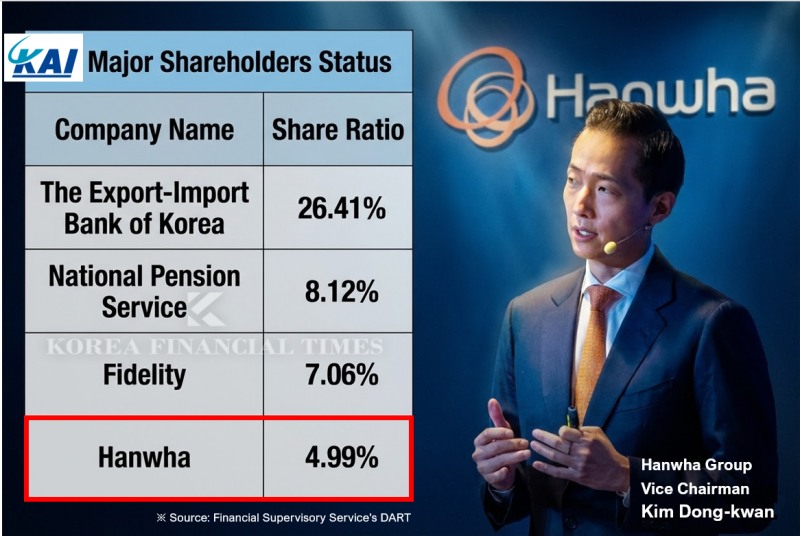
As a result, Hanwha Aerospace has become KAI's fourth-largest shareholder. The current largest shareholder is the Export-Import Bank of Korea (Korea Eximbank), holding a 26.41% stake, followed by the National Pension Service (NPS) at 8.12%, and Fidelity Management & Research Company LLC and 38 other foreign investors at 7.06%.

From Engines to Airframes: Completing the 'Integrated Defense' Picture
Analysts attribute Hanwha's renewed move on KAI to its pursuit of vertical integration. Hanwha has been building out its defense lineup through Hanwha Aerospace (launch vehicles and engines), Hanwha Systems (satellites and communications), and Hanwha Ocean (naval vessels).However, the company had been unable to make direct inroads into the finished aircraft segment due to KAI's dominant position in that space. This equity acquisition is seen as completing a value chain that ties engines and airframes together.
Hanwha Systems Doubles in a Month: Defense Exports and Philly Shipyard Reversal Fuel Stunning RallyHanwha Aerospace Secures KRW 3 Trillion Operating Profit, Targets 25% Annual Growth Through 2030Hanwha Eyes Jeju as Strategic Hub for Space, Defense, and TourismHanwha Aerospace Stock Surges 3,500% in Six Years on 'Extraordinary Strength' [KFT Topic]Hanwha to Split into Defense-Energy and Tech-Lifestyle Entities [KFT Topic]
This convergence is already evident: in February alone, Hanwha Aerospace and KAI signed two memoranda of understanding (MOUs) in the defense and aerospace sectors. The two companies agreed to collaborate broadly on future core businesses, including joint development and export of unmanned aerial vehicles (UAVs), development of aircraft equipped with domestically produced engines along with joint marketing, and entry into the global commercial space market.
Notably, the partnership carries added significance in that both companies have agreed to fully open their respective supply chains to each other — a departure from the previously exclusive practices both parties maintained. Plans include launching joint R&D programs and technical support initiatives, as well as regularizing a "Future Aerospace Strategy Committee" involving senior management from both sides to establish a robust medium-to-long-term cooperation framework.
Additional cooperation was formalized at the World Defense Show (WDS 2024), held in Riyadh, Saudi Arabia. The two companies committed to jointly localizing airborne weapons systems, including long-range air-to-air missiles for domestically produced aircraft. Beyond development, they also plan to pursue joint marketing efforts to expand exports of Korean-built aircraft such as the KF-21 and FA-50, along with their airborne weapon systems.
Meanwhile, the two companies' share prices reacted in opposite directions to the news. On March 16, Hanwha Aerospace closed at KRW 1,476,000, down KRW 12,000 from the previous session.
KAI, on the other hand, surged KRW 8,500 to close at KRW 191,200 on the same day, and opened at KRW 199,600 on March 17 — up KRW 10,300 from the prior session's closing price.
Shin Haeju (hjs0509@fntimes.com)











!['첫 연임' 신학기 vs '新리더십' 이형주…차기 수협은행장 선임 D-Day [2027 은행장 선임 레이스]](https://cfnimage.commutil.kr/phpwas/restmb_setimgmake.php?pp=006&w=69&h=45&m=5&simg=202609211608140057701b5a2213792211381469.jpg&nmt=18)

![서초구 '아크로리버파크' 34평, 10억 오른 74억원에 거래 [일일 신고가]](https://cfnimage.commutil.kr/phpwas/restmb_setimgmake.php?pp=006&w=69&h=45&m=5&simg=20260624115142011110dd55077bc212411124362.jpg&nmt=18)


![[그래픽 뉴스] ‘순대’가 경제용어라고? 순(純)대외자산, 한국의 진짜 해외자산은 얼마일까?](https://cfnimage.commutil.kr/phpwas/restmb_setimgmake.php?pp=006&w=298&h=298&m=1&simg=202609021356075202de68fcbb3512411124362_0.jpg&nmt=18)
![[그래픽 뉴스] ISA 대개편! 나에게 유리한 계좌는?](https://cfnimage.commutil.kr/phpwas/restmb_setimgmake.php?pp=006&w=298&h=298&m=1&simg=202608041713155615de68fcbb3512411124362_0.jpg&nmt=18)
![[그래픽 뉴스] 미국 증시 새로운 키워드 'MANGOS'](https://cfnimage.commutil.kr/phpwas/restmb_setimgmake.php?pp=006&w=298&h=298&m=1&simg=202607291740382069de68fcbb3512411124362_0.jpg&nmt=18)

![[그래픽 뉴스] 은퇴후 30년 부모님 세대의 생존전략](https://cfnimage.commutil.kr/phpwas/restmb_setimgmake.php?pp=006&w=298&h=298&m=1&simg=202606301704439153de68fcbb3512411124362_0.jpg&nmt=18)
![[신간]은퇴연옥…김경록의 은퇴 후 삶의 나침반](https://cfnimage.commutil.kr/phpwas/restmb_setimgmake.php?pp=006&w=81&h=123&m=5&simg=20260414140833047280f8caa4a5ce12411124362.jpg&nmt=18)
![[신간] 물처럼 흐르고 원칙으로 서다…김용환의 통찰을 담다](https://cfnimage.commutil.kr/phpwas/restmb_setimgmake.php?pp=006&w=81&h=123&m=5&simg=20260409114249027860f8caa4a5ce12411124362.jpg&nmt=18)
![[안현정 서평] 플랫폼의 영지에서 ‘미학적 주권’을 선포하라...'K가 죽어야 K가 산다' 장준환 著](https://cfnimage.commutil.kr/phpwas/restmb_setimgmake.php?pp=006&w=81&h=123&m=5&simg=20260527121426063220c1c16452b012411124362.jpg&nmt=18)
![[서평] 추세 매매의 대가들...추세추종 투자전략의 대가 14인 인터뷰](https://cfnimage.commutil.kr/phpwas/restmb_setimgmake.php?pp=006&w=81&h=123&m=5&simg=2023102410444004986c1c16452b0175114235199.jpg&nmt=18)


![[머니무브 2026] “지금 사도 될까?” 답이 안 보인다면…하반기 투자, 4명의 전문가에게 물어보세요](https://cfnimage.commutil.kr/phpwas/restmb_setimgmake.php?pp=006&w=89&h=45&m=1&simg=202609151044050355302a735e27af12411124362.jpg&nmt=18)
![[AD] ‘PBV 라인업 확장’ 기아, 9월 독일서 ‘PV7’ 첫 공개](https://cfnimage.commutil.kr/phpwas/restmb_setimgmake.php?pp=006&w=89&h=45&m=1&simg=2026083111010602815074925877361231180222.jpg&nmt=18)
![[AD] 제네시스, 럭셔리 경험 더한 ‘2027 GV70’‧‘GV70 그래파이트’ 출시](https://cfnimage.commutil.kr/phpwas/restmb_setimgmake.php?pp=006&w=89&h=45&m=1&simg=20260702143546085600749258773622211122717.jpg&nmt=18)
![[AD] 개소세 혜택 종료…현대차, ‘썸머 페스타’로 고객 부담 완화](https://cfnimage.commutil.kr/phpwas/restmb_setimgmake.php?pp=006&w=89&h=45&m=1&simg=20260702142355004830749258773622211122717.jpg&nmt=18)
![[AD] 기아 ‘디 올 뉴 셀토스’, 인도 타임스 드라이브 어워즈서 ‘올해의 SUV’ 선정](https://cfnimage.commutil.kr/phpwas/restmb_setimgmake.php?pp=006&w=89&h=45&m=1&simg=202605071156400590007492587736124111243152.jpg&nmt=18)