






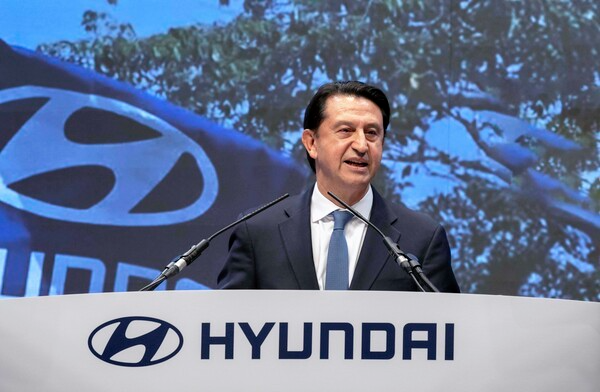
Hyundai Motor President, José Muñoz
José Muñoz joined Hyundai Motor in 2019 as Global COO and Head of the North and South America regional headquarters (President). Under his leadership, Hyundai’s sales strategy—focused on high-value models such as hybrids, SUVs, and electric vehicles—propelled the automaker to become the world’s third-largest automaker by sales volume.
Building on these achievements, José Muñoz became Hyundai Motor’s first foreign CEO. However, the operating environment for Hyundai this year is far from easy.
In particular, as tariff risks under the Trump administration become a reality, Hyundai Motor is facing growing challenges in devising countermeasures.
Hyundai Motor and Kia sold a combined 893,152 vehicles in the U.S. in the first half of this year, accounting for about 40% of their total exports. This marks a new all-time high, up 9.2% from the same period last year. Hyundai sold 476,641 units (up 10.5%), while Kia sold 416,511 units (up 7.8%).
However, the Trump administration began imposing a 25% tariff on all imported vehicles in April and expanded it to auto parts in May, which is expected to erode profitability. Indeed, combined U.S. auto exports by Hyundai and Kia in the first half fell 16.8% from a year earlier to USD 15.34 billion.
According to FnGuide, Hyundai Motor and Kia’s second-quarter operating profits are estimated at KRW 3.612 trillion and KRW 3.082 trillion, respectively, down 15.6% and 15.4% year-on-year. Korea Investment & Securities estimates that tariff burdens for Hyundai and Kia will rise to KRW 5.127 trillion and KRW 4.216 trillion, respectively, for a combined KRW 9.343 trillion.
In response to U.S. tariff risks, José Muñoz is focusing on expanding local production capacity. Hyundai Motor Group Metaplant America (HMGMA) will increase its annual production from 300,000 to 500,000 units, with the Alabama and Georgia plants further boosting total U.S. output to 1.2 million units per year.
What is Hyundai and Kia's Strategy to Counter Trump's Tariffs with a 40% U.S. Production Share?"The Engineer Who Researched Wearable Robots Rises as the Core of Hyundai Motor’s Robotics BusinessHyundai Motor Alters Self-Driving Tech Focus… Hyundai AutoEver's Standing at Risk, CEO Kim Yoon-gu Faces Strategic TestWhy Hyundai Motor Group Purchased Land in Yongin, Yangsan, and Gunsan
Hyundai Motor is also strengthening “mixed production,” where different types of vehicles, such as the IONIQ 5 and IONIQ 9, are produced on a single line. President José Muñoz—who personally oversaw the construction of HMGMA—has been a strong advocate for mixed hybrid production.
As a marketing expert, José Muñoz is reinforcing local promotions to maintain Hyundai’s U.S. market share. Hyundai Motor America recently extended its official vehicle discount program to Sept. 2. With local rivals Ford and GM raising prices due to tariffs, Hyundai aims to maintain price competitiveness.
Investment is now guided by “selection and concentration.” Hyundai Motor Group announced in March a plan to invest USD 21 billion (about KRW 30 trillion) in the U.S. over the next four years. As a result, future projects such as UAM (urban air mobility), autonomous driving, and robotics—originally earmarked for growth—are being scaled back. Hyundai last year announced plans to invest about KRW 22 trillion in these projects.
For example, Hyundai Motor’s Supernal—the startup pursuing commercial air taxis—recently laid off about 8% of its workforce as part of restructuring. Earlier this year, Hyundai Motor laid off 5% of the workforce at its robotics affiliate, Boston Dynamics. The company also implemented job cuts at Motional, its autonomous driving joint venture, last year. These companies are responsible for future businesses but currently incur more R&D expenses than profits.
At the same time, José Muñoz continues to engage in active field management through employee town hall meetings, seeking to unite employees to overcome uncertainty.
He held his first town hall at the Namyang R&D Center in February, introducing his strategy to about 800 employees. In March, he visited Hyundai’s U.K. operations and Hyundai Motor India in Gurugram. Most recently, in June, he visited regional business sites for the first time, checking on sales and marketing.
At these meetings, José Muñoz emphasized, “Amid geopolitical uncertainty in the third quarter, let’s focus on what we can control. What we can control is providing customers with beautifully designed, high-quality, and safe vehicles.”
Kim JaeHun (rlqm93@fntimes.com)











![[기자수첩] 보험사 품는 사모펀드, 대주주 심사 재고해야](https://cfnimage.commutil.kr/phpwas/restmb_setimgmake.php?pp=006&w=69&h=45&m=5&simg=20260913173909069220ed56b8e1f814379898.jpg&nmt=18)


![[그래픽 뉴스] ‘순대’가 경제용어라고? 순(純)대외자산, 한국의 진짜 해외자산은 얼마일까?](https://cfnimage.commutil.kr/phpwas/restmb_setimgmake.php?pp=006&w=298&h=298&m=1&simg=202609021356075202de68fcbb3512411124362_0.jpg&nmt=18)
![[그래픽 뉴스] ISA 대개편! 나에게 유리한 계좌는?](https://cfnimage.commutil.kr/phpwas/restmb_setimgmake.php?pp=006&w=298&h=298&m=1&simg=202608041713155615de68fcbb3512411124362_0.jpg&nmt=18)
![[그래픽 뉴스] 미국 증시 새로운 키워드 'MANGOS'](https://cfnimage.commutil.kr/phpwas/restmb_setimgmake.php?pp=006&w=298&h=298&m=1&simg=202607291740382069de68fcbb3512411124362_0.jpg&nmt=18)

![[그래픽 뉴스] 은퇴후 30년 부모님 세대의 생존전략](https://cfnimage.commutil.kr/phpwas/restmb_setimgmake.php?pp=006&w=298&h=298&m=1&simg=202606301704439153de68fcbb3512411124362_0.jpg&nmt=18)
![[신간]은퇴연옥…김경록의 은퇴 후 삶의 나침반](https://cfnimage.commutil.kr/phpwas/restmb_setimgmake.php?pp=006&w=81&h=123&m=5&simg=20260414140833047280f8caa4a5ce12411124362.jpg&nmt=18)
![[신간] 물처럼 흐르고 원칙으로 서다…김용환의 통찰을 담다](https://cfnimage.commutil.kr/phpwas/restmb_setimgmake.php?pp=006&w=81&h=123&m=5&simg=20260409114249027860f8caa4a5ce12411124362.jpg&nmt=18)
![[안현정 서평] 플랫폼의 영지에서 ‘미학적 주권’을 선포하라...'K가 죽어야 K가 산다' 장준환 著](https://cfnimage.commutil.kr/phpwas/restmb_setimgmake.php?pp=006&w=81&h=123&m=5&simg=20260527121426063220c1c16452b012411124362.jpg&nmt=18)
![[서평] 추세 매매의 대가들...추세추종 투자전략의 대가 14인 인터뷰](https://cfnimage.commutil.kr/phpwas/restmb_setimgmake.php?pp=006&w=81&h=123&m=5&simg=2023102410444004986c1c16452b0175114235199.jpg&nmt=18)


![[머니무브 2026] “지금 사도 될까?” 답이 안 보인다면…하반기 투자, 4명의 전문가에게 물어보세요](https://cfnimage.commutil.kr/phpwas/restmb_setimgmake.php?pp=006&w=89&h=45&m=1&simg=202609151044050355302a735e27af12411124362.jpg&nmt=18)
![[AD] ‘PBV 라인업 확장’ 기아, 9월 독일서 ‘PV7’ 첫 공개](https://cfnimage.commutil.kr/phpwas/restmb_setimgmake.php?pp=006&w=89&h=45&m=1&simg=2026083111010602815074925877361231180222.jpg&nmt=18)
![[AD] 제네시스, 럭셔리 경험 더한 ‘2027 GV70’‧‘GV70 그래파이트’ 출시](https://cfnimage.commutil.kr/phpwas/restmb_setimgmake.php?pp=006&w=89&h=45&m=1&simg=20260702143546085600749258773622211122717.jpg&nmt=18)
![[AD] 개소세 혜택 종료…현대차, ‘썸머 페스타’로 고객 부담 완화](https://cfnimage.commutil.kr/phpwas/restmb_setimgmake.php?pp=006&w=89&h=45&m=1&simg=20260702142355004830749258773622211122717.jpg&nmt=18)
![[AD] 기아 ‘디 올 뉴 셀토스’, 인도 타임스 드라이브 어워즈서 ‘올해의 SUV’ 선정](https://cfnimage.commutil.kr/phpwas/restmb_setimgmake.php?pp=006&w=89&h=45&m=1&simg=202605071156400590007492587736124111243152.jpg&nmt=18)