






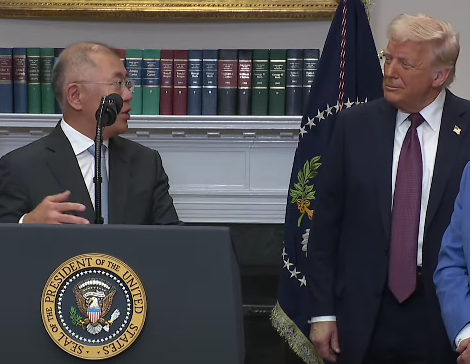
Hyundai Motor Group Chairman Chung Eui-sun (L) and U.S. President Donald Trump announce their investment plans in the United States at the White House in Washington, DC, U.S., March 24, 2025. Photo via White House YouTube Live
On April 4, José Muñoz, President and CEO of Hyundai Motor America (HMA), and Song Ho Sung, President and CEO of Kia Corporation, stated, "We currently have no plans to raise prices in the U.S." This announcement came a day after former U.S. President Donald Trump implemented a 25% tariff on imported vehicles, signaling that the companies would not immediately respond with price hikes.
Hyundai and Kia are not alone in temporarily freezing prices. Other automakers with local production facilities in the U.S., such as General Motors (GM), Toyota, and Honda, have made similar announcements. This approach appears to reflect their strategy to rely on locally produced vehicles while observing how the situation unfolds, especially since President Trump is leveraging tariffs as a negotiation tool.
In contrast, automakers with relatively lower stakes in the U.S. market have responded with immediate price hikes. Ferrari raised its vehicle prices in the U.S. by 10%, while Jaguar Land Rover announced it would suspend exports to the U.S. starting in April. Volkswagen and BMW have also informed that they will add dealer fees to export models subject to tariffs starting next month.
Despite their local production efforts, Hyundai and Kia face limitations in meeting U.S. demand solely with domestically produced vehicles.
At Hyundai's Alabama plant, models such as the Tucson, Santa Fe, and Genesis GV70 are manufactured. Last year, this plant produced 337,467 units for domestic sales. Given Hyundai's total U.S. sales of 911,805 units last year, only 37% of its vehicles were locally produced. Key sedan models like the Elantra (Avante) and Sonata are manufactured at Hyundai's Ulsan plant in South Korea for export. Some Tucson units are also produced at Kia's Mexico plant.
"Investing Despite Trillion-KRW Losses"... Chung Eui-sun's New Business '3 Picks'Hyundai Motor Suffers KRW 700 Billion Loss in China, While Kia Achieves Profit TurnaroundHyundai Motor Group Chairman Chung Eui-sun to Receive Salary from Kia Starting This YearKia also Trump Risk? What to do with the Mexican-made ‘K4’ that just started selling?
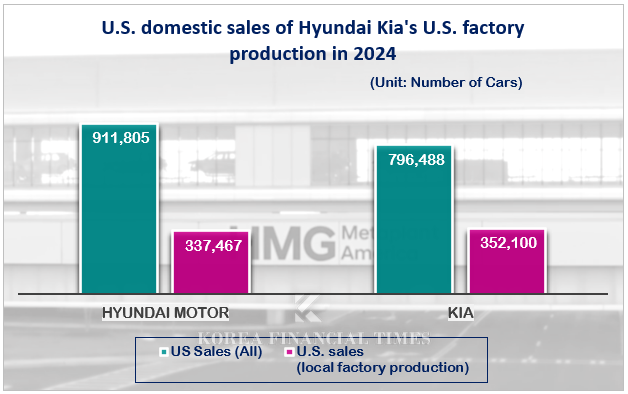
U.S.factories = Hyundai Alabama, Kia Georgia / Data = each company
Given Hyundai and Kia's high reliance on the U.S. market, their financial performance is expected to take a hit.
According to Lee Ji-soo, an analyst at Korea Investment & Securities Co., Ltd., who analyzed various scenarios involving tariffs on Korean automakers on April 3, Hyundai is estimated to face an annual cost increase of KRW 5.145 trillion if it absorbs a 25% tariff on its exported volume of 570,000 units from South Korea. Similarly, Kia's burden is projected at KRW 3.82 trillion under the same conditions. Combined, this amounts to KRW 8.9 trillion—equivalent to 33% of both companies' combined operating profit of KRW 26.9 trillion last year.
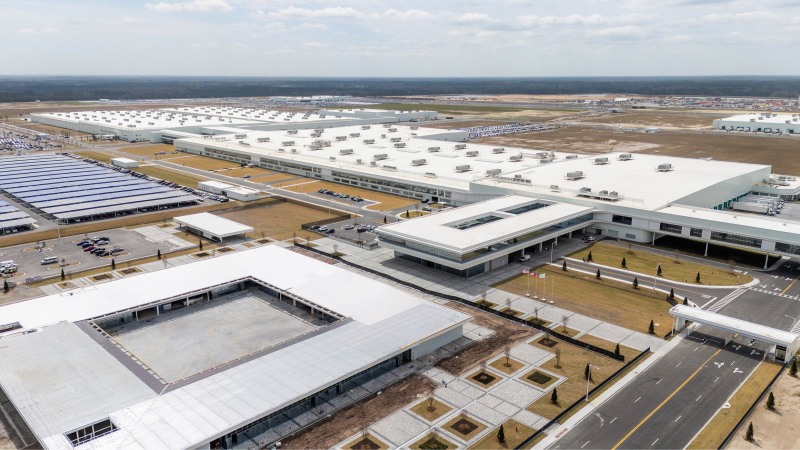
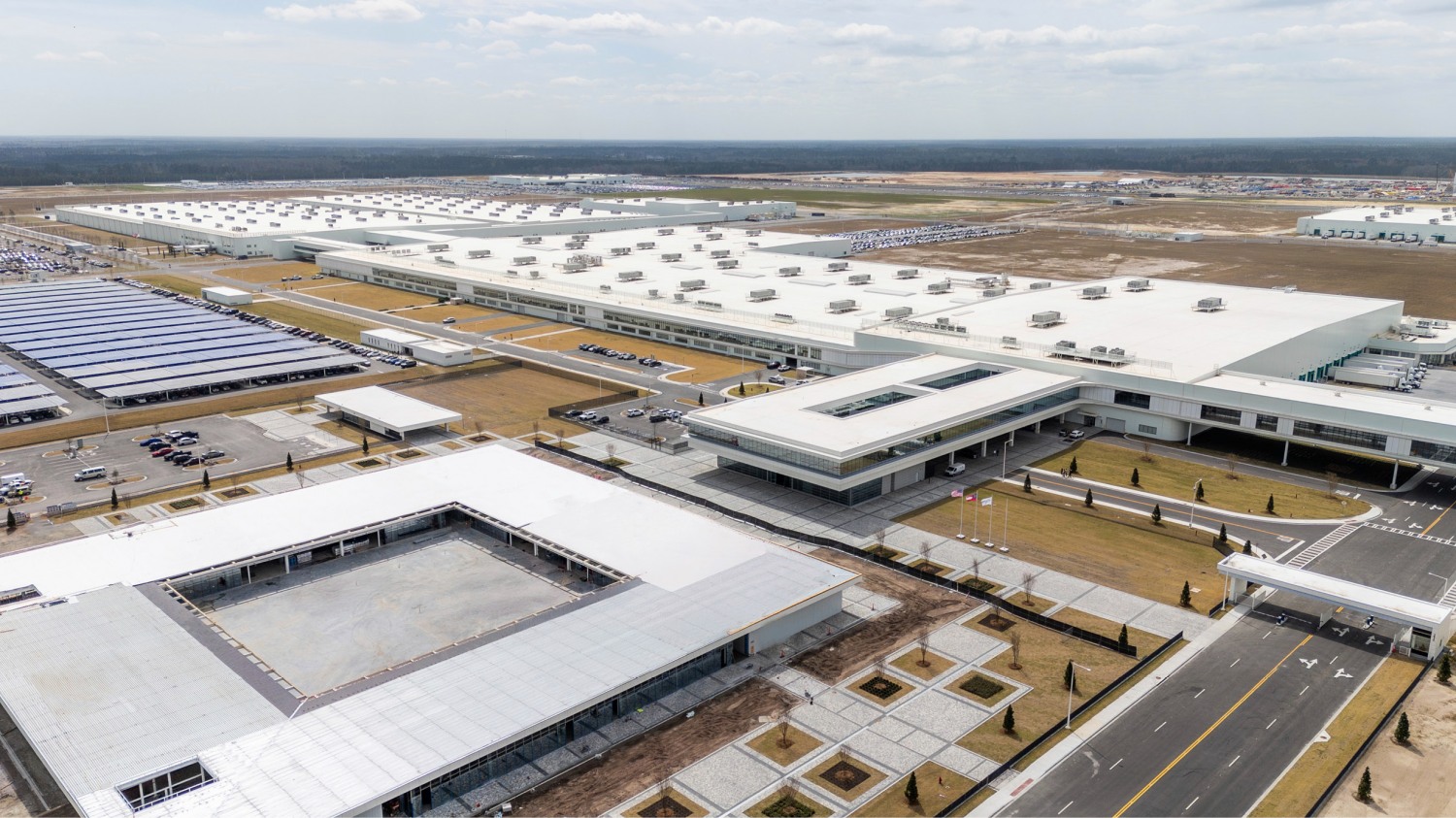
To mitigate tariff-related costs, there is speculation that Hyundai and Kia may consider producing internal combustion engine vehicles at their recently completed eco-friendly Meta Plant America (HMGMA) in Georgia. However, Lee noted that relocating production from South Korea would require union negotiations and limit the range of models that can be produced overseas.
The industry is closely watching Hyundai and Kia's first-quarter earnings conference call scheduled for later this month. An industry insider commented, "Even if they reiterate their commitment to freezing prices until May during this call, it will likely be difficult to exclude tariff impacts from their second-quarter earnings guidance."
Gwak Horyung (horr@fntimes.com)












![[현장] 금융노조, 9·4 총파업 초읽기…주4.5일제·국책은행 이전 저지 전면에 [막 오른 금융권 하투(夏鬪)]](https://cfnimage.commutil.kr/phpwas/restmb_setimgmake.php?pp=006&w=69&h=45&m=5&simg=202608311025470128001b5a221379124355175.jpg&nmt=18)

![넷마블 방준혁, 늘어난 보수처럼 책임 경영 확대 [가성비 C-레벨]](https://cfnimage.commutil.kr/phpwas/restmb_setimgmake.php?pp=006&w=69&h=45&m=5&simg=202609011515110713207492587736124111243152.jpg&nmt=18)
![성북구 '길음뉴타운2단지푸르지오' 26평, 4.3억 떨어진 7.5억원에 거래 [일일 하락가]](https://cfnimage.commutil.kr/phpwas/restmb_setimgmake.php?pp=006&w=69&h=45&m=5&simg=20260715094911024940048b718333124111243152.jpg&nmt=18)


![[그래픽 뉴스] ‘순대’가 경제용어라고? 순(純)대외자산, 한국의 진짜 해외자산은 얼마일까?](https://cfnimage.commutil.kr/phpwas/restmb_setimgmake.php?pp=006&w=298&h=298&m=1&simg=202609021356075202de68fcbb3512411124362_0.jpg&nmt=18)
![[그래픽 뉴스] ISA 대개편! 나에게 유리한 계좌는?](https://cfnimage.commutil.kr/phpwas/restmb_setimgmake.php?pp=006&w=298&h=298&m=1&simg=202608041713155615de68fcbb3512411124362_0.jpg&nmt=18)
![[그래픽 뉴스] 미국 증시 새로운 키워드 'MANGOS'](https://cfnimage.commutil.kr/phpwas/restmb_setimgmake.php?pp=006&w=298&h=298&m=1&simg=202607291740382069de68fcbb3512411124362_0.jpg&nmt=18)

![[그래픽 뉴스] 은퇴후 30년 부모님 세대의 생존전략](https://cfnimage.commutil.kr/phpwas/restmb_setimgmake.php?pp=006&w=298&h=298&m=1&simg=202606301704439153de68fcbb3512411124362_0.jpg&nmt=18)
![[신간]은퇴연옥…김경록의 은퇴 후 삶의 나침반](https://cfnimage.commutil.kr/phpwas/restmb_setimgmake.php?pp=006&w=81&h=123&m=5&simg=20260414140833047280f8caa4a5ce12411124362.jpg&nmt=18)
![[신간] 물처럼 흐르고 원칙으로 서다…김용환의 통찰을 담다](https://cfnimage.commutil.kr/phpwas/restmb_setimgmake.php?pp=006&w=81&h=123&m=5&simg=20260409114249027860f8caa4a5ce12411124362.jpg&nmt=18)
![[안현정 서평] 플랫폼의 영지에서 ‘미학적 주권’을 선포하라...'K가 죽어야 K가 산다' 장준환 著](https://cfnimage.commutil.kr/phpwas/restmb_setimgmake.php?pp=006&w=81&h=123&m=5&simg=20260527121426063220c1c16452b012411124362.jpg&nmt=18)
![[서평] 추세 매매의 대가들...추세추종 투자전략의 대가 14인 인터뷰](https://cfnimage.commutil.kr/phpwas/restmb_setimgmake.php?pp=006&w=81&h=123&m=5&simg=2023102410444004986c1c16452b0175114235199.jpg&nmt=18)


![[AD] 제네시스, 럭셔리 경험 더한 ‘2027 GV70’‧‘GV70 그래파이트’ 출시](https://cfnimage.commutil.kr/phpwas/restmb_setimgmake.php?pp=006&w=89&h=45&m=1&simg=20260702143546085600749258773622211122717.jpg&nmt=18)
![[AD] 개소세 혜택 종료…현대차, ‘썸머 페스타’로 고객 부담 완화](https://cfnimage.commutil.kr/phpwas/restmb_setimgmake.php?pp=006&w=89&h=45&m=1&simg=20260702142355004830749258773622211122717.jpg&nmt=18)
![[AD] 기아 ‘디 올 뉴 셀토스’, 인도 타임스 드라이브 어워즈서 ‘올해의 SUV’ 선정](https://cfnimage.commutil.kr/phpwas/restmb_setimgmake.php?pp=006&w=89&h=45&m=1&simg=202605071156400590007492587736124111243152.jpg&nmt=18)
![[AD]‘그랜저 잡자’ 기아, 상품성 더한 ‘The 2027 K8’ 출시](https://cfnimage.commutil.kr/phpwas/restmb_setimgmake.php?pp=006&w=89&h=45&m=1&simg=2026042110193702730074925877361211627527.jpg&nmt=18)
![[카드뉴스] KT&G, ‘CDP’ 기후변화·수자원 관리 부문 우수기업 선정](https://cfnimage.commutil.kr/phpwas/restmb_setimgmake.php?pp=006&w=89&h=45&m=1&simg=202603241415423015de68fcbb3512411124362_0.png&nmt=18)