





According to Nice Credit Ratings on Feb. 2, the sectors whose ratings and outlooks were upgraded in the first half of this year are automobiles (2 companies), shipbuilding (2 companies), and PPPs (4 companies). On the other hand, the downgrades were made to petrochemicals (7 companies), construction (4 companies), and retail (2 companies).
In the big picture, industries with favorable business conditions due to increased exports to the U.S. were positive, while industries that were unable to withstand sluggish exports to China and high interest rates and inflation were negative.
The economy goes through booms and busts like a clockwork. In this process, companies with strong financial buffers and competitiveness tend to fare well, while those without are subject to a vicious cycle of "credit crunch" followed by "credit crunch".
This reaction is also reflected in the stock market. According to big data platform 'DeepSearch', there are a total of 593 listed companies whose price-to-earnings ratio (PBR) and market capitalization have declined and whose PBR is less than 1x compared to the financial authorities' announcement of the corporate valuation program on January 24th.
To exclude cases where capitalization declines relatively quickly relative to market capitalization, resulting in a higher PBR, we selected companies with both PBR and market capitalization declining simultaneously.
| Korean Companies with Declining Market Cap & PBR | ||||||
| (Based on 24.01.24 vs. 24.07.05 closing price) | (Unit: billion won) | |||||
| Company | PBR | ROE | DTE | Market Cap | ||
| POSCO Holdings | 0.52 | 3.13% | 69.19% | 30,911 | ||
| LG Chem | 0.86 | 5.24% | 89.23% | 24,919 | ||
| Hankook Tire & Technology | 0.57 | 7.88% | 32.54% | 5,370 | ||
| Hanwha Solutions | 0.58 | -1.64% | 171.82% | 4,392 | ||
| LG Uplus | 0.50 | 7.33% | 129.54% | 4,235 | ||
| Hyundai Steel | 0.20 | 2.29% | 80.65% | 3,837 | ||
| KangwonLand | 0.77 | 9.61% | 20.96% | 2,972 | ||
| GS Retail | 0.53 | 0.50% | 126.49% | 2,126 | ||
| CJ Logistics | 0.53 | 6.01% | 131.45% | 2,115 | ||
| Lotte Shopping | 0.19 | 1.55% | 182.79% | 1,777 | ||
| OCI Holdings | 0.46 | 18.15% | 56.14% | 1,665 | ||
| E-Mart | 0.13 | -1.37% | 141.75% | 1,625 | ||
| Daewoo E&C | 0.39 | 13.39% | 176.79% | 1,552 | ||
| Shinsegae | 0.35 | 4.96% | 132.68% | 1,543 | ||
| YOUNGONE | 0.47 | 15.91% | 47.64% | 1,533 | ||
| Hankook & Company | 0.36 | 4.76% | 15.54% | 1,436 | ||
| Dongwon Industries | 0.47 | 9.01% | 146.36% | 1,243 | ||
| DL E&C | 0.27 | 4.27% | 95.94% | 1,229 | ||
| Lotte Fine Chemical | 0.48 | 7.78% | 12.58% | 1,174 | ||
| Seegene | 0.95 | 0.07% | 21.45% | 1,092 | ||
| Source=DeepSearch(Reprocessing) | ||||||
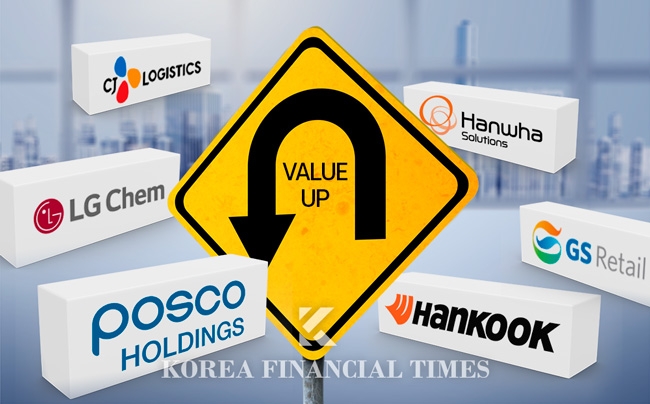
The top 10 companies by market capitalization include POSCO Holdings, LG Chem, Hankook Tire & Technology, Hanwha Solutions, LG U+, Hyundai Steel, Kangwon Land, GS Retail, CJ Logistics, and Lotte Shopping.
If we exclude holding companies, telecom companies, etc. that are 'perennially undervalued', we can see that the companies are concentrated in the credit risk industry.
This trend is even more pronounced when we zoom in outside the top 10 market capitalizations. E-Mart, Daewoo E&C, Shinsegae, DL E&C, Lotte Fine Chemicals, etc. are also in the credit insecure industry, which is also known as 'value retrogression'.
Among them, companies with a debt-to-equity ratio (total debt/total capital) of more than 100% are Hanwha Solutions, GS Retail, CJ Logistics, Lotte Shopping, E-Mart, Daewoo E&C, and Shinsegae.
The higher the debt-to-equity ratio, the lower the total capital, so the return on equity (ROE) should be relatively high. The ROE of each company is -1.64% for Hanwha Solutions, 0.50% for GS Retail, 6.01% for CJ Logistics, 1.55% for Lotte Shopping, -1.37% for E-Mart, 13.39% for Daewoo E&C, and 4.96% for Shinsegae.
Based on ROE and debt-to-equity ratios, the retail sector is the most prominent. The industry is expected to intensify as the domestic and international e-commerce offensive continues. High household debt levels and interest burdens are likely to weaken spending power, which could further shake creditworthiness.
Even companies with low debt-to-equity ratios are not safe. They can improve profitability by increasing leverage, but finding the right investments is not easy.
These companies may have no choice but to sell back shares and increase dividends to increase shareholder value. This is a way to increase ROE with relatively less capital.
However, this can be risky. For bond investors, a reduction in capital buffers reduces investment appeal. The more a company focuses on returning capital to shareholders, the harder it is to raise funds in the form of bonds. Companies with declining market capitalization and PBR, including POSCO Holdings, are caught in the so-called "value trap.
"Companies need to properly source, deploy, and utilize capital and debt for growth," said a fixed income manager at an asset management firm. "Korean companies have low asset allocation efficiency, and the purpose behind it is group control," he criticized. "As bond investors focus on the quality of capital and profitability, and equity investors focus on growth and return, companies should strategically allocate assets considering both sides of the equation, rather than just paying lip service to 'returning to shareholders,'" he advised
Lee Sungkyu (lsk0603@fntimes.com)











!['산 넘어 산' 현대모비스, 순환출자 넘기면 중국발 로봇 경쟁 [저PBR 숨은그림찾기]](https://cfnimage.commutil.kr/phpwas/restmb_setimgmake.php?pp=006&w=69&h=45&m=5&simg=2026090913502608604074925877361231180222.jpg&nmt=18)
![[머니무브 2026 주요 연사에게 미리 듣는다(2)] 김남웅 "토큰증권은 조각투자 아니다…핵심은 금융자산의 온체인 전환”](https://cfnimage.commutil.kr/phpwas/restmb_setimgmake.php?pp=006&w=69&h=45&m=5&simg=202609091620580074502a735e27af12411124362.jpg&nmt=18)


![이은미號 토스뱅크, AWS AI로 장애 잡고 ZeroOps로 운영 효율화 [망분리 넘어서는 인뱅]](https://cfnimage.commutil.kr/phpwas/restmb_setimgmake.php?pp=006&w=69&h=45&m=5&simg=20260401215638076290b4a7c6999c121131189150.jpg&nmt=18)


![[그래픽 뉴스] ‘순대’가 경제용어라고? 순(純)대외자산, 한국의 진짜 해외자산은 얼마일까?](https://cfnimage.commutil.kr/phpwas/restmb_setimgmake.php?pp=006&w=298&h=298&m=1&simg=202609021356075202de68fcbb3512411124362_0.jpg&nmt=18)
![[그래픽 뉴스] ISA 대개편! 나에게 유리한 계좌는?](https://cfnimage.commutil.kr/phpwas/restmb_setimgmake.php?pp=006&w=298&h=298&m=1&simg=202608041713155615de68fcbb3512411124362_0.jpg&nmt=18)
![[그래픽 뉴스] 미국 증시 새로운 키워드 'MANGOS'](https://cfnimage.commutil.kr/phpwas/restmb_setimgmake.php?pp=006&w=298&h=298&m=1&simg=202607291740382069de68fcbb3512411124362_0.jpg&nmt=18)

![[그래픽 뉴스] 은퇴후 30년 부모님 세대의 생존전략](https://cfnimage.commutil.kr/phpwas/restmb_setimgmake.php?pp=006&w=298&h=298&m=1&simg=202606301704439153de68fcbb3512411124362_0.jpg&nmt=18)
![[신간]은퇴연옥…김경록의 은퇴 후 삶의 나침반](https://cfnimage.commutil.kr/phpwas/restmb_setimgmake.php?pp=006&w=81&h=123&m=5&simg=20260414140833047280f8caa4a5ce12411124362.jpg&nmt=18)
![[신간] 물처럼 흐르고 원칙으로 서다…김용환의 통찰을 담다](https://cfnimage.commutil.kr/phpwas/restmb_setimgmake.php?pp=006&w=81&h=123&m=5&simg=20260409114249027860f8caa4a5ce12411124362.jpg&nmt=18)
![[안현정 서평] 플랫폼의 영지에서 ‘미학적 주권’을 선포하라...'K가 죽어야 K가 산다' 장준환 著](https://cfnimage.commutil.kr/phpwas/restmb_setimgmake.php?pp=006&w=81&h=123&m=5&simg=20260527121426063220c1c16452b012411124362.jpg&nmt=18)
![[서평] 추세 매매의 대가들...추세추종 투자전략의 대가 14인 인터뷰](https://cfnimage.commutil.kr/phpwas/restmb_setimgmake.php?pp=006&w=81&h=123&m=5&simg=2023102410444004986c1c16452b0175114235199.jpg&nmt=18)


![[AD] ‘PBV 라인업 확장’ 기아, 9월 독일서 ‘PV7’ 첫 공개](https://cfnimage.commutil.kr/phpwas/restmb_setimgmake.php?pp=006&w=89&h=45&m=1&simg=2026083111010602815074925877361231180222.jpg&nmt=18)
![[AD] 제네시스, 럭셔리 경험 더한 ‘2027 GV70’‧‘GV70 그래파이트’ 출시](https://cfnimage.commutil.kr/phpwas/restmb_setimgmake.php?pp=006&w=89&h=45&m=1&simg=20260702143546085600749258773622211122717.jpg&nmt=18)
![[AD] 개소세 혜택 종료…현대차, ‘썸머 페스타’로 고객 부담 완화](https://cfnimage.commutil.kr/phpwas/restmb_setimgmake.php?pp=006&w=89&h=45&m=1&simg=20260702142355004830749258773622211122717.jpg&nmt=18)
![[AD] 기아 ‘디 올 뉴 셀토스’, 인도 타임스 드라이브 어워즈서 ‘올해의 SUV’ 선정](https://cfnimage.commutil.kr/phpwas/restmb_setimgmake.php?pp=006&w=89&h=45&m=1&simg=202605071156400590007492587736124111243152.jpg&nmt=18)
![[AD]‘그랜저 잡자’ 기아, 상품성 더한 ‘The 2027 K8’ 출시](https://cfnimage.commutil.kr/phpwas/restmb_setimgmake.php?pp=006&w=89&h=45&m=1&simg=2026042110193702730074925877361211627527.jpg&nmt=18)