






Samsung Electronics Chairman Lee Jae-yong Engaging in On-Site Management. / Photo = Samsung Electronics
이미지 확대보기
In particular, expectations are high for Samsung Electronics’ success in three key areas that Chairman Lee Jae-yong has identified: automotive electronics (EV components and electronic devices), displays, and robotics. The company is also restructuring its organization to support subsidiaries involved in these sectors, prioritizing its future business ventures.
Harman: From Struggles to a New Cash Cow
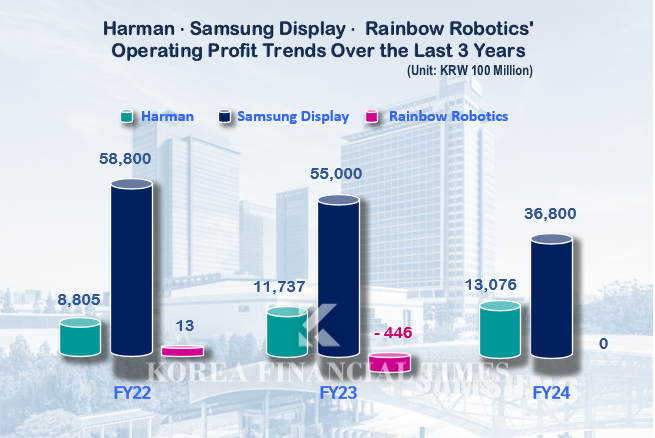
According to Samsung Electronics' business report, its automotive electronics subsidiary Harman recorded an annual revenue of KRW 14.2749 trillion and an operating profit of KRW 1.3076 trillion last year. This marks the highest performance since Samsung Electronics acquired the company in 2017. The achievement is particularly significant given the struggles faced by Samsung’s core businesses, such as semiconductors and home appliances.Harman, the global leader in automotive audio and digital cockpits (automated digital driving spaces), was acquired by Samsung Electronics in 2017 for approximately KRW 9.2 trillion. At the time, it was the largest overseas M&A project by a Korean company, garnering widespread attention.
However, the acquisition initially faced challenges. In its first year under Samsung, Harman’s operating profit was only KRW 57.4 billion in 2017, increasing to KRW 161.7 billion in 2018 and KRW 3.22 billion in 2019. These figures still fell short of its pre-acquisition profit of KRW 680.9 trillion in 2016. The situation worsened in 2020 when the global automotive industry was severely impacted by COVID-19, causing Harman’s profit to plummet to KRW 50 billion.
Things took a turn in 2021 with the growth of the electric vehicle market and expansion into vehicle software businesses, such as Head-Up Displays (HUD). Harman’s operating profit surged to KRW 599.1 billion in 2021, surpassing KRW 1 trillion for the first time in 2023 at KRW 1.1737 trillion. For two consecutive years, Harman has maintained over KRW 1 trillion in operating profit, solidifying itself as Samsung’s new cash cow.

This Year’s Key Figures Leading Samsung’s Future Businesses (From Left): Christian Sobottka, Newly Appointed President of Harman; Lee Chung, New CEO of Samsung Display; Lee Jung-ho, CEO of Rainbow Robotics. / Photos = Respective Companies
이미지 확대보기
This year, Harman faces a new challenge: fending off the rapidly growing Chinese automotive electronics companies. Despite achieving record earnings, its global market share in digital cockpits has been declining for four consecutive years due to the electric vehicle market slowdown and competition from Chinese firms.
Will Samsung Electronics Unlock Its Treasury After 8 Years? Potential for Mega M&ASamsung Electronics 'Trapped in the KRW 50,000 Swamp'... "Vows to Secure Competitiveness in AI and Robotics"Samsung Biologics Replaces CFO and R&D Head... Will It Find New Momentum This Year?'Semiconductor Variables Pour In'—Samsung Confident in Responding with Global Supply Chain Management Capabilities'Humanoid Pioneer' Oh Jun-ho Tasked with Nurturing Samsung Electronics' Future Robot Business
Samsung Electronics is also bolstering Harman’s competitiveness by restructuring its organization. At the end of last year, it transformed the ‘Automotive Electronics Business Team’ into the ‘Harman Support Team’ under the CEO’s direct supervision. Additionally, Harman appointed Christian Sobottka, a vehicle software expert, as its new president, signaling its ambition to dominate not just EV technology but also future Software-Defined Vehicles (SDVs).
Samsung Display: A KRW 4 Trillion Investment to Maintain OLED Leadership
Samsung Display, another focus of Chairman Lee’s attention, is also expected to make significant moves this year. Lee has been personally involved in the business since his time as an executive director, overseeing the development of QD (Quantum Dot)-OLED technology, which is now used in Samsung’s premium TV lineup.After completing its transition to OLED in 2020, Samsung Display achieved a record revenue of KRW 34.3 trillion, operating profit of KRW 5.88 trillion, and net profit of KRW 6.61 trillion in 2022. However, its performance slightly declined in 2023 and 2024 due to weak global IT device demand.
This year, Samsung Display is focusing on maintaining its technological edge in the mid-to-small-sized OLED market while recovering profitability. To this end, the company recently announced a KRW 4 trillion investment to enhance its competitiveness in next-generation 8.6-generation OLED and QD-OLED technologies.
A key focus is securing leadership in 8.6-generation OLED technology, which is optimized for IT devices. Samsung Display supplies OLED panels not only for Samsung’s tablets, laptops, and smartphones but also for major clients such as Apple, Razer, and Intel. With the OLED transition in tablets and laptops accelerating this year, securing 8.6-generation OLED leadership is expected to be a turning point for profitability.
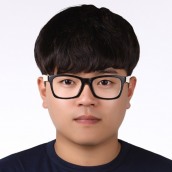
To strengthen its competitiveness in mid-to-small-sized OLEDs, Samsung Display recently appointed Lee Chung as its new CEO. Lee, who previously led the Small-Sized Business Division and IT Business Team, spearheaded the investment in 8.6-generation OLED production lines in 2023.
“This year marks a major turning point for business expansion, requiring us to perfect foldable technology, secure 8.6-generation IT OLED mass-production capabilities, and expand our IT and automotive display business,” Lee said. “We will establish barriers to entry that competitors cannot easily overcome through differentiated performance and manufacturing competitiveness.”
Robotics: Samsung’s Next Big Bet with Rainbow Robotics
While automotive electronics and Samsung Display have been key focuses for Chairman Lee even before his official appointment, robotics is a new frontier he has been pursuing since becoming chairman in 2022. At the time of his appointment, Lee identified AI, biotechnology, telecommunications, and robotics as the core future industries for Samsung Electronics.Samsung’s ultimate goal in robotics is the development of humanoid robots. Unlike LG Electronics and Hyundai Motor Group, which focus on auxiliary robots, Samsung envisions a robotics ecosystem where humanoids integrate seamlessly into everyday life, similar to home appliances.

A Rainbow Robotics robot demonstrated at the Robot Zone during Samsung Electronics’ 56th Annual General Shareholders' Meeting. / Photo = Samsung Electronics
이미지 확대보기
A key player in this vision is Rainbow Robotics, founded by KAIST professor Oh Jun-ho, who developed the world’s first bipedal humanoid robot, HUBO, in 2004. In January 2023, Samsung Electronics invested KRW 59 billion to acquire a 10.22% stake in Rainbow Robotics through a rights issue. In March of the same year, Samsung Electronics spent KRW 27.8 billion to expand its stake to 14.7% through an over-the-counter purchase and signed a call option agreement. On December 31 of last year, it exercised the call option, increasing its stake to 35.0%, becoming the largest shareholder, and effectively incorporating Rainbow Robotics as a subsidiary.
To maximize synergies, Samsung Electronics established the Future Robotics Initiative under the CEO’s direct supervision, appointing Oh Jun-ho, who stepped down as Rainbow Robotics’ CEO, as its head.
The humanoid robot market is heating up, with global giants such as NVIDIA and Tesla unveiling their models. Samsung plans to integrate its AI and software technologies with Rainbow Robotics’ expertise to accelerate the development of intelligent humanoid robots.
The two companies recently launched their first joint commercial project: security robots. These quadruped robots are seen as a solution to future labor shortages caused by declining birth rates. By developing this new business line before full humanoid commercialization, Samsung aims to gradually build its robotics capabilities.
Rainbow Robotics has designated security quadruped robots as a key research project, focusing on enhancing their performance. Samsung Electronics is equipping these robots with PTZ (pan-tilt-zoom) cameras to enable 24/7 surveillance and security operations.
A Samsung Electronics official stated, “At the shareholder meeting on March 19, we introduced the quadruped security robot ‘RBQ-10’ and shared our robotics strategy. The RBQ-10 is currently under development and is set to launch later this year.”
Kim JaeHun (rlqm93@fntimes.com)











![서초구 '래미안원베일리' 44평, 9억 오른 94억원에 거래 [일일 신고가]](https://cfnimage.commutil.kr/phpwas/restmb_setimgmake.php?pp=006&w=69&h=45&m=5&simg=2025053017540607971e41d7fc6c2183101242202.jpg&nmt=18)


![[그래픽 뉴스] ‘순대’가 경제용어라고? 순(純)대외자산, 한국의 진짜 해외자산은 얼마일까?](https://cfnimage.commutil.kr/phpwas/restmb_setimgmake.php?pp=006&w=298&h=298&m=1&simg=202609021356075202de68fcbb3512411124362_0.jpg&nmt=18)
![[그래픽 뉴스] ISA 대개편! 나에게 유리한 계좌는?](https://cfnimage.commutil.kr/phpwas/restmb_setimgmake.php?pp=006&w=298&h=298&m=1&simg=202608041713155615de68fcbb3512411124362_0.jpg&nmt=18)
![[그래픽 뉴스] 미국 증시 새로운 키워드 'MANGOS'](https://cfnimage.commutil.kr/phpwas/restmb_setimgmake.php?pp=006&w=298&h=298&m=1&simg=202607291740382069de68fcbb3512411124362_0.jpg&nmt=18)

![[그래픽 뉴스] 은퇴후 30년 부모님 세대의 생존전략](https://cfnimage.commutil.kr/phpwas/restmb_setimgmake.php?pp=006&w=298&h=298&m=1&simg=202606301704439153de68fcbb3512411124362_0.jpg&nmt=18)
![[신간]은퇴연옥…김경록의 은퇴 후 삶의 나침반](https://cfnimage.commutil.kr/phpwas/restmb_setimgmake.php?pp=006&w=81&h=123&m=5&simg=20260414140833047280f8caa4a5ce12411124362.jpg&nmt=18)
![[신간] 물처럼 흐르고 원칙으로 서다…김용환의 통찰을 담다](https://cfnimage.commutil.kr/phpwas/restmb_setimgmake.php?pp=006&w=81&h=123&m=5&simg=20260409114249027860f8caa4a5ce12411124362.jpg&nmt=18)
![[안현정 서평] 플랫폼의 영지에서 ‘미학적 주권’을 선포하라...'K가 죽어야 K가 산다' 장준환 著](https://cfnimage.commutil.kr/phpwas/restmb_setimgmake.php?pp=006&w=81&h=123&m=5&simg=20260527121426063220c1c16452b012411124362.jpg&nmt=18)
![[서평] 추세 매매의 대가들...추세추종 투자전략의 대가 14인 인터뷰](https://cfnimage.commutil.kr/phpwas/restmb_setimgmake.php?pp=006&w=81&h=123&m=5&simg=2023102410444004986c1c16452b0175114235199.jpg&nmt=18)


![[머니무브 2026] “지금 사도 될까?” 답이 안 보인다면…하반기 투자, 4명의 전문가에게 물어보세요](https://cfnimage.commutil.kr/phpwas/restmb_setimgmake.php?pp=006&w=89&h=45&m=1&simg=202609151044050355302a735e27af12411124362.jpg&nmt=18)
![[AD] ‘PBV 라인업 확장’ 기아, 9월 독일서 ‘PV7’ 첫 공개](https://cfnimage.commutil.kr/phpwas/restmb_setimgmake.php?pp=006&w=89&h=45&m=1&simg=2026083111010602815074925877361231180222.jpg&nmt=18)
![[AD] 제네시스, 럭셔리 경험 더한 ‘2027 GV70’‧‘GV70 그래파이트’ 출시](https://cfnimage.commutil.kr/phpwas/restmb_setimgmake.php?pp=006&w=89&h=45&m=1&simg=20260702143546085600749258773622211122717.jpg&nmt=18)