






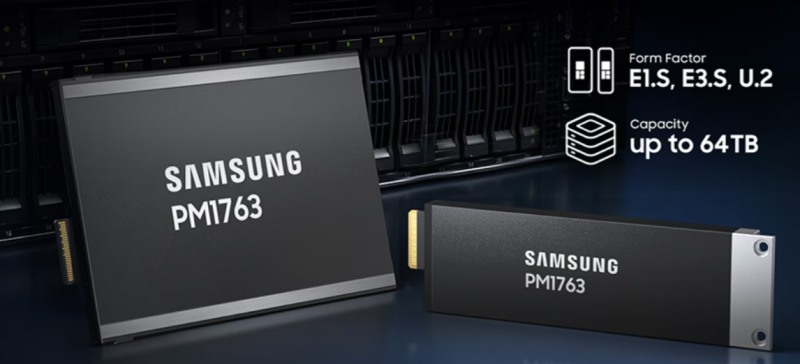
Samsung Electronics PCIe Gen 6 eSSD 'PM1763'. Source: Samsung Semiconductor official website
이미지 확대보기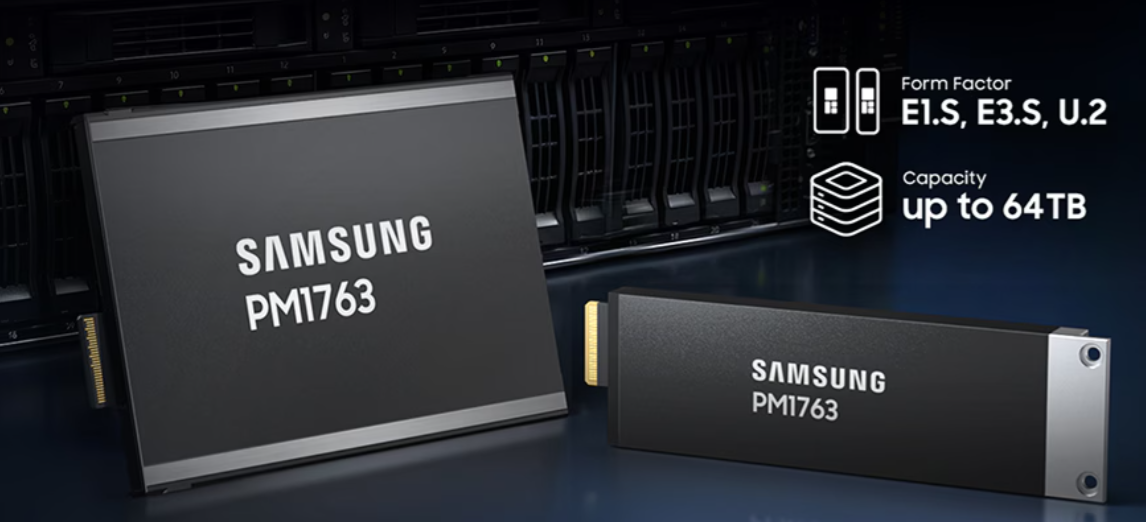
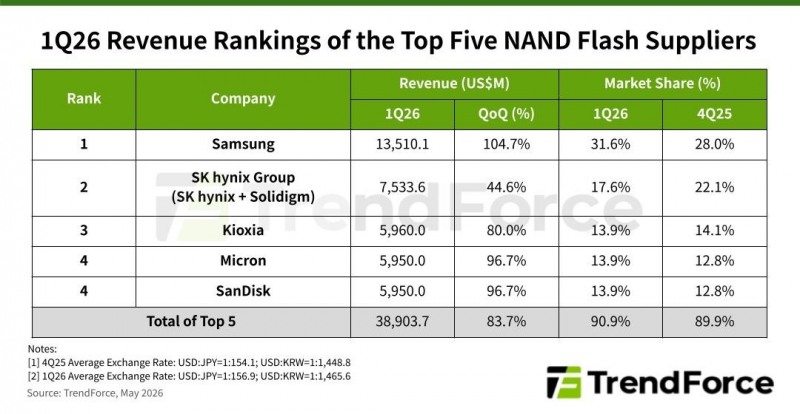
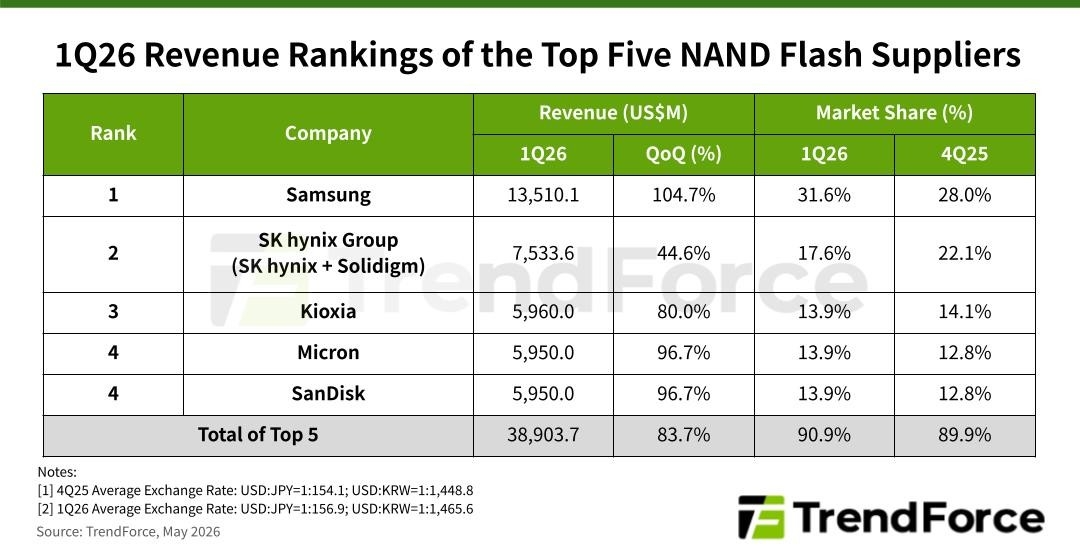
According to market research firm TrendForce, Samsung Electronics recorded NAND flash revenue of USD 13.51 billion (approximately KRW 20 trillion) in Q1 2026. This represents a 104.7% increase from the prior quarter and a more-than-threefold rise compared to the same period last year — the highest growth rate among the top five NAND flash vendors. Its market share also climbed from 28% in the prior quarter to 31.6%.
During the same period, combined revenue of the top five NAND flash vendors rose 83.7% to USD 38.9 billion. SK hynix ranked second with USD 7.5 billion (17.6% market share). Japan's Kioxia and U.S.-based Micron and SanDisk occupied the third through fifth positions, each recording a revenue share of 13.9%.
The rapid expansion of the NAND flash market is being driven primarily by the proliferation of generative AI services. NAND flash is a type of non-volatile memory semiconductor that retains data even when power is cut off. As AI inference processes generate exponentially increasing volumes of KV (key-value) cache data — used to maintain preceding context and long-term memory — data centers are actively investing in high-performance NAND flash-based storage infrastructure.
During its Q1 2026 earnings conference call, Samsung Electronics noted that server-use NAND flash bit growth (sales volume growth) for the quarter came in at the low-20% range compared to the prior quarter, surpassing initial forecasts.
NAND Operating Margin Eyes 70% Range as Segment Gains Prominence
Samsung's Device Solutions (DS) division — which encompasses its semiconductor operations — posted revenue of KRW 81.7 trillion in Q1. NAND flash accounted for approximately 15% of that figure. DRAM, which has led the AI-driven boom, remained the largest contributor at approximately 65% of DS revenue, while non-memory segments including System LSI and foundry accounted for roughly 9%.Meritz Securities estimates that Samsung's NAND flash division posted an operating profit margin of 63.9% in Q1, a sharp improvement from 24.8% in the preceding quarter. The DRAM operating profit margin stood at approximately 78%. The brokerage further projected that Samsung's NAND flash revenue will reach KRW 33 trillion in Q4 2026, with an operating profit margin in the mid-to-upper 70% range.
Samsung's Harman: From High-End Audio to the Brain of Future MobilitySamsung's EUR 1.5 Billion Cooling Systems Bet: From Home Appliances to AI Data CentersExynos Reborn: How Samsung Is Betting Its Chip Future on On-Device AISamsung Foundry Eyes Turnaround After Years of LossesSamsung Eyes Record KRW 90 Trillion Shareholder Payout as Chip Supercycle Ignites Earnings [Treasury Stock Report]
Samsung NAND Earmarked for NVIDIA's 'Vera Rubin'
Looking ahead, Samsung Electronics plans to launch new PCIe Gen 6 enterprise NAND flash storage products based on V9 TLC (9th-generation Vertical NAND, Triple-Level Cell) architecture in the second half of this year, with the aim of extending its "super-gap" lead as the global No. 1 player.The product in question is the PM1763, which Samsung unveiled at NVIDIA's GTC conference in March. Samsung has confirmed that the PM1763 will serve as the primary storage solution in NVIDIA's next-generation AI platform, "Vera Rubin."
Compared to the previous fifth-generation product, the PM1763 delivers up to twice the data transfer bandwidth and 1.8 times greater power efficiency. Its form factor has also been slimmed down to accommodate the liquid cooling designs increasingly adopted by enterprise customers. The device will support storage capacities ranging from 4TB up to a maximum of 64TB.
"NVIDIA has proposed a storage architecture in which data generated during AI inference is stored not only in High Bandwidth Memory (HBM) but also in NAND-based storage," Samsung Electronics said. "We will take the lead in the market by capturing early demand from AI servers and data centers."
Gwak Horyung (horr@fntimes.com)











![서초구 '아크로리버파크' 34평, 10억 오른 74억원에 거래 [일일 신고가]](https://cfnimage.commutil.kr/phpwas/restmb_setimgmake.php?pp=006&w=69&h=45&m=5&simg=20260624115142011110dd55077bc212411124362.jpg&nmt=18)
!['첫 연임' 신학기 vs '新리더십' 이형주…차기 수협은행장 선임 D-Day [2027 은행장 선임 레이스]](https://cfnimage.commutil.kr/phpwas/restmb_setimgmake.php?pp=006&w=69&h=45&m=5&simg=202609211608140057701b5a2213792211381469.jpg&nmt=18)


![[그래픽 뉴스] ‘순대’가 경제용어라고? 순(純)대외자산, 한국의 진짜 해외자산은 얼마일까?](https://cfnimage.commutil.kr/phpwas/restmb_setimgmake.php?pp=006&w=298&h=298&m=1&simg=202609021356075202de68fcbb3512411124362_0.jpg&nmt=18)
![[그래픽 뉴스] ISA 대개편! 나에게 유리한 계좌는?](https://cfnimage.commutil.kr/phpwas/restmb_setimgmake.php?pp=006&w=298&h=298&m=1&simg=202608041713155615de68fcbb3512411124362_0.jpg&nmt=18)
![[그래픽 뉴스] 미국 증시 새로운 키워드 'MANGOS'](https://cfnimage.commutil.kr/phpwas/restmb_setimgmake.php?pp=006&w=298&h=298&m=1&simg=202607291740382069de68fcbb3512411124362_0.jpg&nmt=18)

![[그래픽 뉴스] 은퇴후 30년 부모님 세대의 생존전략](https://cfnimage.commutil.kr/phpwas/restmb_setimgmake.php?pp=006&w=298&h=298&m=1&simg=202606301704439153de68fcbb3512411124362_0.jpg&nmt=18)
![[신간]은퇴연옥…김경록의 은퇴 후 삶의 나침반](https://cfnimage.commutil.kr/phpwas/restmb_setimgmake.php?pp=006&w=81&h=123&m=5&simg=20260414140833047280f8caa4a5ce12411124362.jpg&nmt=18)
![[신간] 물처럼 흐르고 원칙으로 서다…김용환의 통찰을 담다](https://cfnimage.commutil.kr/phpwas/restmb_setimgmake.php?pp=006&w=81&h=123&m=5&simg=20260409114249027860f8caa4a5ce12411124362.jpg&nmt=18)
![[안현정 서평] 플랫폼의 영지에서 ‘미학적 주권’을 선포하라...'K가 죽어야 K가 산다' 장준환 著](https://cfnimage.commutil.kr/phpwas/restmb_setimgmake.php?pp=006&w=81&h=123&m=5&simg=20260527121426063220c1c16452b012411124362.jpg&nmt=18)
![[서평] 추세 매매의 대가들...추세추종 투자전략의 대가 14인 인터뷰](https://cfnimage.commutil.kr/phpwas/restmb_setimgmake.php?pp=006&w=81&h=123&m=5&simg=2023102410444004986c1c16452b0175114235199.jpg&nmt=18)


![[머니무브 2026] “지금 사도 될까?” 답이 안 보인다면…하반기 투자, 4명의 전문가에게 물어보세요](https://cfnimage.commutil.kr/phpwas/restmb_setimgmake.php?pp=006&w=89&h=45&m=1&simg=202609151044050355302a735e27af12411124362.jpg&nmt=18)
![[AD] ‘PBV 라인업 확장’ 기아, 9월 독일서 ‘PV7’ 첫 공개](https://cfnimage.commutil.kr/phpwas/restmb_setimgmake.php?pp=006&w=89&h=45&m=1&simg=2026083111010602815074925877361231180222.jpg&nmt=18)
![[AD] 제네시스, 럭셔리 경험 더한 ‘2027 GV70’‧‘GV70 그래파이트’ 출시](https://cfnimage.commutil.kr/phpwas/restmb_setimgmake.php?pp=006&w=89&h=45&m=1&simg=20260702143546085600749258773622211122717.jpg&nmt=18)
![[AD] 개소세 혜택 종료…현대차, ‘썸머 페스타’로 고객 부담 완화](https://cfnimage.commutil.kr/phpwas/restmb_setimgmake.php?pp=006&w=89&h=45&m=1&simg=20260702142355004830749258773622211122717.jpg&nmt=18)
![[AD] 기아 ‘디 올 뉴 셀토스’, 인도 타임스 드라이브 어워즈서 ‘올해의 SUV’ 선정](https://cfnimage.commutil.kr/phpwas/restmb_setimgmake.php?pp=006&w=89&h=45&m=1&simg=202605071156400590007492587736124111243152.jpg&nmt=18)