






Despite pressure from the Trump administration to expand semiconductor investment in the US, Samsung appears to be leveraging major contract wins as a springboard for reviving its struggling non-memory business.
From Tesla to Apple
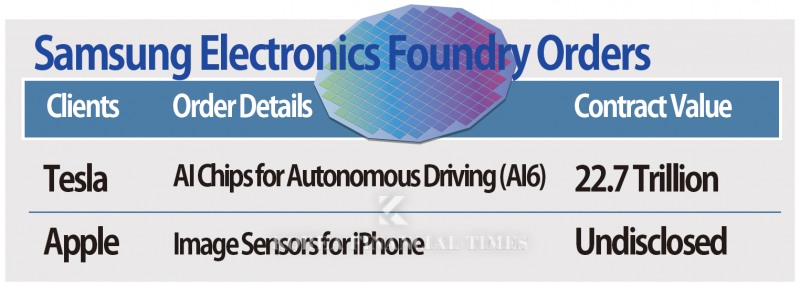
Samsung Electronics' foundry division has announced a series of order wins with global technology companies.US-based Apple announced earlier this month that it would "produce low-power, high-performance chips for use in iPhones and other Apple products at Samsung's foundry in Austin, Texas". Chief Executive Tim Cook announced this news alongside plans to invest a total of USD 600 billion (approximately KRW 830 trillion) in the US over the next four years during his White House visit.
Industry observers estimate Samsung Electronics successfully secured orders for camera sensors (CSI) for Apple's iPhone 18 series, set for launch next year.
An industry source explained: "Among smartphone components, the application processor (AP) has the highest added value, but Taiwan's TSMC is still producing these. That said, this Samsung order win is not meaningless."
Samsung Electronics has a vision of becoming a "comprehensive semiconductor company" handling both fabless (System LSI) and foundry operations. The problem is that this creates concerns among fabless clients about technology leaks, making them reluctant to place foundry orders with Samsung Electronics. This differs from TSMC, which focuses on foundry with the motto of "not competing with customers". For Samsung Electronics, securing a major global client like Apple could have the positive effect of enhancing industry trust.
Japanese company Sony has reportedly monopolised existing Apple CSI design and production. According to market research firm Counterpoint Research, Sony leads with a 45% market share based on global CSI shipment volume in 2024.
Hope for LG Display's Rebound vs. Dilemma for Samsung ElectronicsSamsung Electronics Enters Strategy Meetings Without Lee Jae-yong... Will There Be a Semiconductor Solution?Samsung Electronics Loses D-RAM Top Spot After 33 Years... Will It Struggle All Year?"Samsung Electronics Bets Big on HBM: Completed Sample Supply of Improved HBM3E, to Be Reflected in Q2 Earnings"Lee Jae-yong’s 3 Picks Transforming Samsung Electronics : 'Automotive Electronics, Displays, and Robotics'
Samsung Electronics ranks second with a 19% share. Having secured Apple as a client, Samsung Electronics now has a greater chance of catching up to Sony.
Samsung Electronics also announced through regulatory filings at the end of last month that it had "signed a semiconductor foundry supply contract worth KRW 22.7658 trillion (USD 16.5 billion) with a major global company".
There was growing curiosity about which major global company had signed a contract with Samsung Electronics, but Tesla Chief Executive Elon Musk surprised the industry by directly revealing that "the major global company is Tesla". Musk also hinted at the possibility of additional cooperation, saying "USD 16.5 billion is merely the minimum amount".
The Tesla chip that Samsung Electronics' foundry will produce is 'AI6'. This will not only be installed in electric vehicles to enable autonomous driving functions, but also serve as a core chip to be deployed in Tesla's next-generation products including humanoid robots.
At its July 31 earnings conference call, Samsung Electronics highlighted its foundry supply deal with Tesla, calling it “a milestone that demonstrates the competitiveness of its advanced (2-nanometer) process technology.”

Turning Trump Pressure into Opportunity
The supply contracts Samsung Electronics secured with Apple and Tesla share the common feature of direct production at the foundry facility in Austin, Texas. This is interpreted as Samsung Electronics benefiting from the Trump administration's policy emphasising domestic US production of advanced strategic industries.There are also expectations that Samsung Electronics will expand its US semiconductor investment in response.
The company previously announced plans to invest over USD 40 billion in US foundry facilities in July 2024 during the Biden administration.
However, as semiconductor industry conditions remained sluggish for an extended period, Samsung Electronics decided to reduce the investment scale to USD 37 billion. Now there are forecasts that the company will return to an investment expansion stance following the Trump administration's arrival.
President Trump made a surprise announcement at Apple's US investment announcement event, saying he would "impose 100% tariffs on semiconductors". He added: "We will not impose them on companies that clearly promise US production".
As concerns grew about domestic companies including Samsung Electronics and SK hynix, the South Korean government stepped in to calm fears, stating it had "secured promises of most-favoured-nation treatment (15%) for tariffs on items including semiconductors" during mutual tariff negotiations with the US. Uncertainty remains as there has been no official confirmation from the US yet. An industry source said: "This is Trump-style negotiation strategy using tariffs as leverage to pressure local US investment. Considering various circumstances, Samsung Electronics may increase its US semiconductor investment."
KRW 8 trillion Loss This Year, But...
From Samsung Electronics' perspective, the current situation is not the worst-case scenario. This is because expanding US investment is also necessary from a business standpoint to secure major local clients.An industry source pointed out: "These Apple and Tesla foundry contracts were likely signed with Samsung Electronics accepting considerable losses in terms of supply pricing. Nevertheless, we can glimpse hope in terms of securing global big tech clients and seeking recovery opportunities through this."
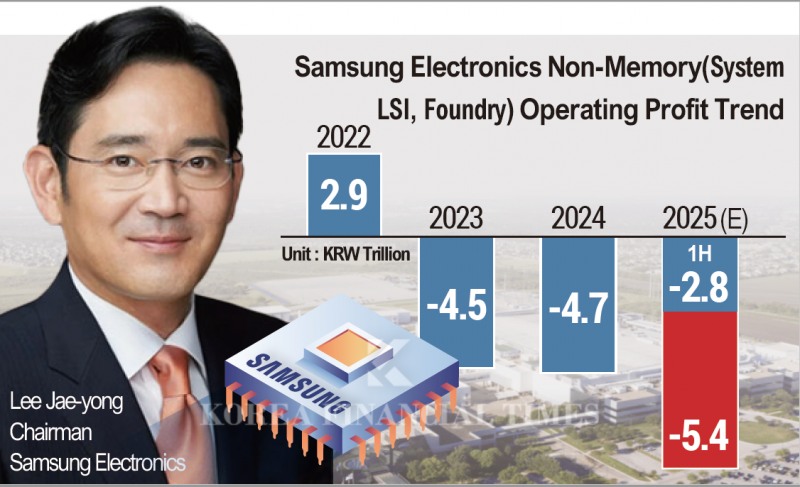
Samsung Electronics' non-memory division (System LSI, foundry) has indeed been struggling with massive losses since 2023. Samsung Electronics' non-memory losses are estimated at KRW 4.5 trillion in 2023, KRW 4.7 trillion in 2024, and KRW 2.8 trillion in the first half of 2025 (January-June).
There are gloomy forecasts that this year's loss scale could expand to approximately KRW 8.2 trillion. The cause of losses has been declining revenues due to problems securing major clients stemming from poor foundry yields.
Kim Rok-ho, senior analyst at Hana Securities, said, “By securing customers for its leading-edge foundry processes, Samsung Electronics has gained clearer visibility for mid- to long-term growth,” adding, “We expect the foundry division’s valuation to step up a level as earnings normalize by 2027.”
Gwak Horyung (horr@fntimes.com)










![[THE COMPASS] 한미사이언스 경영권 분쟁, 신동국이 주도하는 ‘종식’ 게임](https://cfnimage.commutil.kr/phpwas/restmb_setimgmake.php?pp=006&w=69&h=45&m=5&simg=20261008122108000710a837df649412411124362.jpg&nmt=18)

![영업익 53% 뛴다는데…대웅제약 몸값 누르는 두 가지 변수 [5대 제약사 3Q 실적 ④]](https://cfnimage.commutil.kr/phpwas/restmb_setimgmake.php?pp=006&w=69&h=45&m=5&simg=202610081106100618007fd637f543112168227135.jpg&nmt=18)

![[기고] 앞으로 10년 뒤, 당신의 예금 통장은 과연 안전할까](https://cfnimage.commutil.kr/phpwas/restmb_setimgmake.php?pp=006&w=69&h=45&m=5&simg=20261008135710064190c1c16452b012411124362.jpg&nmt=18)


![[그래픽 뉴스] ‘순대’가 경제용어라고? 순(純)대외자산, 한국의 진짜 해외자산은 얼마일까?](https://cfnimage.commutil.kr/phpwas/restmb_setimgmake.php?pp=006&w=298&h=298&m=1&simg=202609021356075202de68fcbb3512411124362_0.jpg&nmt=18)
![[그래픽 뉴스] ISA 대개편! 나에게 유리한 계좌는?](https://cfnimage.commutil.kr/phpwas/restmb_setimgmake.php?pp=006&w=298&h=298&m=1&simg=202608041713155615de68fcbb3512411124362_0.jpg&nmt=18)
![[그래픽 뉴스] 미국 증시 새로운 키워드 'MANGOS'](https://cfnimage.commutil.kr/phpwas/restmb_setimgmake.php?pp=006&w=298&h=298&m=1&simg=202607291740382069de68fcbb3512411124362_0.jpg&nmt=18)
![[그래픽 뉴스] 은퇴후 30년 부모님 세대의 생존전략](https://cfnimage.commutil.kr/phpwas/restmb_setimgmake.php?pp=006&w=298&h=298&m=1&simg=202606301704439153de68fcbb3512411124362_0.jpg&nmt=18)
![[신간]은퇴연옥…김경록의 은퇴 후 삶의 나침반](https://cfnimage.commutil.kr/phpwas/restmb_setimgmake.php?pp=006&w=81&h=123&m=5&simg=20260414140833047280f8caa4a5ce12411124362.jpg&nmt=18)
![[신간] 물처럼 흐르고 원칙으로 서다…김용환의 통찰을 담다](https://cfnimage.commutil.kr/phpwas/restmb_setimgmake.php?pp=006&w=81&h=123&m=5&simg=20260409114249027860f8caa4a5ce12411124362.jpg&nmt=18)
![[안현정 서평] 플랫폼의 영지에서 ‘미학적 주권’을 선포하라...'K가 죽어야 K가 산다' 장준환 著](https://cfnimage.commutil.kr/phpwas/restmb_setimgmake.php?pp=006&w=81&h=123&m=5&simg=20260527121426063220c1c16452b012411124362.jpg&nmt=18)
![[서평] 추세 매매의 대가들...추세추종 투자전략의 대가 14인 인터뷰](https://cfnimage.commutil.kr/phpwas/restmb_setimgmake.php?pp=006&w=81&h=123&m=5&simg=2023102410444004986c1c16452b0175114235199.jpg&nmt=18)


![[머니무브 2026] “지금 사도 될까?” 답이 안 보인다면…하반기 투자, 4명의 전문가에게 물어보세요](https://cfnimage.commutil.kr/phpwas/restmb_setimgmake.php?pp=006&w=89&h=45&m=1&simg=202609151044050355302a735e27af12411124362.jpg&nmt=18)
![[AD] ‘PBV 라인업 확장’ 기아, 9월 독일서 ‘PV7’ 첫 공개](https://cfnimage.commutil.kr/phpwas/restmb_setimgmake.php?pp=006&w=89&h=45&m=1&simg=2026083111010602815074925877361231180222.jpg&nmt=18)
![[AD] 제네시스, 럭셔리 경험 더한 ‘2027 GV70’‧‘GV70 그래파이트’ 출시](https://cfnimage.commutil.kr/phpwas/restmb_setimgmake.php?pp=006&w=89&h=45&m=1&simg=20260702143546085600749258773622211122717.jpg&nmt=18)