






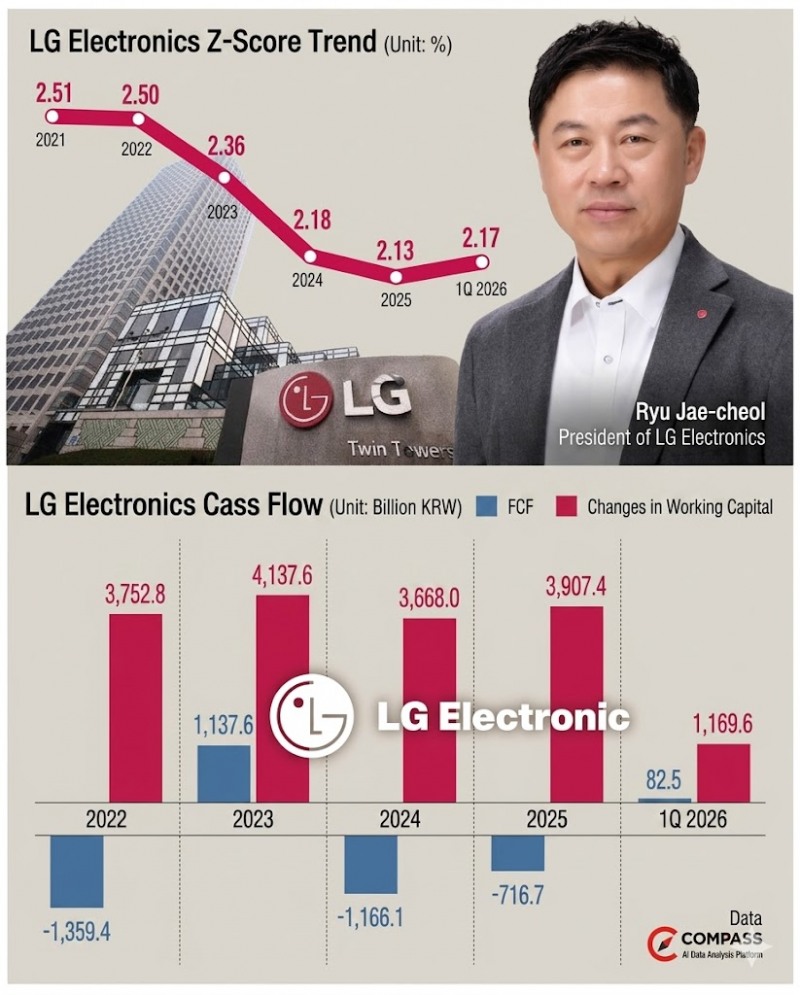
This infographic, originally published by Korea Financial Times, has been reconstructed using generative AI (Gemini).
이미지 확대보기
This brings to mind the "fundamental competitiveness" of Ryu Jae-cheol, President and CEO of LG Electronics, who began his career at the Home Appliance Research Lab of GoldStar (now LG Electronics) and climbed to the top after steering the company to global leadership in home appliances.
LG Electronics' Altman Z-score has shown a gradual declining trend: 2.51 in 2021, 2.50 in 2022, 2.36 in 2023, 2.18 in 2024, and 2.15 in 2025.
At first glance, this appears to indicate a year-on-year deterioration in financial health. Among the sub-indicators, the profitability metric (operating income/total assets) — which carries the highest weighting in the Z-score model — fell from 0.072 in 2021 to 0.036 in 2025, before a modest recovery to 0.040 in the first quarter of this year.
The biggest drag on overall corporate profitability is the underperformance of the MS (Media Solution) Division, which oversees TVs, monitors, and PCs. The profitability problem is clearly concentrated in the television segment.
The TV division, which generated an operating profit of KRW 1.1 trillion in 2021, recorded a loss of KRW 750 billion last year. The primary cause is attributed to a surge in costs and a loss of market share as the company battles Chinese manufacturers such as TCL and Hisense, which have been aggressively competing on price.
In the first quarter of this year, however, the division successfully returned to profitability, driven by workforce optimization measures — including voluntary early retirement programs implemented preemptively last year — and an expanded push into higher-margin OLED TVs. Analysts caution, however, that the road to full business normalization remains long, with losses expected to resume in the second half of the year.
Nonetheless, LG Electronics continues to benefit from a solid floor of support built on the longstanding product credibility it has established on the global stage.
LG Electronics Transcends Manufacturing: Robotics Is Only the Tip of the IcebergFrom iPhones to Humanoids: LG Innotek Bets Big on Robotics and AILG Corp. Taps Asset Sale Proceeds to Defend Dividend Amid Subsidiary SlumpRobot Joints, 80%-a-Year Growth: Hyundai Mobis, Samsung Electro-Mechanics Lead Korea's Actuator Rush [K-Humanoid Wars ④]Samsung's EUR 1.5 Billion Cooling Systems Bet: From Home Appliances to AI Data Centers
The short-term liquidity indicator (working capital/total assets) improved to 0.13 in Q1 of this year, up from 0.07 in 2021. Over the same period, retained earnings grew from KRW 14.43 trillion to KRW 18.18 trillion.
Even amid persistent external headwinds — including U.S. tariffs that began to take full effect in the second half of last year and the outbreak of the U.S.-Iran war in March of this year — the business foundation built through the home appliance segment continues to generate a stable earnings flow.
The company is also reaping the benefits of a structural shift toward business-to-business (B2B) transactions, which generate more consistent performance. LG Electronics has raised its B2B revenue share — spanning home appliance subscription services, webOS, HVAC systems, and vehicle components (VS Division) — to 36% of total revenue, reducing earnings volatility in the face of external uncertainties.
On the back of this shift, free cash flow (FCF) has also rebounded. LG Electronics recorded FCF of KRW 82.5 billion in Q1 of this year, successfully turning positive after two consecutive years of negative FCF in 2024 and 2025.
This improvement has not come at the expense of investment. Capital expenditure (CAPEX) in Q1 stood at KRW 1.1696 trillion, maintaining an annual investment trajectory of approximately KRW 4 trillion.
One area that warrants closer scrutiny, however, is that a significant portion of the working capital increase stems not from cash but from accounts receivable and inventory assets.
The company disclosed that accounts receivable — outstanding payments from customers — reached KRW 12.43 trillion in Q1 of this year, a rise of 11% in just three months. The inventory ratio (16.4%) is trending upward, approaching levels last seen during the COVID-19 pandemic in 2021 (18.2%).
As external headwinds persist, the pace at which the company collects receivables and clears inventory will likely serve as a critical barometer of "qualitative growth."
LG Electronics' true "value-up" is expected to materialize when tangible results emerge from its new businesses in chillers (large-scale industrial cooling systems) and robotics.
The chiller business appears to be scaling faster than anticipated. Shin Dong-hun, Executive Vice President and Finance Director of LG Electronics' ES (Energy Solution) Division, said during the Q1 earnings conference call: "We expect the chiller business to achieve its KRW 1 trillion revenue target, which was originally set for 2027, ahead of schedule."
A delegation of UAE government officials and representatives of state-owned investment funds visited LG Electronics' Pyeongtaek chiller manufacturing plant earlier this month, signaling that the company's chiller business targeting AI data centers is set to gain full momentum.
The robotics segment has also begun executing a concrete commercialization roadmap. The company has set out a plan to fully launch Axiom — a key robot actuator component — this year, and to commercialize its home robot CLOi d by 2028. The strategy is to consolidate the Group's robotics capabilities in order to secure leadership in the physical AI ecosystem.
Gwak Horyung (horr@fntimes.com)











![[THE COMPASS] 한미사이언스 경영권 분쟁, 신동국이 주도하는 ‘종식’ 게임](https://cfnimage.commutil.kr/phpwas/restmb_setimgmake.php?pp=006&w=69&h=45&m=5&simg=20261008122108000710a837df649412411124362.jpg&nmt=18)

![영업익 53% 뛴다는데…대웅제약 몸값 누르는 두 가지 변수 [5대 제약사 3Q 실적 ④]](https://cfnimage.commutil.kr/phpwas/restmb_setimgmake.php?pp=006&w=69&h=45&m=5&simg=202610081106100618007fd637f543112168227135.jpg&nmt=18)

![[기고] 앞으로 10년 뒤, 당신의 예금 통장은 과연 안전할까](https://cfnimage.commutil.kr/phpwas/restmb_setimgmake.php?pp=006&w=69&h=45&m=5&simg=20261008135710064190c1c16452b012411124362.jpg&nmt=18)


![[그래픽 뉴스] ‘순대’가 경제용어라고? 순(純)대외자산, 한국의 진짜 해외자산은 얼마일까?](https://cfnimage.commutil.kr/phpwas/restmb_setimgmake.php?pp=006&w=298&h=298&m=1&simg=202609021356075202de68fcbb3512411124362_0.jpg&nmt=18)
![[그래픽 뉴스] ISA 대개편! 나에게 유리한 계좌는?](https://cfnimage.commutil.kr/phpwas/restmb_setimgmake.php?pp=006&w=298&h=298&m=1&simg=202608041713155615de68fcbb3512411124362_0.jpg&nmt=18)
![[그래픽 뉴스] 미국 증시 새로운 키워드 'MANGOS'](https://cfnimage.commutil.kr/phpwas/restmb_setimgmake.php?pp=006&w=298&h=298&m=1&simg=202607291740382069de68fcbb3512411124362_0.jpg&nmt=18)
![[그래픽 뉴스] 은퇴후 30년 부모님 세대의 생존전략](https://cfnimage.commutil.kr/phpwas/restmb_setimgmake.php?pp=006&w=298&h=298&m=1&simg=202606301704439153de68fcbb3512411124362_0.jpg&nmt=18)
![[신간]은퇴연옥…김경록의 은퇴 후 삶의 나침반](https://cfnimage.commutil.kr/phpwas/restmb_setimgmake.php?pp=006&w=81&h=123&m=5&simg=20260414140833047280f8caa4a5ce12411124362.jpg&nmt=18)
![[신간] 물처럼 흐르고 원칙으로 서다…김용환의 통찰을 담다](https://cfnimage.commutil.kr/phpwas/restmb_setimgmake.php?pp=006&w=81&h=123&m=5&simg=20260409114249027860f8caa4a5ce12411124362.jpg&nmt=18)
![[안현정 서평] 플랫폼의 영지에서 ‘미학적 주권’을 선포하라...'K가 죽어야 K가 산다' 장준환 著](https://cfnimage.commutil.kr/phpwas/restmb_setimgmake.php?pp=006&w=81&h=123&m=5&simg=20260527121426063220c1c16452b012411124362.jpg&nmt=18)
![[서평] 추세 매매의 대가들...추세추종 투자전략의 대가 14인 인터뷰](https://cfnimage.commutil.kr/phpwas/restmb_setimgmake.php?pp=006&w=81&h=123&m=5&simg=2023102410444004986c1c16452b0175114235199.jpg&nmt=18)


![[머니무브 2026] “지금 사도 될까?” 답이 안 보인다면…하반기 투자, 4명의 전문가에게 물어보세요](https://cfnimage.commutil.kr/phpwas/restmb_setimgmake.php?pp=006&w=89&h=45&m=1&simg=202609151044050355302a735e27af12411124362.jpg&nmt=18)
![[AD] ‘PBV 라인업 확장’ 기아, 9월 독일서 ‘PV7’ 첫 공개](https://cfnimage.commutil.kr/phpwas/restmb_setimgmake.php?pp=006&w=89&h=45&m=1&simg=2026083111010602815074925877361231180222.jpg&nmt=18)
![[AD] 제네시스, 럭셔리 경험 더한 ‘2027 GV70’‧‘GV70 그래파이트’ 출시](https://cfnimage.commutil.kr/phpwas/restmb_setimgmake.php?pp=006&w=89&h=45&m=1&simg=20260702143546085600749258773622211122717.jpg&nmt=18)