






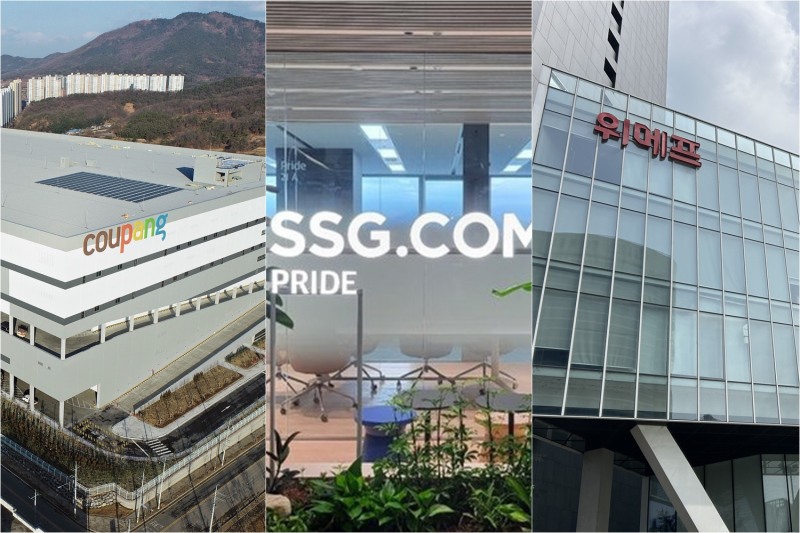
It's been an eventful year for e-commerce in 2024 /Photo courtesy: Coupang, SSG.com, WeMakePrice
이미지 확대보기
Coupang, C-commerce attack, Fair Trade Commission controversy, but still 'firm'
This year was not easy for Coupang either. Although it set a new record with the highest sales ever, it had a difficult year due to the onslaught of C-commerce and the fine of KRW 162.8 billion imposed by the Fair Trade Commission for manipulating search rankings.Earlier this year, the offensive of C-commerce companies such as AliExpress, Temu, and Shein was fierce. Aliexpress, in particular, has captivated domestic consumers by boasting unbeatable prices with the help of China's huge capital. Coupang is also an e-commerce company that emphasizes the lowest prices, and anxiety grew as their competitive areas overlapped. Furthermore, AliExpress announced that it would invest approximately KRW 1.5 trillion in Korea over the next three years to build a logistics center, foreshadowing competition in logistics.
According to the e-commerce market trend analysis data released by data platform company IGA Works Mobile Index on the 26th, the cumulative number of new installations of Temu and AliExpress applications (apps) from the beginning of this year to last month was 18.04 million and 6.58 million, respectively. Combined, the two apps totaled 25.62 million, growing so fast that more than half of the Korean population has installed them.
However, considering that the number of consumers using C-commerce is small compared to the number of installations and the average purchase price is low, some say that it is far from enough to break Coupang’s momentum.
It was also embroiled in suspicions of manipulation of search rankings. In August, the Fair Trade Commission imposed a fine of KRW 162.8 billion on Coupang for manipulating the search ranking algorithm and giving preferential treatment to private brand (PB) products. At the same time, it issued a corrective order to “not engage in illegal acts such as algorithm manipulation.” Coupang was dissatisfied with this decision and filed an administrative lawsuit against the Fair Trade Commission in September to have the fine and corrective order canceled.
There was also an outlook that the increase in membership monthly fees would be a crisis factor for Coupang. It was predicted that the number of ‘de-Coupang’ members would increase as the price increased by 58% from KRW 4,990 to KRW 7,890. However, the number of consumers using Coupang actually increased. As of the third quarter of this year, the number of customers who purchased something from Coupang at least once was 22.5 million, an 11% increase from the same period last year (20.2 million) and an 800,000 increase from the second quarter (21.7 million).
Amidst all the noise, Coupang remained steadfast. It posted record sales of KRW 10.6 trillion in the third quarter of this year, and is on track to top KRW 40 trillion in annual sales.
[2024 Retail Review - Hypermarkets] 'Shaken' by Consumption Recession & Strength of SSM... E-Mart did Well Through Main Business ReinforcementChung Yoo-kyung, Chung Gyo-sun, Heo Seo-hong, Shin Yu-yeol ‘7080 Owners’ Forward Deployment…Overcoming Crisis with ‘Young Blood’Coupang, Q3 sales of KRW 10.6 trillion, ‘highest ever again’… Kim Beom-seok “Still hungry”Coupang Eats' scary chase... 'No. 1' Baemin falls below 60% market share‘Price destruction, strengthening of main business’ Chung Yong-jin’s ‘emergency management’… E-Mart achieves highest performance in Q3
SSG.com, Gmarket, and LOTTE ON tightened their belts again this year.
The two mainstays of Shinsegae's e-commerce business, SSG.com and Gmarket, and LOTTE ON, an e-commerce company operated by LOTTE, have tightened their belts this year as well. Coincidentally, all three companies have implemented voluntary retirement this year, and LOTTE ON has implemented voluntary retirement twice, in June and December, indicating at the severity of the industry recession.SSG.com focused on reducing its deficit rather than outward growth this year. In the process, it experienced a change in leadership due to Chairman Chung Yong-jin's frequent personnel changes, and also experienced a conflict with financial investors (FIs) over the 'KRW 1 trillion put option (stock purchase right)'. The FI risk was resolved in November when Shinsegae Group attracted a new FI.
SSG.com's sales in the first quarter of 2024 was KRW 413.4 billion, down 1.9% from the same period a year earlier, and its operating loss was KRW 13.9 billion, down KRW 1.7 billion. In the second quarter, sales decreased by 7.5% to KRW 395.2 billion and operating loss improved by KRW 1.4 billion to KRW 16.9 billion. In the third quarter, sales decreased and profits improved. Sales decreased by 9.1% to KRW 390.5 billion and operating loss decreased by KRW 14.2 billion to KRW 16.5 billion. It is evaluated that this is a significant improvement even though one-time costs of KRW 7.6 billion due to personnel reductions such as voluntary retirement were reflected. The accumulated deficit up to the third quarter of this year was tallied at KRW 47.3 billion.
Gmarket is one of the places that was hit hard by the ‘TMON ·WeMakePrice’ incident. Gmarket, an open market operator, experienced unexpected bleeding while conducting marketing activities to support sellers who suffered damages from TMON and WeMakePrice. Since sellers are the core of open markets, Gmarket put a lot of effort into support measures to prevent sellers from leaving.
As a result, Gmarket reduced its operating loss in the first and second quarters of this year, but its deficit widened in the third quarter when the ‘TMON ·WeMakePrice’ incident broke out. Gmarket’s operating loss in the first quarter was KRW 8.5 billion, a KRW 2.4 billion decrease from the same period last year, and in the second quarter, it decreased by KRW 3.7 billion to KRW 7.6 billion. Then, in the third quarter, it increased to KRW 18 billion, widening the deficit by KRW 7.9 billion from the previous year.
In the midst of this, Shinsegae Group announced on the 26th that it would establish a joint venture with China’s Alibaba Group. Gmarket and AliExpress Korea will be incorporated as subsidiaries in the joint venture scheduled to be established next year. The plan is to enhance e-commerce competitiveness by utilizing Gmarket’s quality management and customer experience and Alibaba’s global network synergy.
LOTTE ON has been working hard to improve cost efficiency throughout this year. CEO Park Ik-jin, who was hired as the new head of LOTTE ON in December of last year, has been working hard to improve the company's organization. LOTTE ON moved its headquarters from Lotte World Tower in Jamsil, Seoul to Samseong-dong, Gangnam-gu in July of this year, and has implemented two rounds of voluntary retirement.
LOTTE ON, which has been losing about KRW 100 billion every year, has a cumulative deficit of KRW 500 billion. The cumulative deficit for the third quarter of this year was KRW 61.5 billion. Although the deficit has been decreasing every year, it is still large. LOTTE ON plans to focus on improving profitability by collaborating with retail affiliates within LOTTE Shopping and focusing on vertical services.
The 'TMON - WeMakePrice' incident caused by Koo Young-bae's greed... E-commerce industry 'Crisis'
The 'TMON · WeMakePrice' non-settlement incident that broke out in July put the e-commerce industry at risk. The non-payment of settlement fees by e-commerce companies in the Qoo10 Group, including TMON, WeMakePrice, Interpark Commerce, Qoo10 and others, has caused a lot of damage not only to the sellers but also to the customers who purchased products from them. As a result, trust in the e-commerce industry's settlement system was shaken, and sellers, the core assets of open marketplaces, were harmed, causing difficulties for existing open market operators.The general opinion is that the recent 'TMON · WeMakePrice' incident was triggered by the greed of Qoo10 Group CEO Koo Young-bae. Koo acquired Timon in 2022, Interpark Commerce later that year, and WeMakePrice in March of the following year, bringing three e-commerce companies under his wing in a short period of time. Koo's e-commerce shopping did not stop there. In February of this year, he acquired the American e-commerce company 'Wish', and a month later in March, he even purchased AK Plaza's online shopping mall, AK Mall. In just two years, he has acquired a whopping five e-commerce businesses.
This was the big picture of CEO Koo for the NASDAQ listing of QooExpress, a logistics subsidiary of Qoo10. In particular, in order to rapidly expand the transaction volume, he distributed indiscriminate discount coupons, etc., which further worsened the financial status of the acquired e-commerce companies. Although TMON and WeMakePrice were already in a state of capital erosion, CEO Koo ignored this and continued with reckless management.
As a result, a large-scale non-settlement situation occurred, and Mr. Koo became the target of national criticism. The damage from the ‘TMON-WeMakePrice’ incident amounted to KRW 1.595 trillion, and affected 500,000 people. TMON and WeMakePrice have entered rehabilitation procedures and are scheduled to resume operations early next year. The industry is skeptical about the normalization of TMON and WeMakePrice.
CEO Koo is accused of conspiring with Ryu Kwang-jin, CEO of TMON, and Ryu Hwa-hyun, CEO of WeMakePrice, to embezzle KRW 1.85 trillion worth of TMON and WeMakePrice seller settlement funds. He is also accused of embezzling KRW 50 billion in TMON and WeMakePrice gift certificate settlement funds under the pretext of acquisition money for an American e-commerce company, and of causing total of KRW 72.7 billion in damages to TMON, WeMakePrice, and Interpark Commerce by funneling money to affiliates for the purpose of listing its logistics subsidiary QooExpress on the NASDAQ. Prosecutors believe Mr. Koo used the settlement payments owed to TMON and WeMakePrice sellers as a personal coffer to fund Coo10's operations.
Park seulgi (seulgi@fntimes.com)











![[르포] 1100평 한 층서 '협업', 보안데이터 하루 '10억 건'…하나금융의 진화](https://cfnimage.commutil.kr/phpwas/restmb_setimgmake.php?pp=006&w=69&h=45&m=5&simg=202609301743410358601b5a2213792211381469.jpg&nmt=18)


![[그래픽 뉴스] ‘순대’가 경제용어라고? 순(純)대외자산, 한국의 진짜 해외자산은 얼마일까?](https://cfnimage.commutil.kr/phpwas/restmb_setimgmake.php?pp=006&w=298&h=298&m=1&simg=202609021356075202de68fcbb3512411124362_0.jpg&nmt=18)
![[그래픽 뉴스] ISA 대개편! 나에게 유리한 계좌는?](https://cfnimage.commutil.kr/phpwas/restmb_setimgmake.php?pp=006&w=298&h=298&m=1&simg=202608041713155615de68fcbb3512411124362_0.jpg&nmt=18)
![[그래픽 뉴스] 미국 증시 새로운 키워드 'MANGOS'](https://cfnimage.commutil.kr/phpwas/restmb_setimgmake.php?pp=006&w=298&h=298&m=1&simg=202607291740382069de68fcbb3512411124362_0.jpg&nmt=18)
![[그래픽 뉴스] 은퇴후 30년 부모님 세대의 생존전략](https://cfnimage.commutil.kr/phpwas/restmb_setimgmake.php?pp=006&w=298&h=298&m=1&simg=202606301704439153de68fcbb3512411124362_0.jpg&nmt=18)
![[신간]은퇴연옥…김경록의 은퇴 후 삶의 나침반](https://cfnimage.commutil.kr/phpwas/restmb_setimgmake.php?pp=006&w=81&h=123&m=5&simg=20260414140833047280f8caa4a5ce12411124362.jpg&nmt=18)
![[신간] 물처럼 흐르고 원칙으로 서다…김용환의 통찰을 담다](https://cfnimage.commutil.kr/phpwas/restmb_setimgmake.php?pp=006&w=81&h=123&m=5&simg=20260409114249027860f8caa4a5ce12411124362.jpg&nmt=18)
![[안현정 서평] 플랫폼의 영지에서 ‘미학적 주권’을 선포하라...'K가 죽어야 K가 산다' 장준환 著](https://cfnimage.commutil.kr/phpwas/restmb_setimgmake.php?pp=006&w=81&h=123&m=5&simg=20260527121426063220c1c16452b012411124362.jpg&nmt=18)
![[서평] 추세 매매의 대가들...추세추종 투자전략의 대가 14인 인터뷰](https://cfnimage.commutil.kr/phpwas/restmb_setimgmake.php?pp=006&w=81&h=123&m=5&simg=2023102410444004986c1c16452b0175114235199.jpg&nmt=18)


![[머니무브 2026] “지금 사도 될까?” 답이 안 보인다면…하반기 투자, 4명의 전문가에게 물어보세요](https://cfnimage.commutil.kr/phpwas/restmb_setimgmake.php?pp=006&w=89&h=45&m=1&simg=202609151044050355302a735e27af12411124362.jpg&nmt=18)
![[AD] ‘PBV 라인업 확장’ 기아, 9월 독일서 ‘PV7’ 첫 공개](https://cfnimage.commutil.kr/phpwas/restmb_setimgmake.php?pp=006&w=89&h=45&m=1&simg=2026083111010602815074925877361231180222.jpg&nmt=18)
![[AD] 제네시스, 럭셔리 경험 더한 ‘2027 GV70’‧‘GV70 그래파이트’ 출시](https://cfnimage.commutil.kr/phpwas/restmb_setimgmake.php?pp=006&w=89&h=45&m=1&simg=20260702143546085600749258773622211122717.jpg&nmt=18)
![[AD] 개소세 혜택 종료…현대차, ‘썸머 페스타’로 고객 부담 완화](https://cfnimage.commutil.kr/phpwas/restmb_setimgmake.php?pp=006&w=89&h=45&m=1&simg=20260702142355004830749258773622211122717.jpg&nmt=18)