







HMM logo. / Image courtesy of HMM
While shareholders may welcome the rally, the mood among employees is uneasy. There is growing concern that political interference could undermine the competitiveness of Korea’s shipping industry.
On May 21, industry sources reported that Lee Jae-myung, during a recent campaign rally in Busan, said to transform the city into a hub for the Arctic shipping route by relocating the Ministry of Oceans and Fisheries and major maritime logistics firms, including HMM, to Busan.
The controversy centers on Lee’s claim that “HMM employees also agreed to the headquarters relocation.” However, both of HMM’s main unions—the Korea Financial Industry Union HMM Branch (onshore union) and the HMM Seafarers’ Union (offshore union)—have stated, “We have never met nor agreed to this proposal”. In fact, to reassure shocked employees, the onshore union reportedly sent an email to all staff clarifying that there had been no agreement to the move.
This is not the first time the idea of moving HMM’s headquarters to Busan has surfaced. Lee Jae-myung made a similar pledge during the 2022 presidential election, aiming to turn Busan into a shipping industry hub. Ahead of last year’s April general election, he also advocated relocating the Korea Development Bank (KDB) and HMM, in which KDB is the largest shareholder, to Busan.
Although HMM is a private company, the government currently owns over 70% of its shares, with KDB holding 36.02% and the Korea Ocean Business Corporation 35.67%. Lee Jae-myung has stated, “With government investment and support, if we make up our minds, relocating to Busan is not impossible.”
This ownership structure dates back to 2016, when the government injected public funds to rescue Hyundai Merchant Marine (now HMM) after the bankruptcy of Hanjin Shipping. KDB became the largest shareholder through debt-to-equity swaps and convertible bonds.
Industry insiders argue that the government’s stake should eventually be privatized, and that KDB is not a suitable long-term owner. They also question the business rationale for relocating HMM’s headquarters, noting that shipping is a sales-driven industry and that most key clients and financial institutions are based in Seoul, not Busan. “Unlike airlines, shipping companies operate circular routes with multiple ports of call, so there is little geographic or economic advantage to having the headquarters in Busan,” said one industry official.
Another pointed out that most of the container management and shipping staff are already based in Busan, while sales and finance personnel—crucial for ship investment and client relations—are concentrated in Seoul. “Relocating the headquarters could result in significant employee attrition,” the official warned.
As of the end of last year, HMM had 1,824 employees, including regular and contract staff. Of these, 1,063 were onshore staff based in Seoul, and 827 were seafaring crew, with onshore staff accounting for just over 58%.
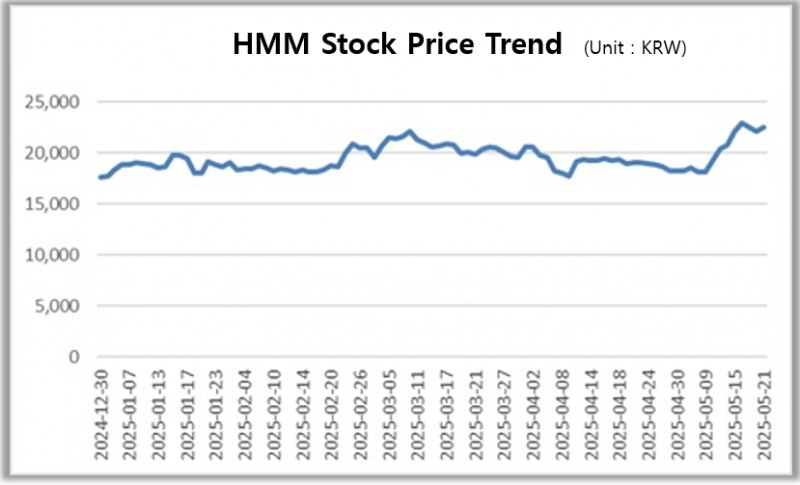
Despite the internal turmoil, HMM’s stock price surged 6.49% to KRW 22,150 on May 15, the day after Lee’s campaign rally. It marks the second-highest gain for the stock so far this year.
However, the stock’s rise also appears to reflect HMM’s solid performance in the first quarter. On May 14, just 30 minutes before the market closed, the company released its quarterly report. HMM posted revenue of 2.8547 trillion KRW and an operating profit of 613.9 billion KRW in the first quarter of this year. Revenue increased by 22.52% year-on-year, while operating profit surged by 50.84%.
Regardless of the reasons, HMM’s stock has maintained its momentum, closing at a record high of KRW 22,950 on May 16, and ending at KRW 22,100 on May 20 and KRW 22,350 on May 21.
Adding to the positive sentiment, NICE Investors Service upgraded HMM’s credit rating by two notches from ‘A- (Stable)’ to ‘A+ (Stable)’ on May 19.
HMM now boasts cash and cash equivalents of KRW 3.1303 trillion as of the end of March, up 192.41% year-on-year, putting its liquidity on par with global shipping giants.
Shin Haeju (hjs0509@fntimes.com)











![‘삼전닉스ʼ에 가린 반도체주…주성엔지니어링 ‘질주ʼ·리노공업 ‘주춤ʼ [정답은 TSR]](https://cfnimage.commutil.kr/phpwas/restmb_setimgmake.php?pp=006&w=69&h=45&m=5&simg=20260918223152079000dd55077bc212411124362.jpg&nmt=18)
![스틱벤처스 정보라, 네오사피엔스 IPO 잰걸음 ‘딥테크 투자 강화ʼ [VC 2026 하반기 프리뷰 (7)]](https://cfnimage.commutil.kr/phpwas/restmb_setimgmake.php?pp=006&w=69&h=45&m=5&simg=20260918221427079140dd55077bc212411124362.jpg&nmt=18)


![[그래픽 뉴스] ‘순대’가 경제용어라고? 순(純)대외자산, 한국의 진짜 해외자산은 얼마일까?](https://cfnimage.commutil.kr/phpwas/restmb_setimgmake.php?pp=006&w=298&h=298&m=1&simg=202609021356075202de68fcbb3512411124362_0.jpg&nmt=18)
![[그래픽 뉴스] ISA 대개편! 나에게 유리한 계좌는?](https://cfnimage.commutil.kr/phpwas/restmb_setimgmake.php?pp=006&w=298&h=298&m=1&simg=202608041713155615de68fcbb3512411124362_0.jpg&nmt=18)
![[그래픽 뉴스] 미국 증시 새로운 키워드 'MANGOS'](https://cfnimage.commutil.kr/phpwas/restmb_setimgmake.php?pp=006&w=298&h=298&m=1&simg=202607291740382069de68fcbb3512411124362_0.jpg&nmt=18)

![[그래픽 뉴스] 은퇴후 30년 부모님 세대의 생존전략](https://cfnimage.commutil.kr/phpwas/restmb_setimgmake.php?pp=006&w=298&h=298&m=1&simg=202606301704439153de68fcbb3512411124362_0.jpg&nmt=18)
![[신간]은퇴연옥…김경록의 은퇴 후 삶의 나침반](https://cfnimage.commutil.kr/phpwas/restmb_setimgmake.php?pp=006&w=81&h=123&m=5&simg=20260414140833047280f8caa4a5ce12411124362.jpg&nmt=18)
![[신간] 물처럼 흐르고 원칙으로 서다…김용환의 통찰을 담다](https://cfnimage.commutil.kr/phpwas/restmb_setimgmake.php?pp=006&w=81&h=123&m=5&simg=20260409114249027860f8caa4a5ce12411124362.jpg&nmt=18)
![[안현정 서평] 플랫폼의 영지에서 ‘미학적 주권’을 선포하라...'K가 죽어야 K가 산다' 장준환 著](https://cfnimage.commutil.kr/phpwas/restmb_setimgmake.php?pp=006&w=81&h=123&m=5&simg=20260527121426063220c1c16452b012411124362.jpg&nmt=18)
![[서평] 추세 매매의 대가들...추세추종 투자전략의 대가 14인 인터뷰](https://cfnimage.commutil.kr/phpwas/restmb_setimgmake.php?pp=006&w=81&h=123&m=5&simg=2023102410444004986c1c16452b0175114235199.jpg&nmt=18)


![[머니무브 2026] “지금 사도 될까?” 답이 안 보인다면…하반기 투자, 4명의 전문가에게 물어보세요](https://cfnimage.commutil.kr/phpwas/restmb_setimgmake.php?pp=006&w=89&h=45&m=1&simg=202609151044050355302a735e27af12411124362.jpg&nmt=18)
![[AD] ‘PBV 라인업 확장’ 기아, 9월 독일서 ‘PV7’ 첫 공개](https://cfnimage.commutil.kr/phpwas/restmb_setimgmake.php?pp=006&w=89&h=45&m=1&simg=2026083111010602815074925877361231180222.jpg&nmt=18)
![[AD] 제네시스, 럭셔리 경험 더한 ‘2027 GV70’‧‘GV70 그래파이트’ 출시](https://cfnimage.commutil.kr/phpwas/restmb_setimgmake.php?pp=006&w=89&h=45&m=1&simg=20260702143546085600749258773622211122717.jpg&nmt=18)
![[AD] 개소세 혜택 종료…현대차, ‘썸머 페스타’로 고객 부담 완화](https://cfnimage.commutil.kr/phpwas/restmb_setimgmake.php?pp=006&w=89&h=45&m=1&simg=20260702142355004830749258773622211122717.jpg&nmt=18)
![[AD] 기아 ‘디 올 뉴 셀토스’, 인도 타임스 드라이브 어워즈서 ‘올해의 SUV’ 선정](https://cfnimage.commutil.kr/phpwas/restmb_setimgmake.php?pp=006&w=89&h=45&m=1&simg=202605071156400590007492587736124111243152.jpg&nmt=18)