





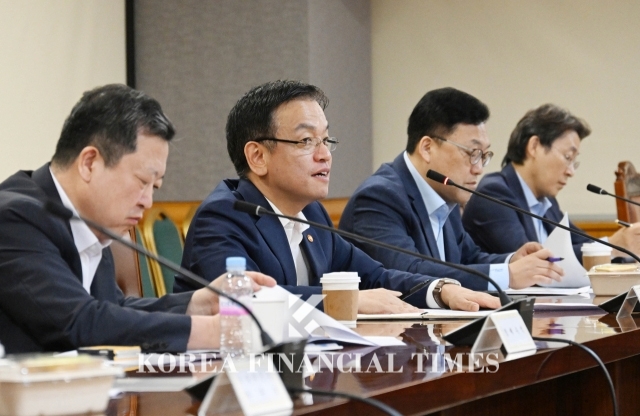
Choi Sang-mok, deputy prime minister and minister of economy and finance, chairs a meeting on urgent macroeconomic and financial issues related to recent domestic and international financial market trends at the Bank of Korea Hall in Jung-gu, Seoul, on June 6.(Source=Ministry of Strategy and Finance)
Choi Sang-mok, Deputy Prime Minister and Minister of Strategy and Finance, held an urgent meeting on macroeconomic and financial issues at the National Banking Association Hall on June 6 with Bank of Korea(BOK) Governor Lee Chang-yong, Chairman of the Financial Services Commission(FSC) Kim Byung-hwan, Financial Supervisory Service(FSS) Governor Lee Bok-hyun, and Chief Economic Advisor Park Chun-seop to review recent domestic and international financial market trends and discuss future responses.
Last week, U.S. stocks began to reflect concerns about a slowdown in the economy following a weak July employment report. This was due to a combination of factors, including earnings concerns and valuation pressure from major big tech companies, the liquidation of yen carry trades following the Bank of Japan's (BOJ) interest rate hike, and renewed unrest in the Middle East.
Key players at the meeting said that the lack of assessment of the U.S. market has led to further damage to Asian equities. There was a sense of overreaction to the current events.
Over the past five days, the Kospi has dropped 8.77% from the previous trading day, and Japan's Nikkei has plunged 12.40%.
However, the market's reaction is unusual. In the past, market shocks have affected real assets, stocks, bonds, and foreign exchange simultaneously, but this time, only the stock market showed a major correction.
In addition, the foreign exchange and money markets have been performing well as Korea's economy is gradually showing signs of recovery. The government and the BOK agreed that the BOK has sufficient policy response capacity to deal with market volatility due to external shocks.
Choi said the government plans to continue operating a 24-hour joint inspection system as external uncertainties remain high, including the spread of geopolitical unrest in the Middle East and the US presidential election. In addition, if market volatility escalates, they will closely coordinate according to the situation-specific response plan. The participants were urged to maintain the response system of related organizations so that market stabilization measures can be implemented quickly if necessary.
Meanwhile, the participants agreed that the government will continue to pursue tasks to strengthen Korea's capital and foreign exchange markets and expand the external safety net, such as corporate valuation programs, advanced foreign exchange and bond markets, and supply chain expansion.
Lee Sungkyu (lsk0603@fntimes.com)












![[현장] “비전공자도 은행원 될 수 있나요?” 초AI 시대, 은행 면접 트렌드는 [2026 금융권 공동채용박람회]](https://cfnimage.commutil.kr/phpwas/restmb_setimgmake.php?pp=006&w=69&h=45&m=5&simg=202608191601410921405e6e69892f2115355215.jpg&nmt=18)


![[현장] 김은경 서금원장 "자격증보다 경청"…금융공기업 취업 '업무 이해'가 핵심 [2026 금융권 공동채용 박람회]](https://cfnimage.commutil.kr/phpwas/restmb_setimgmake.php?pp=006&w=69&h=45&m=5&simg=202608191658080287601b5a2213792115355215.jpg&nmt=18)


![[그래픽 뉴스] ISA 대개편! 나에게 유리한 계좌는?](https://cfnimage.commutil.kr/phpwas/restmb_setimgmake.php?pp=006&w=298&h=298&m=1&simg=202608041713155615de68fcbb3512411124362_0.jpg&nmt=18)
![[그래픽 뉴스] 미국 증시 새로운 키워드 'MANGOS'](https://cfnimage.commutil.kr/phpwas/restmb_setimgmake.php?pp=006&w=298&h=298&m=1&simg=202607291740382069de68fcbb3512411124362_0.jpg&nmt=18)
![[그래픽 뉴스] 은퇴후 30년 부모님 세대의 생존전략](https://cfnimage.commutil.kr/phpwas/restmb_setimgmake.php?pp=006&w=298&h=298&m=1&simg=202606301704439153de68fcbb3512411124362_0.jpg&nmt=18)
![[그래픽 뉴스] 퇴근 후 주차했는데 수익 발생? V2G의 정체](https://cfnimage.commutil.kr/phpwas/restmb_setimgmake.php?pp=006&w=298&h=298&m=1&simg=202605131656357745de68fcbb3512411124362_0.jpg&nmt=18)
![[신간]은퇴연옥…김경록의 은퇴 후 삶의 나침반](https://cfnimage.commutil.kr/phpwas/restmb_setimgmake.php?pp=006&w=81&h=123&m=5&simg=20260414140833047280f8caa4a5ce12411124362.jpg&nmt=18)
![[신간] 물처럼 흐르고 원칙으로 서다…김용환의 통찰을 담다](https://cfnimage.commutil.kr/phpwas/restmb_setimgmake.php?pp=006&w=81&h=123&m=5&simg=20260409114249027860f8caa4a5ce12411124362.jpg&nmt=18)
![[안현정 서평] 플랫폼의 영지에서 ‘미학적 주권’을 선포하라...'K가 죽어야 K가 산다' 장준환 著](https://cfnimage.commutil.kr/phpwas/restmb_setimgmake.php?pp=006&w=81&h=123&m=5&simg=20260527121426063220c1c16452b012411124362.jpg&nmt=18)
![[서평] 추세 매매의 대가들...추세추종 투자전략의 대가 14인 인터뷰](https://cfnimage.commutil.kr/phpwas/restmb_setimgmake.php?pp=006&w=81&h=123&m=5&simg=2023102410444004986c1c16452b0175114235199.jpg&nmt=18)


![[AD] 제네시스, 럭셔리 경험 더한 ‘2027 GV70’‧‘GV70 그래파이트’ 출시](https://cfnimage.commutil.kr/phpwas/restmb_setimgmake.php?pp=006&w=89&h=45&m=1&simg=20260702143546085600749258773622211122717.jpg&nmt=18)
![[AD] 개소세 혜택 종료…현대차, ‘썸머 페스타’로 고객 부담 완화](https://cfnimage.commutil.kr/phpwas/restmb_setimgmake.php?pp=006&w=89&h=45&m=1&simg=20260702142355004830749258773622211122717.jpg&nmt=18)
![[AD] 기아 ‘디 올 뉴 셀토스’, 인도 타임스 드라이브 어워즈서 ‘올해의 SUV’ 선정](https://cfnimage.commutil.kr/phpwas/restmb_setimgmake.php?pp=006&w=89&h=45&m=1&simg=202605071156400590007492587736124111243152.jpg&nmt=18)
![[AD]‘그랜저 잡자’ 기아, 상품성 더한 ‘The 2027 K8’ 출시](https://cfnimage.commutil.kr/phpwas/restmb_setimgmake.php?pp=006&w=89&h=45&m=1&simg=2026042110193702730074925877361211627527.jpg&nmt=18)
![[카드뉴스] KT&G, ‘CDP’ 기후변화·수자원 관리 부문 우수기업 선정](https://cfnimage.commutil.kr/phpwas/restmb_setimgmake.php?pp=006&w=89&h=45&m=1&simg=202603241415423015de68fcbb3512411124362_0.png&nmt=18)