






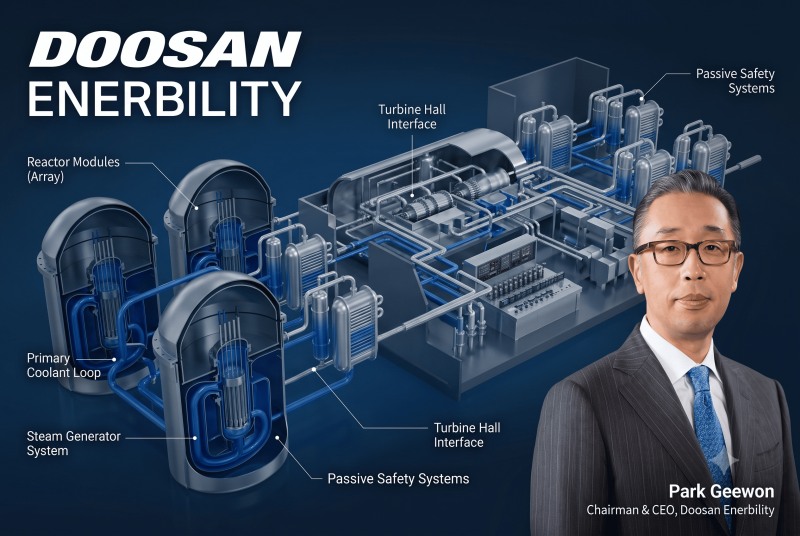
Park Geewon, Chairman & CEO of Doosan Enerbility. / This image was created using AI, based on a photo provided by Doosan Enerbility.
이미지 확대보기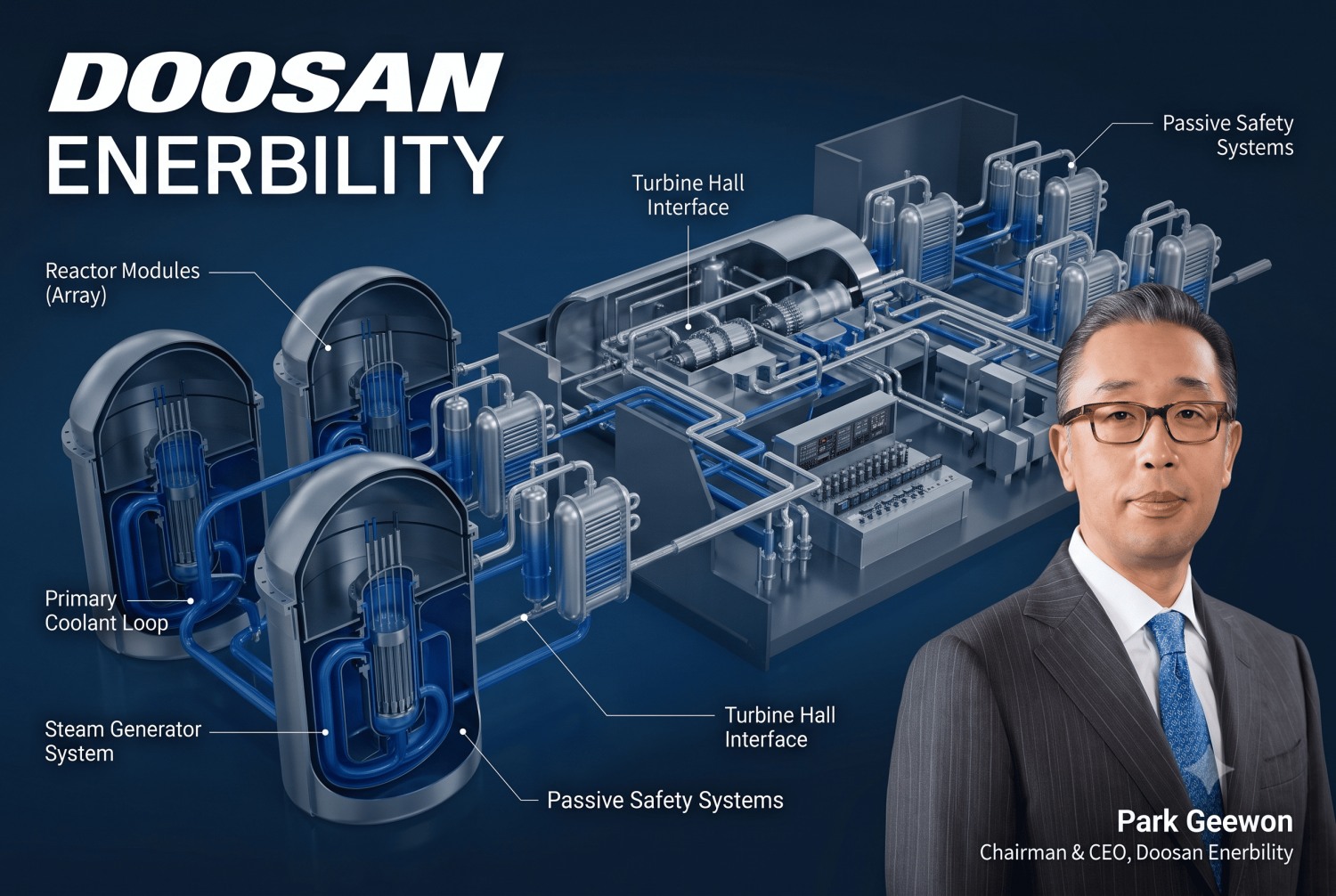
An SMR is a reactor built by scaling down a conventional large-scale nuclear power plant. While its power generation capacity is smaller, its components are pre-manufactured at a factory and assembled on-site, allowing for shorter construction periods and enabling installation directly adjacent to power-intensive facilities such as data centers. The market has been expanding rapidly as major tech firms, including Amazon and Google, have recently selected SMRs as a power source for their AI data centers.
Order backlogs are expected to begin converting into revenue starting in 2027. Meritz Securities projects that Doosan Enerbility's SMR revenue will start at KRW 702.0 billion in 2027, then rise to KRW 1.4908 trillion in 2028, KRW 2.6825 trillion in 2029, and KRW 3.7677 trillion in 2030. By 2031, it is expected to reach KRW 6.6734 trillion — more than a ninefold increase from 2027, the first year revenue is recorded, within just four years.
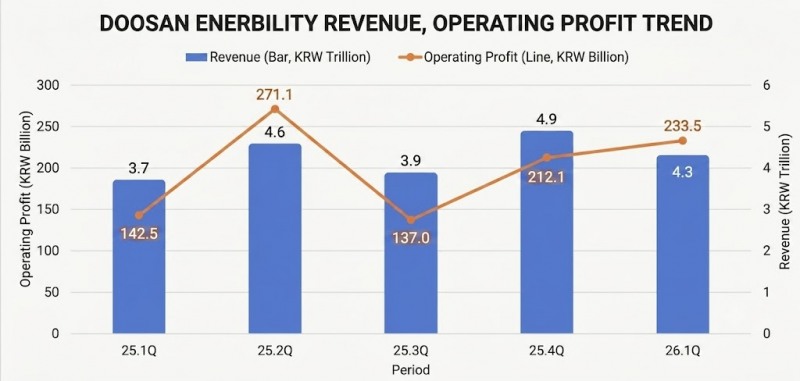
This infographic, originally published by Korea Financial Times, has been reconstructed using generative AI. / Data Source = Doosan Enerbility
이미지 확대보기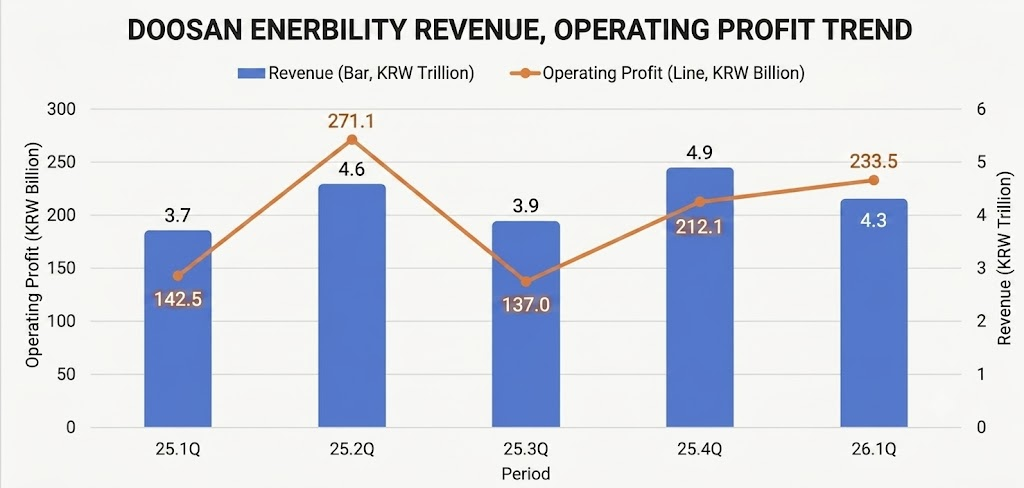
First Formal SMR Main Equipment Order Secured, Among Other Achievements — Earnings, Revenue and Share Price Growth Anticipated
Actual contract results support these projections. In the first quarter, Doosan Enerbility signed an SMR main equipment contract with TerraPower. The deal, worth roughly KRW 100 billion annually, marks the company's first formal main equipment contract in the SMR business, going beyond earlier reservation agreements for materials production or core component supply.Earnings have also been on an upward trajectory. Last year's quarterly operating profit fluctuated — KRW 142.5 billion in Q1, KRW 271.1 billion in Q2, KRW 137.0 billion in Q3, and KRW 212.1 billion in Q4 — but annual revenue reached KRW 17.0579 trillion, up 5.1% from the previous year.
In the first quarter of this year, the company posted revenue of KRW 4.2611 trillion and operating profit of KRW 233.5 billion, with operating profit up 63.9% year-on-year. Notably, the Enerbility division's operating profit turned positive at KRW 57.0 billion.
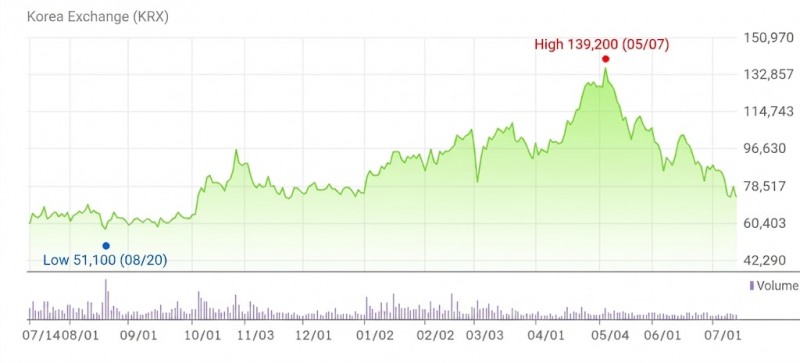
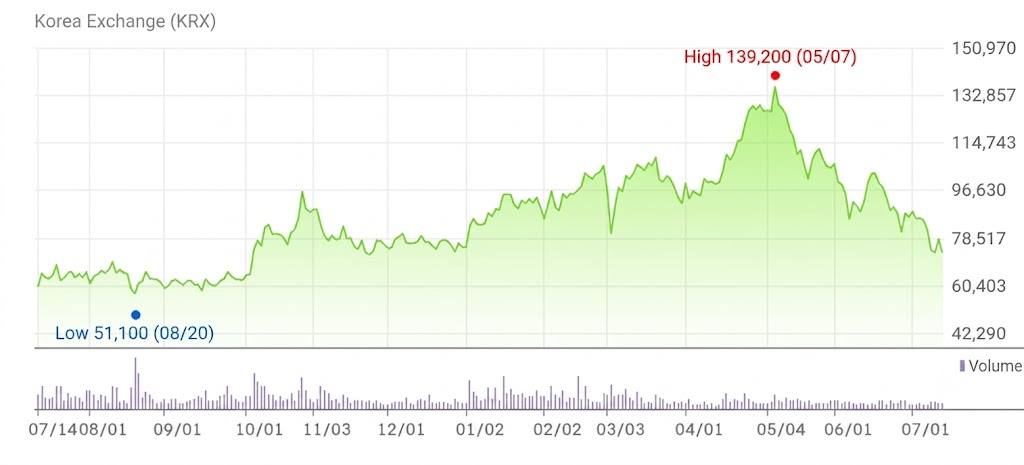
Share prices moved in tandem with earnings. The stock, which averaged KRW 76,852 in December last year, climbed to an average of KRW 99,876 by March this year and surged as high as KRW 136,400 in early May. It has since pulled back into the KRW 70,000 range amid profit-taking.
Doosan Enerbility Eyes Return to 'A' Credit Rating After 9 Years on Nuclear Power and Gas Turbine Boom [KFT Topic]The Robot Gamble: Doosan Robotics CEO Bets Big on North America Despite 11 Straight Years in the Red'From Heavy Industry to Humanoids' — Doosan Robotics Charts a New Future in Physical AI [K-Humanoid Wars, Part 3]NearthLab: The Drone Startup That Inspected Wind Turbines — Now Targeting the Global Battlefield [Rising Stars of K-Defense]
Aggressive SMR Investment — Facility Expansion and Partnership Agreements Underway
Doosan Enerbility is investing KRW 806.8 billion to build a dedicated SMR factory at its plant site in Changwon, South Gyeongsang Province. Once completed, the facility will raise annual production capacity from the current 12 units to 20 units. The plant is reportedly still in the basic design phase after completing its contract with a design firm, with a construction start date yet to be determined.The company has also forged a series of partnerships with U.S. SMR developers, including NuScale Power and X-energy. It signed a reservation agreement with X-energy to supply core forged components for 16 units of the Xe-100 reactor, and, following a materials production contract with NuScale Power, continues sales efforts to secure equipment manufacturing orders.
These partnerships align with broader South Korea-U.S. cooperation on SMR projects. Doosan Enerbility Chairman Park Geewon, after signing a memorandum of understanding (MOU) on SMR business cooperation with Amazon Web Services (AWS), X-energy, and Korea Hydro & Nuclear Power in August last year, said the company would faithfully fulfill its role based on its proven manufacturing capabilities so that the agreement could serve as a model case for energy industry cooperation between the two countries.
Riding the Wave of Rising Global Power Demand
Doosan Enerbility's SMR business expansion is underpinned by rising power demand worldwide. As data center electricity consumption grows alongside the spread of artificial intelligence (AI) and electric vehicles, global power generation capacity is projected to rise from 10,741 gigawatts (GW) this year to 14,702 GW by 2030 and 17,890 GW by 2035.The United States has announced a policy to expand its nuclear power capacity to approximately 400 GW by 2050, while the United Kingdom, Romania, and other countries are also accelerating SMR adoption.
The South Korean government is likewise backing SMR development. A special act to promote and support the development of small modular reactors passed the National Assembly's plenary session in February and is set to take effect in September this year. The law, passed with bipartisan support, includes measures to accelerate SMR technology development and demonstration and to designate special zones for the purpose. The government has also included plans in its 11th Basic Plan for Electricity Supply and Demand to demonstrate commercial-scale SMR deployment of 0.7 GW by 2035.
Jung Jina (urzinnie@fntimes.com)












![기술력 1위 ‘현대건설ʼ…계룡건설 ‘톱10ʼ 진입 [2026 시평-기술능력평가]](https://cfnimage.commutil.kr/phpwas/restmb_setimgmake.php?pp=006&w=69&h=45&m=5&simg=20260822010947010760dd55077bc212411124362.jpg&nmt=18)
![삼성·현대 3조대 ‘양강ʼ…3위는 대우건설 [2026 시평-신인도평가]](https://cfnimage.commutil.kr/phpwas/restmb_setimgmake.php?pp=006&w=69&h=45&m=5&simg=20260822011230051350dd55077bc212411124362.jpg&nmt=18)


![[데스크 칼럼] 돈 모이는 홍콩, 돈 불리는 싱가포르…한국은?](https://cfnimage.commutil.kr/phpwas/restmb_setimgmake.php?pp=006&w=69&h=45&m=5&simg=20260822011609014670dd55077bc212411124362.jpg&nmt=18)


![[그래픽 뉴스] ISA 대개편! 나에게 유리한 계좌는?](https://cfnimage.commutil.kr/phpwas/restmb_setimgmake.php?pp=006&w=298&h=298&m=1&simg=202608041713155615de68fcbb3512411124362_0.jpg&nmt=18)
![[그래픽 뉴스] 미국 증시 새로운 키워드 'MANGOS'](https://cfnimage.commutil.kr/phpwas/restmb_setimgmake.php?pp=006&w=298&h=298&m=1&simg=202607291740382069de68fcbb3512411124362_0.jpg&nmt=18)

![[그래픽 뉴스] 은퇴후 30년 부모님 세대의 생존전략](https://cfnimage.commutil.kr/phpwas/restmb_setimgmake.php?pp=006&w=298&h=298&m=1&simg=202606301704439153de68fcbb3512411124362_0.jpg&nmt=18)
![[그래픽 뉴스] 퇴근 후 주차했는데 수익 발생? V2G의 정체](https://cfnimage.commutil.kr/phpwas/restmb_setimgmake.php?pp=006&w=298&h=298&m=1&simg=202605131656357745de68fcbb3512411124362_0.jpg&nmt=18)
![[신간]은퇴연옥…김경록의 은퇴 후 삶의 나침반](https://cfnimage.commutil.kr/phpwas/restmb_setimgmake.php?pp=006&w=81&h=123&m=5&simg=20260414140833047280f8caa4a5ce12411124362.jpg&nmt=18)
![[신간] 물처럼 흐르고 원칙으로 서다…김용환의 통찰을 담다](https://cfnimage.commutil.kr/phpwas/restmb_setimgmake.php?pp=006&w=81&h=123&m=5&simg=20260409114249027860f8caa4a5ce12411124362.jpg&nmt=18)
![[안현정 서평] 플랫폼의 영지에서 ‘미학적 주권’을 선포하라...'K가 죽어야 K가 산다' 장준환 著](https://cfnimage.commutil.kr/phpwas/restmb_setimgmake.php?pp=006&w=81&h=123&m=5&simg=20260527121426063220c1c16452b012411124362.jpg&nmt=18)
![[서평] 추세 매매의 대가들...추세추종 투자전략의 대가 14인 인터뷰](https://cfnimage.commutil.kr/phpwas/restmb_setimgmake.php?pp=006&w=81&h=123&m=5&simg=2023102410444004986c1c16452b0175114235199.jpg&nmt=18)


![[AD] 제네시스, 럭셔리 경험 더한 ‘2027 GV70’‧‘GV70 그래파이트’ 출시](https://cfnimage.commutil.kr/phpwas/restmb_setimgmake.php?pp=006&w=89&h=45&m=1&simg=20260702143546085600749258773622211122717.jpg&nmt=18)
![[AD] 개소세 혜택 종료…현대차, ‘썸머 페스타’로 고객 부담 완화](https://cfnimage.commutil.kr/phpwas/restmb_setimgmake.php?pp=006&w=89&h=45&m=1&simg=20260702142355004830749258773622211122717.jpg&nmt=18)
![[AD] 기아 ‘디 올 뉴 셀토스’, 인도 타임스 드라이브 어워즈서 ‘올해의 SUV’ 선정](https://cfnimage.commutil.kr/phpwas/restmb_setimgmake.php?pp=006&w=89&h=45&m=1&simg=202605071156400590007492587736124111243152.jpg&nmt=18)
![[AD]‘그랜저 잡자’ 기아, 상품성 더한 ‘The 2027 K8’ 출시](https://cfnimage.commutil.kr/phpwas/restmb_setimgmake.php?pp=006&w=89&h=45&m=1&simg=2026042110193702730074925877361211627527.jpg&nmt=18)
![[카드뉴스] KT&G, ‘CDP’ 기후변화·수자원 관리 부문 우수기업 선정](https://cfnimage.commutil.kr/phpwas/restmb_setimgmake.php?pp=006&w=89&h=45&m=1&simg=202603241415423015de68fcbb3512411124362_0.png&nmt=18)